
Weather and LNG Demand Hold the Keys to a Breakout Week
August natural gas futures are trading at $3.258 at 07:59 GMT Monday, down $0.029 or 0.88% at the start of a holiday-shortened week. The market is holding above the short-term pivot and the support base that has been building since spring remains intact. The question this week is whether the demand side finally delivers the catalyst the bulls have been waiting for or whether production and storage keep the lid on.
Two demand drivers are converging. Weather models are pointing to hotter-than-normal temperatures across the central and eastern United States starting after the holiday weekend and extending into mid-July. LNG export flows are expected to stabilize or improve after spring maintenance reduced feedgas volumes earlier in June. If both come through at the same time, the supply cushion that has been keeping the bears comfortable gets tested. The EIA storage report Thursday adds a third variable into a week where the desks start thinning out for the Fourth of July.

Early July Heat Is the First Real Demand Test of the Summer
The models flipped. After weeks of mild temperatures that kept power burn subdued, the forecast now calls for above-normal heat across the central and eastern United States starting after the holiday weekend and running into mid-July. The bulls have been pointing to this window since May. The support base held through comfortable weather and comfortable storage. Now the market finds out whether that base was accumulation or just the absence of a reason to sell.
One revision cooler in the models and this support disappears before Thursday.
LNG Flows Need to Confirm the Rebound
Spring maintenance pulled Gulf Coast feedgas volumes lower in June. The plants are coming back. If the daily flow numbers start climbing this week toward pre-maintenance levels, the demand side of this market has two legs under it at the same time for the first time this summer. Weather and LNG pulling in the same direction is the combination that narrows the surplus fast. One without the other keeps the market rangebound.
Thursday’s Storage Report Lands in a Thin Holiday Book
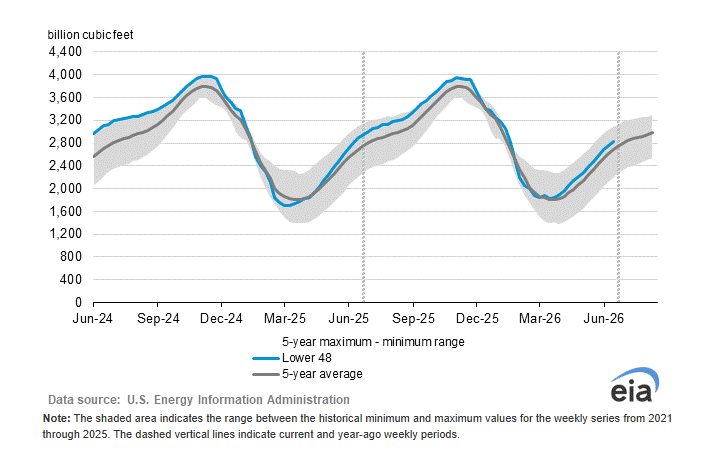
The EIA reports Thursday covering the week ending June 26. The last print was 76 Bcf with inventories above the five-year average. A smaller build this week would be the first signal that demand is catching up to the production gains. A larger build gives the bears another headline to sell.
Natural Gas Price Forecast
Every new Natural Gas analysis as it publishes, today's technical signal and key levels, live price — on one page.
See all Natural Gas forecastsThe report drops with traders already positioning for the long weekend. Thin volume around the release makes the headline number louder than it deserves to be. Anyone holding size through Thursday’s print is carrying it into a three-day weekend with no way to adjust until Monday.
Production Is the Constant the Market Has to Outgrow
Output is above 110 Bcf per day and growing year over year. Associated gas from oil drilling keeps adding supply whether gas prices justify it or not. That is the number the demand side has to beat every single week. Weather and LNG cannot just be good. They have to be good enough to outpace a production baseline that does not respond to the gas market’s mood.
Production is not expected to change this week. It functions as the constant pressure that defines how much the demand drivers have to deliver. The weather and LNG cannot just be good. They have to be good enough to outpace 110-plus Bcf per day of production that keeps flowing no matter what the market is doing.
Weekly August Natural Gas Technical Analysis
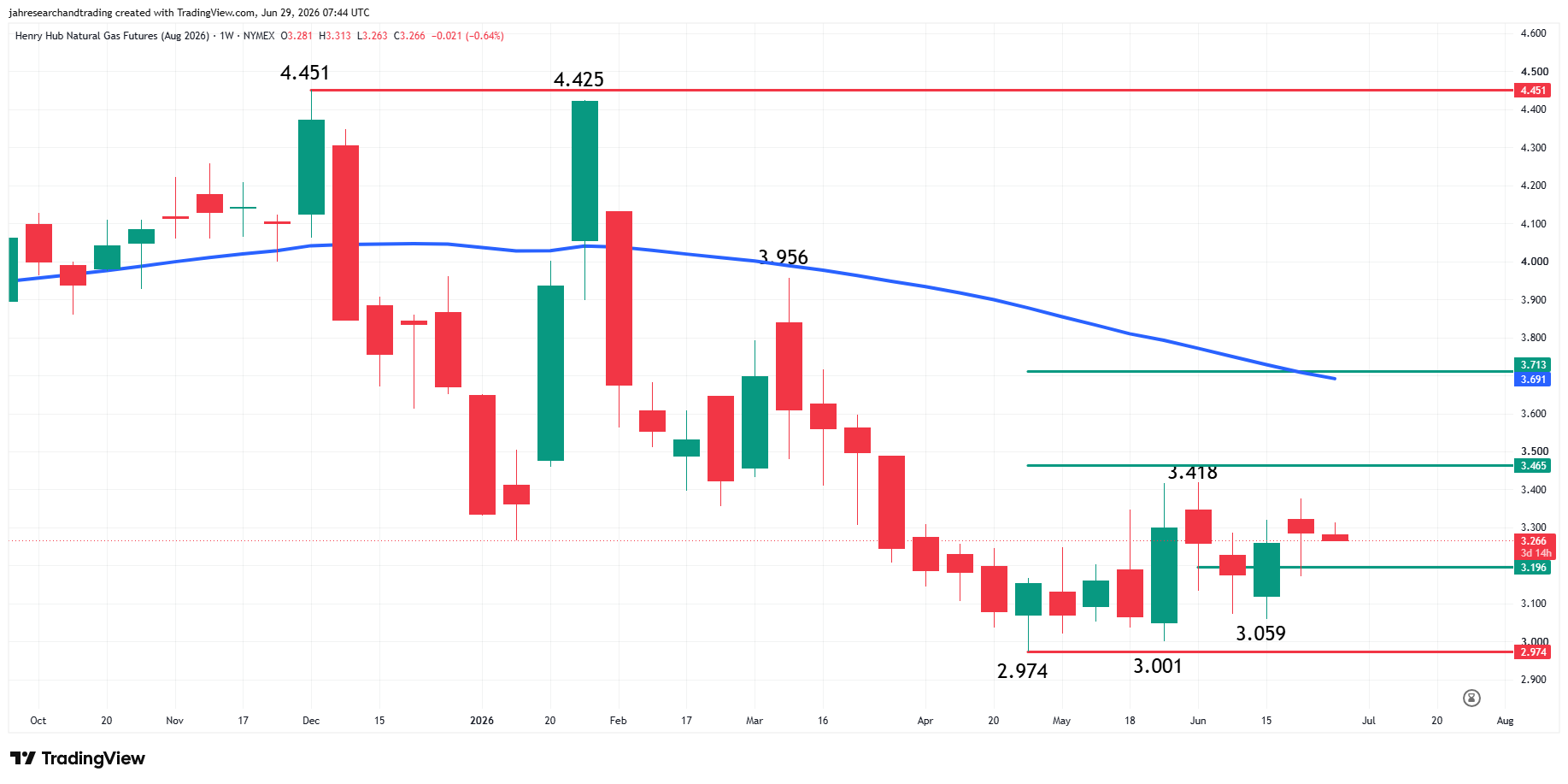
August natural gas futures are edging lower at the start of the holiday-shortened week, but still holding above a short-term pivot at $3.196. The price action suggests longs are still showing support, while waiting for a bullish catalyst to drive prices higher.
At 07:59 GMT, August natural gas futures are trading $3.258, down $0.029 or -0.88%.
The aforementioned pivot at $3.196 is the key to sustaining upside momentum. The three bottoms at $3.059, $3.001 and $2.974 are holding together the support base with help from LNG demand.
The key targets on the upside are the main top at $3.418 and an intermediate pivot at $3.465. The latter is a potential trigger point for an acceleration to the upside.
The longer-term upside target area is a resistance cluster formed by the 52-week moving average at $3.691 and the long-term 50% level at $3.713.
Essentially, hold the pivot at $3.196 and the market has a chance to breakout to the upside if the weather and LNG demand cooperate. A failure at $3.196 is not likely to lead to new lows, but rather lead to the formation of an elongated support base.
What to Watch
Weather and LNG are the two variables that determine this week’s direction. If the early July heat forecasts hold and feedgas volumes recover from the spring maintenance dip, the demand story catches up to the support base the technicals have been building since April. The pivot is holding. The bottoms are intact. The market needs the catalyst.
Thursday’s storage report either confirms that the demand improvement is real or hands the bears another comfortable injection number to trade on. The holiday book makes the reaction faster and louder than normal. If both demand drivers deliver and the storage number cooperates, this is the week the breakout conversation moves from setup to execution. If either one disappoints, the base holds but the breakout waits.
More Information in our Economic Calendar.