


WTI Crude Rebounds Over 3.5% as War Fears Return
U.S. West Texas Intermediate crude oil futures are up over 3.5% on Thursday, rebounding from yesterday’s loss on renewed worries over an escalation of the war in the Middle East and prolonged supply disruptions.
At 09:09 GMT, May WTI crude oil is trading $93.64, up $3.32 or +3.68%.

Technical Outlook
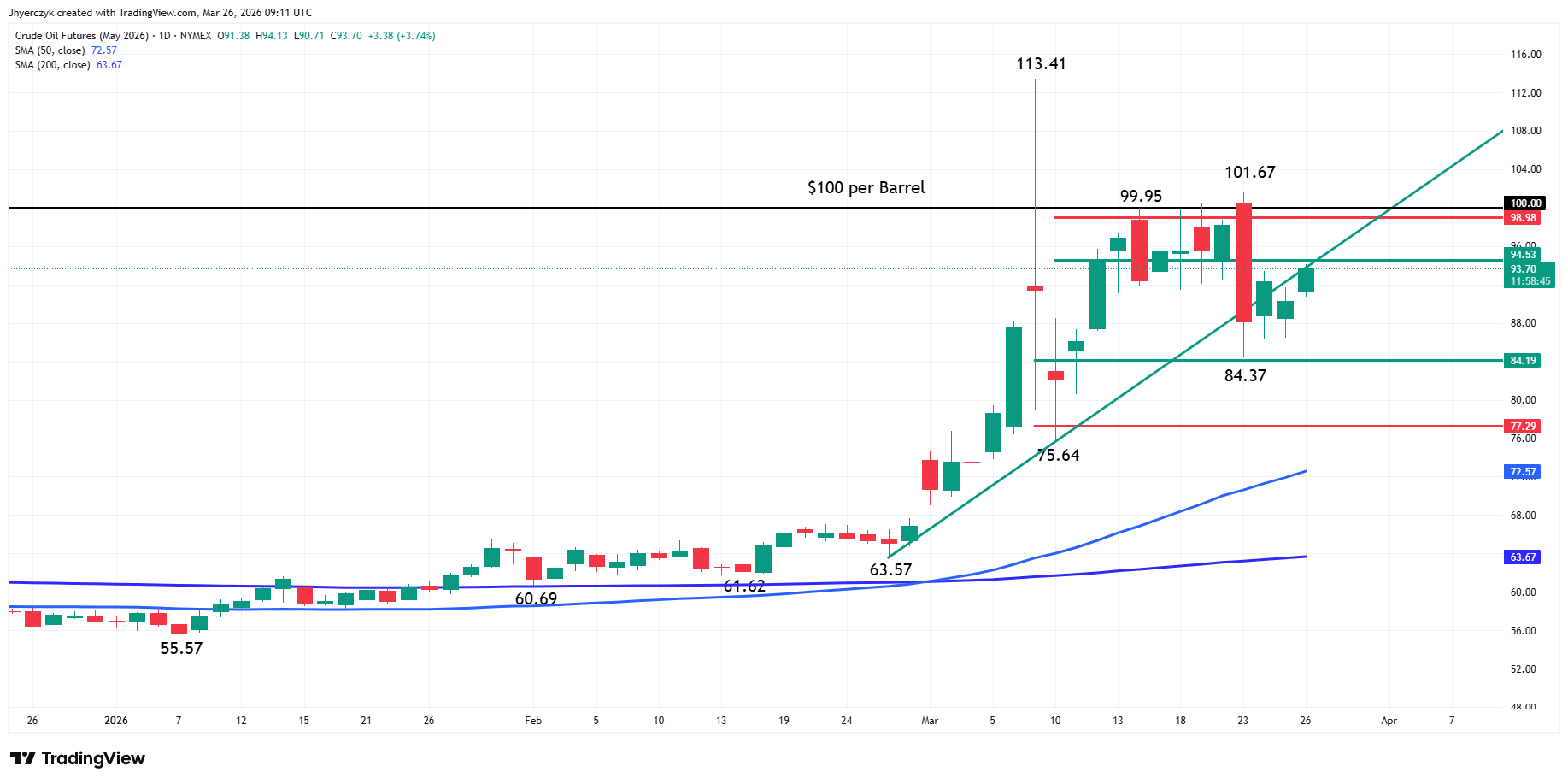
Technically, the main trend is up according to the swing chart and the moving averages. However, momentum shifted to the downside on Monday with the formation of the dramatic closing price reversal top at $101.67 and the failure of an uptrend line. Since that low at $84.37, the market has edged higher, hitting $94.13 earlier today.
In order to shift momentum back to the upside, the futures contract has to overcome a minor pivot at $94.53. This will also put the market back on the strong side of the trendline at $94.05. This move could trigger an acceleration to the upside with the next major target zone $98.98 to $101.67.
Momentum could continue to build over $101.67, putting the March 9 main top at $113.41 back on the radar.
On the downside, the nearest support cluster is the combination of Monday’s low at $84.37 and a 50% level at $84.19. If this fails, the next support cluster comes in at $77.29 to $75.64. This is the last support zone before the 50-day moving average at $72.57.
Brent Oil Price Forecast
Every new Brent Oil analysis as it publishes, today's technical signal and key levels, live price — on one page.
See all Brent Oil forecastsIran Rejects Peace Terms and Traders Take Notice
Aggressive chatter out of Washington and Tehran is rattling traders early Thursday. All the talk centers around whether Iran agrees to the U.S. peace deal proposal. It is a 15-point document calling for the removal of Iran’s stocks of highly enriched uranium, the halting of enrichment, the curbing of its ballistic missile program and the cutting off of funding for regional allies, three Israeli cabinet sources familiar with the plan told Reuters.
Today’s price action indicates Monday’s optimism regarding a ceasefire has faded and now oil traders are fearing an escalation of the war.
Iran’s foreign minister said on Wednesday it is still reviewing the U.S. proposal to end the war, but it has no plans of holding talks to discuss the ending of the conflict, now in its fourth week. White House press secretary Karoline Leavitt said President Trump will hit Iran harder if the country refuses to accept that it has been “defeated militarily.”
Rangebound Trade or a Breakout — Iran Decides
With the U.S. setting the bar for an agreement pretty high, traders are already pricing in the possibility Iran continues to take a hard stance against it. If the two countries continue to negotiate then we could be looking at a near-term rangebound trade. But if Iran flat out rejects the idea of peace, prices could soar to a one-month high on heightened volatility.
Even if Iran agrees in principle, the tone is likely to remain bullish with prices underpinned by the thought of supply bottlenecks and lengthy repairs to oil facilities bombed by Iran.
More Information in our Economic Calendar.


