Fed Removes Easing Bias and Silver Pays for It
Spot Silver dropped 1.07% to $69.27 Wednesday after hitting $71.56 earlier in the session. That is a full round trip and then some. The five-day counter-trend rally ran straight into a Fed decision that nobody on the bullish side was positioned for. Warsh held rates at 3.50% to 3.75% and that part was expected. What was not expected was the committee pulling the easing language out of the statement entirely and releasing projections that show no rate cuts in 2026 and the door open to a hike before year-end.
Silver gave back every cent of its early gains in a matter of hours. The 2-year Treasury yield surged 9 basis points to 4.134% and that move alone tells you where the money went. Out of metals and into yield.
Spot Silver (XAGUSD) Technical Analysis
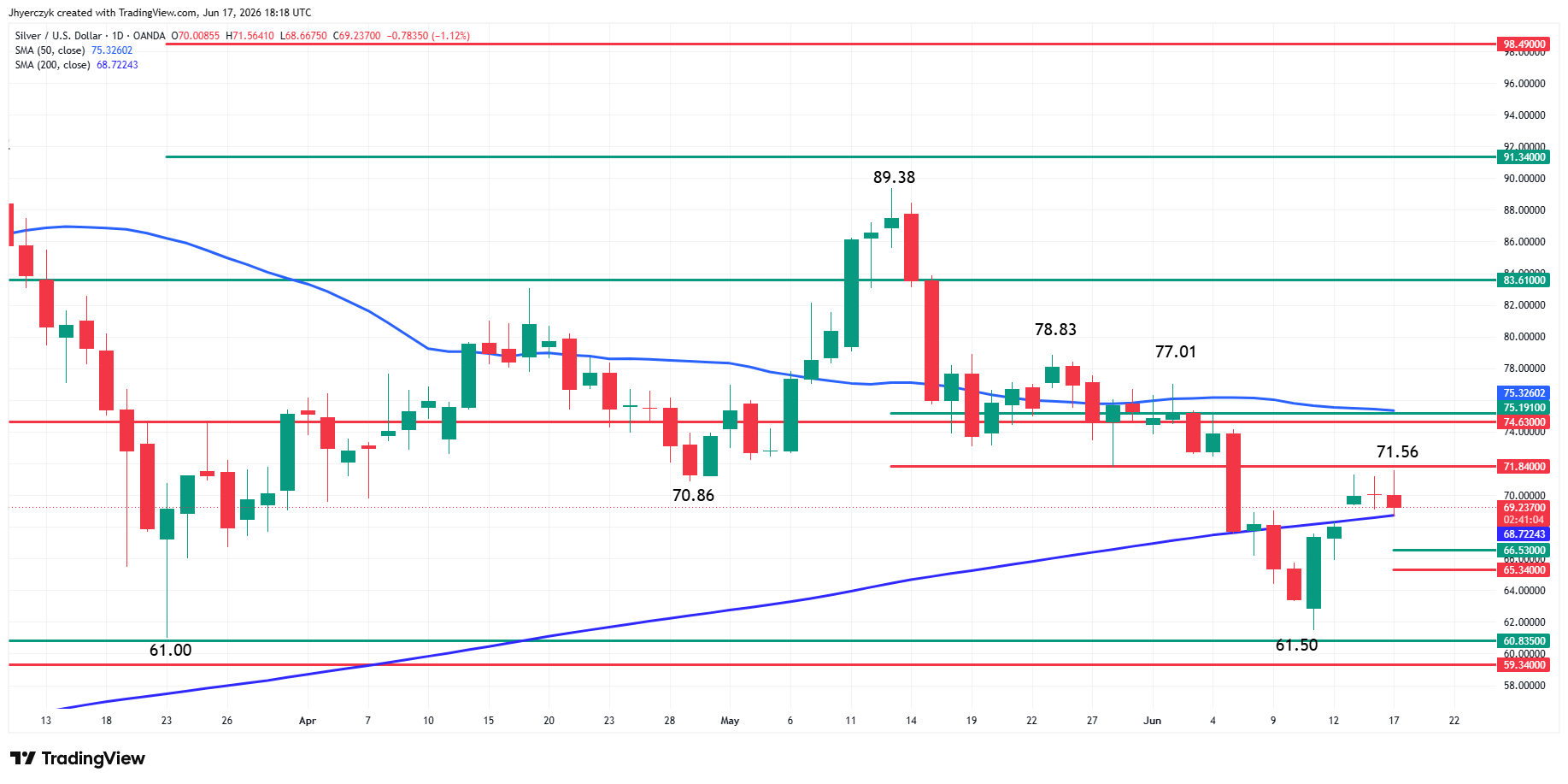
Spot Silver is lower late in the session on Wednesday after giving back all of its earlier gains. The price action suggests the five day counter-trend rally may be coming to an end.
Earlier in the session, the rally was rejected by an intermediate Fibonacci level at $71.84 with the rally stopping at $71.56. The downside momentum created by the intraday reversal drove silver back to the 200-day moving average at $68.72.
The short-term range is $61.50 to $71.56. If the 200-day MA fails as support then look for the sell-off to extend into at least $66.53 to $65.34. That could turn out to be a counter-trend buying opportunity, but we will be monitoring trader reaction when it is being tested.
The Statement Was Short and the Message Was Clear
Warsh cut the statement down and packed the inflation language in tight. The committee said, “Economic activity is expanding at a solid pace despite elevated uncertainty that owes, in part, to the conflict in the Middle East. Productivity growth and capital investment are strong.”
On the labor market the Fed noted, “Job gains have kept pace with the workforce, and the unemployment rate has changed little.”
Then the line that moved silver: “Inflation remains elevated relative to the Committee’s 2 percent goal, in part reflecting supply shocks that have driven price increases in certain sectors, including energy. The Committee will deliver price stability.”
“The Committee will deliver price stability” is not a suggestion. That is Warsh putting inflation control at the top of the priority list and silver traders read it exactly that way. The intraday reversal from $71.56 back to the 200-day moving average at $68.72 started on that sentence.
The Projections Killed the Rate Cut Trade
The median estimate for the fed funds rate at the end of 2026 moved up to 3.8% from 3.4% in March. That is a full shift from a committee that was leaning toward easing three months ago to one that now sees at least one hike as necessary. Rate cuts got pushed out to 2027 and 2028.
Silver Price Forecast
Every new Silver analysis as it publishes, today's technical signal and key levels, live price — on one page.
See all Silver forecastsThe updated inflation outlook backs up the move. Policymakers raised their 2026 headline inflation forecast to 3.6% and core to 3.3%, both well above the March projections. They lowered unemployment estimates and barely touched growth expectations. That is a committee looking at an economy that can handle restrictive policy for as long as it takes.
Silver rallied into the announcement on the assumption that Warsh might come in softer than the committee. That bet lost. The projections made it clear that the entire committee moved hawkish, not just the statement language. Futures pricing now shows no cuts in 2026 and a quarter-point hike potentially arriving before December. That is a completely different rate landscape than what silver was trading on a week ago.
Warsh’s Longer View Did Not Save the Session
Warsh has argued publicly that supply-shock inflation should not drive monetary policy and that AI-driven productivity gains could create disinflationary pressure over time. Those views are still out there and silver bulls are going to cling to them. But Wednesday’s press conference did not deliver that version of Warsh.
ING strategist Michiel Tukker wrote, “Whilst the statement should turn more hawkish, Warsh may want to communicate his more dovish view, though probably not explicitly.”
Tukker may have been right about Warsh’s instincts but the statement and projections drowned out whatever dovish signal Warsh tried to thread through the press conference. The 2-year yield jumping 9 basis points tells you the bond market did not hear a dovish Fed Chair. It heard a committee that is done talking about cuts and starting to talk about hikes. Silver is not going to fight that until the data changes.
The Rally Had Support but Not Enough
Silver has been running on inflation concerns, geopolitical tension from the Iran situation, and strong demand for hard assets. Those factors have not disappeared. The Iran agreement is still unsigned, energy prices bounced Wednesday with WTI toward $77 and Brent near $79, and the inflation hedging bid has been real money.
But rate expectations just shifted hard against the metal. Silver can hold on geopolitical demand and inflation hedging for a while, but when the 2-year yield is ripping higher and the Fed is openly discussing the possibility of another hike, rallies become selling opportunities. That is the environment Warsh just created and the five-day counter-trend rally stalling at the Fibonacci rejection at $71.84 confirmed it technically.
What to Watch
The 200-day moving average at $68.72 is the line right now. Silver is sitting on it after Wednesday’s reversal and the next session tells you whether buyers are willing to defend it or whether the sell-off extends into the $66.53 to $65.34 zone. That support area could turn into a buying opportunity but only if the data starts softening enough to walk back the hawkish projections.
The Fed just told the market that inflation is the priority, growth is holding, and the labor market is not giving them a reason to ease. Until something in that picture breaks, silver rallies are going to run into selling. Warsh may eventually deliver the dovish pivot his history suggests, but Wednesday was not that day and the next few sessions are about finding out whether $68.72 holds or whether the counter-trend rally is completely unwound.
More Information in our Economic Calendar.