
US Dollar News: NFP Week Puts Dollar, Euro and Pound in Focus
It’s a crucial week for the dollar, with the market bracing for the July Non-Farm Payrolls on Friday. This is the most important data release before the Federal Open Market Committee (FOMC) policy meeting in September. The Federal Reserve’s decision last week to hold rates at 3.50%–3.75% reaffirmed the data-dependence of Chair Kevin Warsh. It has forced the market to focus even closer to labour data. Besides the payroll data, investors will scan multiple data points, including JOLTS, ADP, the ISM Services PMI, and the initial claims for evidence of the economy’s strain. Given the inflation trend of subsiding to above the target of 2% set by the Fed, the strength of the labour market will be the focus of the uncertainty for the September meeting. The recent volatility in the Treasury market shows the market is pricing labour market strength to a Fed policy delay.
The Euro is supported by the ECB’s hold of its deposit rate at 2.25%, with the Council employing a meeting-by-meeting stance. This week will bring more data from the Euro area with retail sales, German factory orders, and the final services PMI which will show progress on domestic demand stabilizing after a weak first half.
Sterling trades today in light of the Bank of England holding rates at 3.75% and policymakers suggesting that lingering inflation still poses a threat. Investors focus on the the UK Services PMI, the latest housing data, and labor market data to help understand how the economy may respond to a monetary policy that remains restrictive without a substantial economic downturn. These releases will shape the most immediate outlook on the dollar, euro, and pound.

US Dollar Index (DXY) Technical Analysis: Daily Uptrend Tested as Bulls Defend Key Trendline
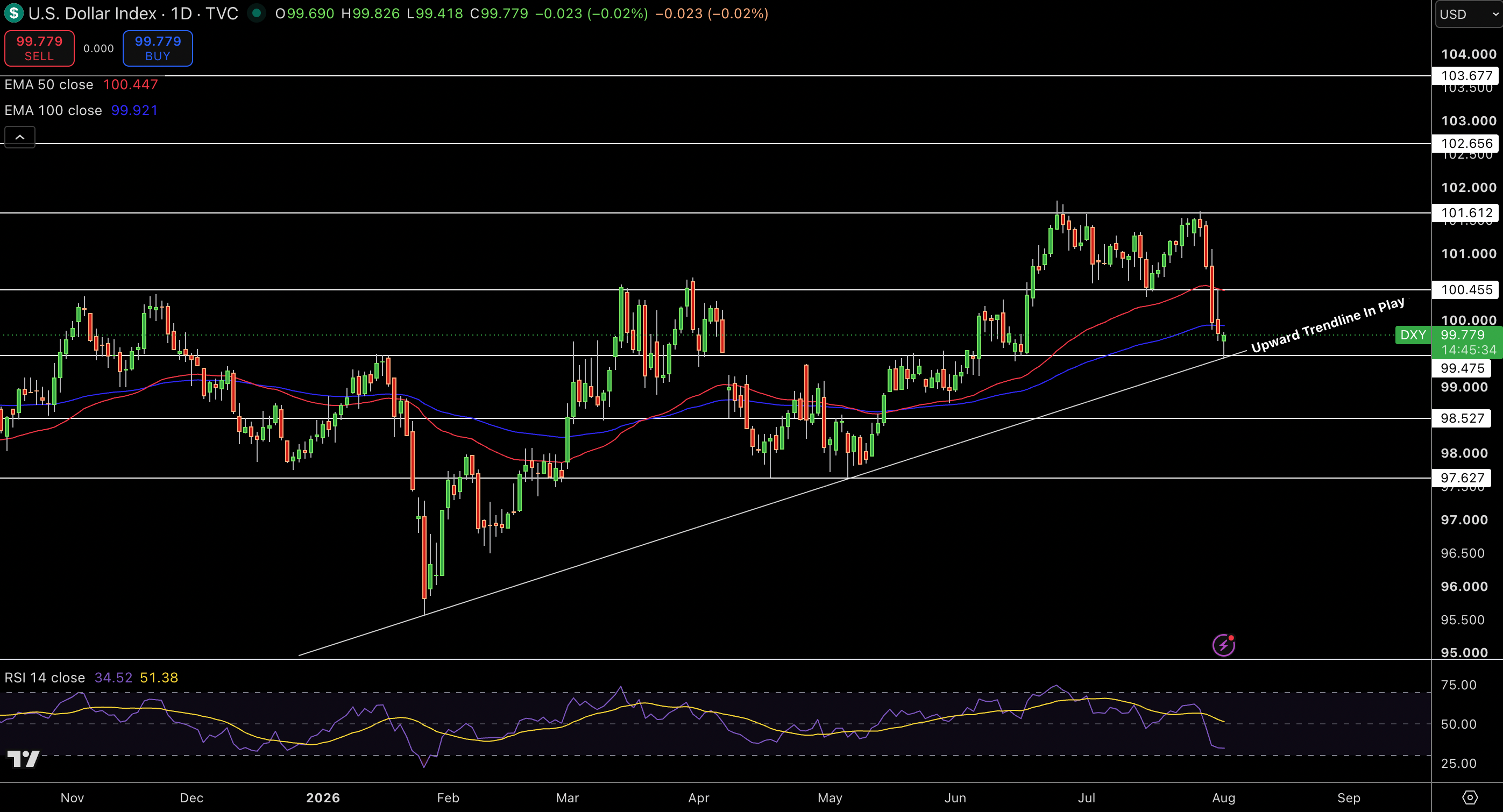
Currently, the U.S. Dollar Index sits around 99.79, approaching significant support due to the long-term ascending trendline intersecting with the 100-day EMA (99.92). After buying pressure was absorbed around 101.61, the Index was pressed to the psychological 100.00, but the broader uptrend is still in effect.
Now the 100-day EMA at 100.45 is the first point of resistance, and the RSI indicates a bearish trend may be losing momentum due to the recent fall to 34. A daily close at 99.47 or lower would negate the uptrend, with a target at 98.53, then 97.63. If prices hold above the trendline, expect a move to 100.45, with the 101.61 target remaining in effect.
While the trend remains bullish, and prices are above the trendline, the next few daily candles will dictate whether the trend remains bullish, or a deeper correction is in effect.
GBP/USD Technical Analysis: GBP Approaches Important Resistance Level at 1.3500
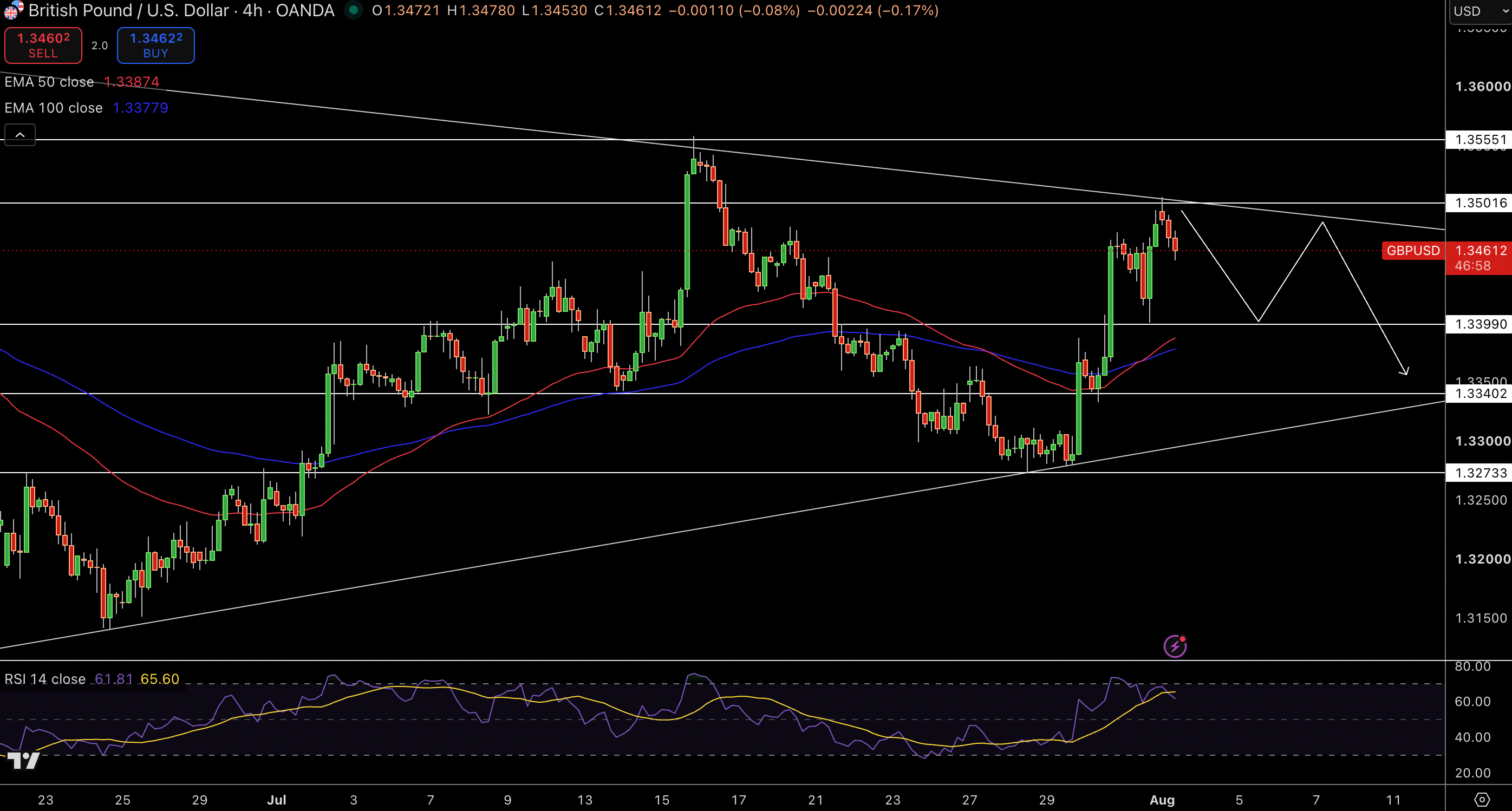
After bouncing off the 1.3280 ascending trend support line GBP/USD has extended its recovery to 1.3460. Price has now moved above the 50-EMA (1.3387) and 100- EMA (1.3378) displaying bullish momentum.
EUR/USD Price Forecast
Every new EUR/USD analysis as it publishes, today's technical signal and key levels, live price — on one page.
See all EUR/USD forecastsHowever, the resistance 1.3500 long term descending trend line is a significant resistance point. This zone has previously rejected buyers.
The first descending support is found at 1.3400 and then at 1.3340 and the rising trend line at 1.3270. A break beyond 1.3500 will eliminate the descending range and expose 1.3550. A break beyond 1.3500 will eliminate the descending range and a break beyond 1.3400 will offer another attempt to break the range.
The moving averages signal a modest bullish sentiment which is countered by the descending 1.3500 resistance.
EUR/USD Technical Analysis: Bullish Breakout Stalls at Multi-Month Trendline Resistance
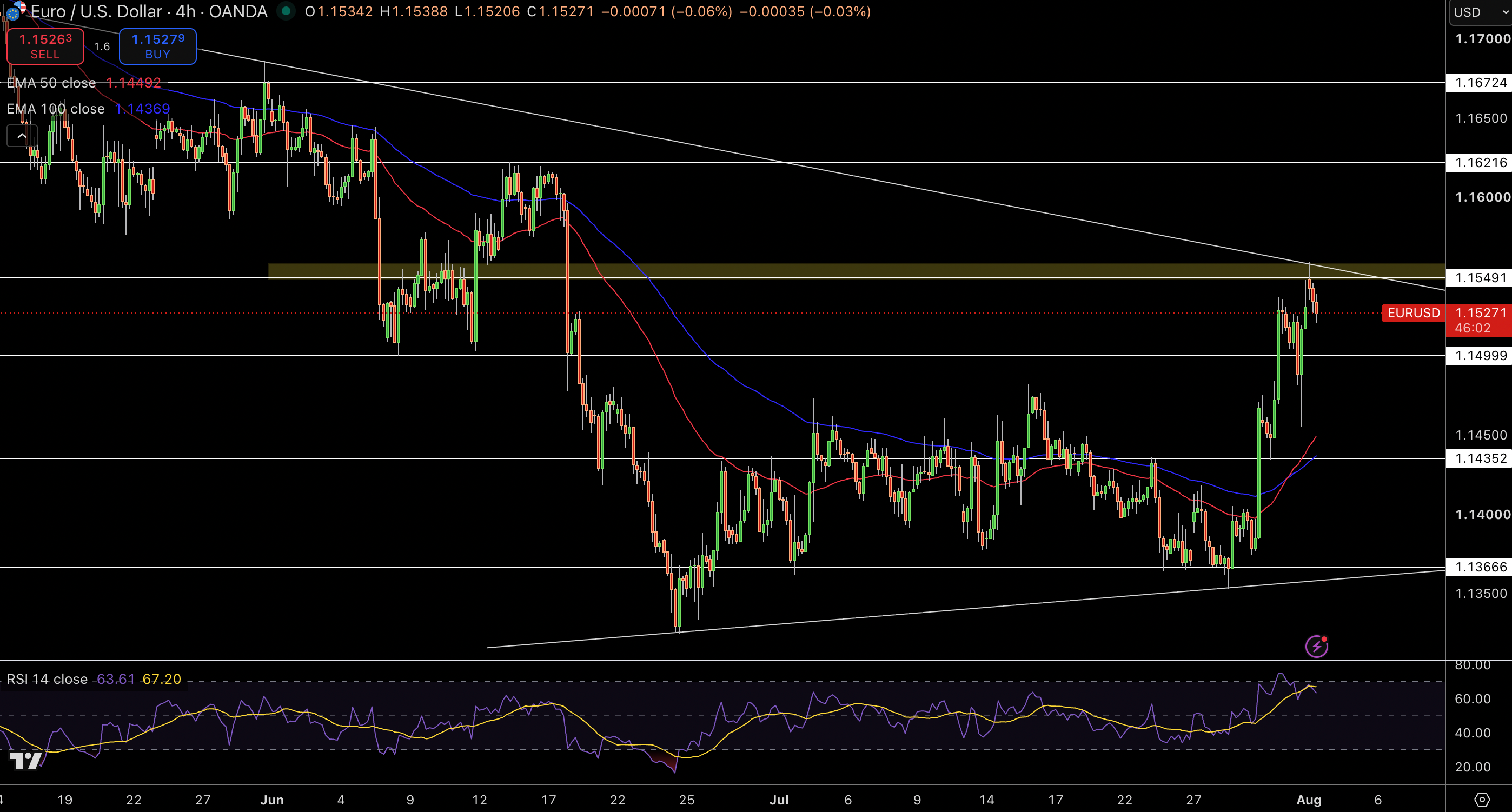
EUR/USD made a bullish breakout above 1.1500 to 1.1525, but bullish pressure temporary stalled below the long-term descending trendline, and the major supply zone around 1.1549.
The bullish breakout is confirmed with prices trading above the 50-EMA (1.1449) and 100-EMA (1.1437). However, the RSI suggests bullish momentum is beginning to cool.
If the price remains above the 1.1550 mark, we can expect the breakout to continue. We can expect price targets 1.1622 and 1.1672. The price target of 1.1500 and then 1.435. Dynamic support from the moving averages can be expected at both targets.
The long term outlook remains bullish as long as the price is above 1.1500. Confirmation of the target is expected beyond the long term descending resistance.