Dollar Pulls Back but the Big Questions Remain
The U.S. Dollar (DXY) is edging lower against a basket of major currencies late in the session on Tuesday on profit-taking and position-squaring ahead of major central bank interest rate decisions this week. Last week, the greenback hit a 10-month high as Middle East tensions and soaring crude oil prices drove up inflation fears, prompting investors to cut the chances of Fed rate cuts in June and July. Some of the strength was attributed to safe-haven buying.

Every Major Central Bank Speaks This Week
The Fed started its two-day meeting on Tuesday and is scheduled to announce its policy decision tomorrow at 18:00 GMT. Later in the week on Thursday, the European Central Bank (ECB), the Bank of England (BOE) and the Bank of Japan (BOJ) will release their decisions. All are expected to leave their benchmark interest rates unchanged, but the focus for traders will be on inflation expectations with crude oil hovering around the $100 level. Economic growth will also be discussed with the market looking at worst case scenarios predicting a global recession if the war doesn’t end in a timely manner.
The Fed Was Already in a Tough Spot Before the War
Early in the year, traders basically took a March Fed rate cut off the board because of sticky inflation and a firm U.S. labor market. However, conditions began to change, highlighted by persistent inflation and a weakening labor market. This put the Fed in a bad spot. Should they cut rates to save jobs and run the risk of higher inflation, or should they hold them steady? Fed Fund futures indicate the latter with investors pushing the next rate cut from June to July and now September, according to Goldman Sachs.
Four Questions That Will Decide Where the Dollar Goes Next
Then came the war and the subsequent dollar rally. Traders were pretty active in buying dips on the way to a multi-month high, but will this buying continue? Were traders buying the dollar for safety or because they think the Fed will hold rates higher-for-longer? Will the Fed’s comments on Wednesday extend the rally or trigger a near-term correction? Did dollar bulls just price in the war lasting weeks or months? These are the questions that need to be addressed before the current rally resumes.
The Breakout Level Every Dollar Trader Is Watching
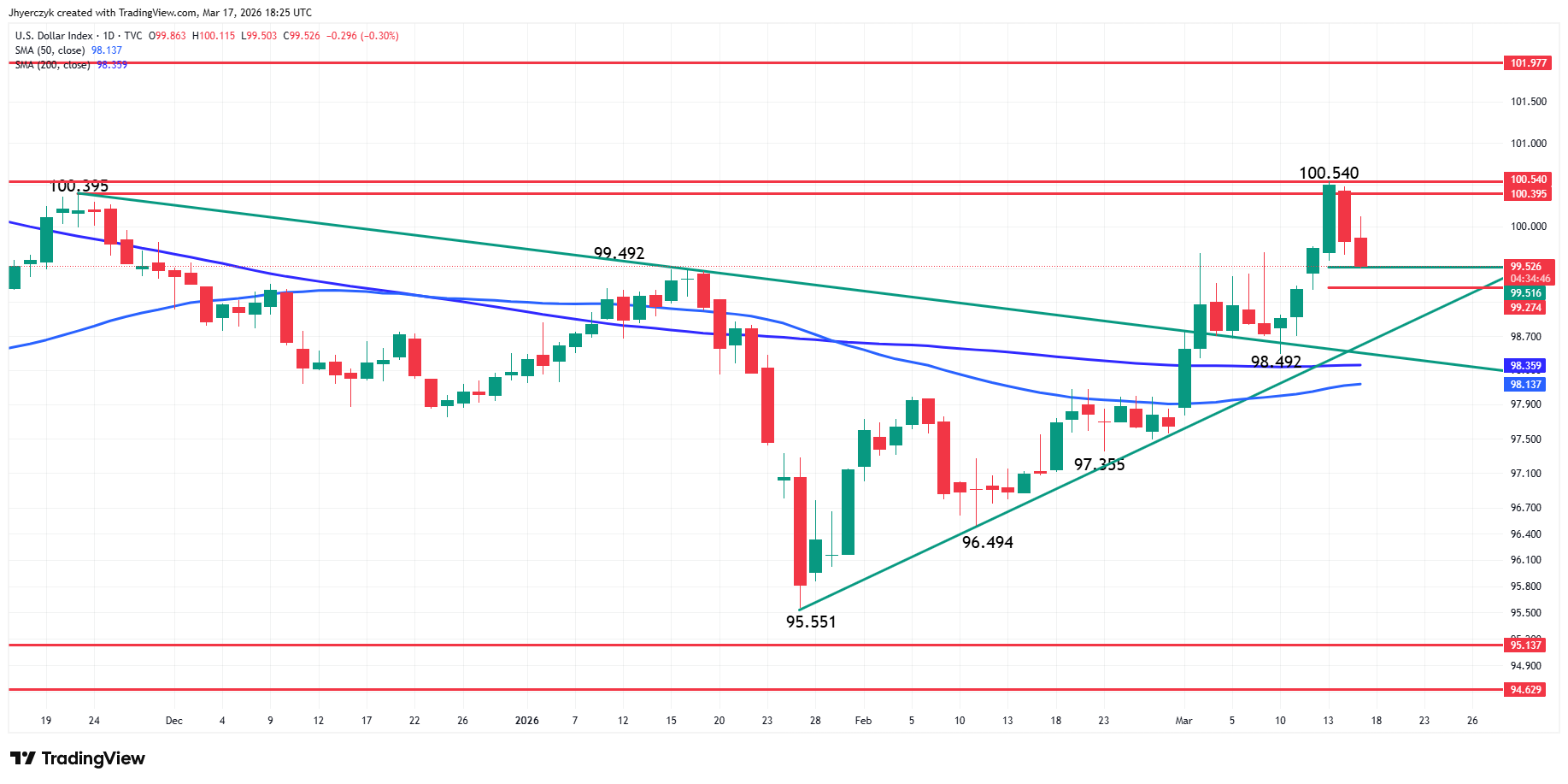
Technically, the main trend is up. A breakout over 100.540 will reaffirm the uptrend and set up the possibility of a near-term surge to 101.977. It all depends on whether the rally is fueled by short-covering or new buying.
EUR/USD Price Forecast
Every new EUR/USD analysis as it publishes, today's technical signal and key levels, live price — on one page.
See all EUR/USD forecastsWhere Support Steps In on a Pullback
On the downside, minor support is a retracement zone at 99.516 to 99.274. If the uptrend is strong then look for a technical bounce on a test of this area. If it’s weak then prices could collapse all the way back to the trend line at 98.610.
Bottom Line
The major support is the 200-day moving average at 98.359 and the 50-day moving average at 98.138. Bullish traders would like to see the 50-day MA cross to the strong side of the 200-day, but that could take weeks to happen.
More Information in our Economic Calendar.