In Part One, we explored how artificial intelligence has become a structural driver of Walmart‘s transformation from traditional retailer to technology-powered enterprise. However, AI alone doesn’t tell the complete story of Walmart’s remarkable ascent to a $1 trillion valuation.
As the company prepares to report earnings on February 19, 2026, investors will be scrutinizing several additional factors that have fueled its growth: the migration of affluent consumers to discount retail, explosive e-commerce expansion, a rapidly growing advertising business, and the company’s ability to consistently exceed its own ambitious forecasts.
Why High-Income Shoppers Are Flocking to Walmart
One of Walmart’s most significant competitive advantages has emerged from an unexpected source: the shifting shopping habits of affluent consumers. The stereotype of Walmart as exclusively serving lower-income households has been upended by data showing a dramatic influx of high-earning shoppers over the past several years.
According to research from GlobalData Retail, nearly 28% of high-income consumers shopped at discount chains like Walmart in 2025, up from approximately 20% just four years earlier in 2021. More striking still, Walmart specifically has captured an increasing share of six-figure earners: more than 17% of Americans earning $100,000 or more annually now shop at the retail giant, compared to less than 15% in 2021.
New Chief Financial Officer John David Rainey explained to CNBC last quarter that, while Walmart has gained market share across all income levels, the gains are “more pronounced in the upper-income segment.”
What’s Driving This Shift?
Neil Saunders of GlobalData points out that the pandemic and the subsequent inflationary surge beginning in 2021 have acted as major catalysts. Wealthier shoppers are now flocking to discount stores at a much faster rate than in previous years. Saunders notes that a similar pattern emerged following the 2008 financial crisis, suggesting that economic uncertainty prompts even wealthy consumers to reassess their spending habits.
As the “inflation safety net” for wealthy shoppers has eroded—and as prices climb for groceries, housing, healthcare, and other essentials—even those with higher incomes are feeling the squeeze on their disposable income. So even high-income households are seeking opportunities to stretch their dollars further. Walmart’s value proposition—combining low prices with convenience and an increasingly sophisticated shopping experience—has proven “irresistible”.
Strategic Investments That Appeal to Affluent Shoppers
Walmart hasn’t simply benefited from external economic trends—it has actively courted these new customers through strategic investments. The company has wooed inflation-weary shoppers by significantly expanding its online product assortment with premium brands, remodeling thousands of stores to create more appealing shopping environments, and offering faster e-commerce delivery options.
These improvements have resonated particularly strongly with higher-income consumers who value convenience and quality alongside low prices. The result is that affluent shoppers are not only visiting Walmart more frequently but are also purchasing higher-margin items such as apparel, home goods, and premium grocery products—categories where Walmart has historically struggled to compete with specialized retailers.
The Multiplier Effect on Revenue Streams
The influx of higher-income customers creates a multiplier effect across Walmart’s business model. These shoppers are driving significant e-commerce growth as they embrace online ordering and rapid delivery options. They are more likely to subscribe to Walmart+ (the subscription-based membership program that creates recurring revenue streams, increases customer loyalty and competes with Amazon Prime). And they provide an attractive audience for Walmart Connect, the company’s advertising business, as brands pay premium rates to reach affluent consumers.
E-Commerce and Advertising Fuel Explosive Growth
While AI capabilities provide the operational foundation for Walmart’s transformation, the company’s digital channels—e-commerce and advertising—represent the most visible and financially significant manifestations of that transformation.
In May 2025, Walmart achieved a milestone: its first profitable quarter for e-commerce operations. This accomplishment represents the culmination of years of strategic investment and operational refinement, transforming what was once viewed as a necessary but costly defensive measure against Amazon into a genuine growth engine.
The most recent quarter demonstrated the power of this transformation: global e-commerce sales surged 27%, with gains across all business segments. U.S. e-commerce sales jumped 28%, fueled by growth in store-based order fulfillment and the expanding third-party marketplace. International e-commerce sales jumped 26%, while Sam’s Club e-commerce in the United States rose 22%.
The Speed Factor
A critical element of Walmart’s e-commerce success has been its ability to deliver on the promise of speed—a capability that leverages its vast network of physical stores as fulfillment centers. The retailer now offers sub-three-hour delivery to roughly 95% of American households from its store locations. The service has proven wildly popular, with nearly one-third of online orders now being expedited for arrival within one to three hours.
According to CFO Rainey, revenue related to these faster deliveries has increased 70% year over year—a growth rate that underscores how speed has become a key competitive differentiator.
Walmart monetizes this speed advantage through multiple channels. Some expedited orders carry additional fees, generating direct revenue, while others are included as benefits of Walmart+.
The Marketplace Expansion
In just five years, Walmart has grown its online marketplace to more than 500 million items. This vast inventory creates multiple advantages: it attracts more customers searching for specialty or niche products, generates commission revenue from third-party sellers, and provides Walmart with valuable data about emerging product categories and consumer preferences.
The High-Margin Growth Story of Advertising
As Walmart’s digital traffic has increased and its marketplace has expanded, advertising has emerged as one of the company’s most significant growth opportunities. Advertising businesses are particularly attractive because they generate high margins with relatively low capital requirements, directly boosting profitability.
In the most recent quarter, Walmart’s global advertising business increased by a remarkable 53%. The company has built what is now a $4 billion advertising business—a revenue stream that barely existed five years ago and that continues to gain momentum.
Can Walmart Deliver on Raised Guidance & Push its Stock Price to New Highs?
Walmart’s confidence in its momentum is evident in its guidance revisions. The company has raised its full-year fiscal 2026 forecast twice in recent months—a move that signals management’s conviction that the business is performing better than even their own projections anticipated.
After its online business surged by double digits again in August 2025, Walmart increased its full-year sales forecast from 3–4% to 3.75–4.75%. Just months later, the company raised its outlook again, now projecting sales growth of 4.8–5.1%. The company also raised its adjusted earnings per share guidance twice, landing at $2.58 to $2.63.
These upward revisions matter for investors.
First, they demonstrate that Walmart is experiencing accelerating momentum rather than simply maintaining steady growth. Second, they reflect management’s confidence that recent investments in technology, supply chain capabilities, and customer experience are generating returns that exceed the costs. Third, they set a high bar for the February 19th earnings report and investors will be watching closely to see if the company can deliver on these ambitious targets.
Stock Performance Reflects Optimism
Walmart’s strong operational performance has translated directly into impressive stock market returns. So far in 2026, Walmart shares are already up approximately 20%—outpacing the S&P 500’s roughly 12% gain over the same period. The longer-term picture is even more striking: over the past five years, Walmart shares have surged approximately 178%, dramatically outperforming the S&P 500’s 74% gain over the same timeframe.
This outperformance reflects a fundamental rerating of the stock. Investors who once viewed Walmart primarily as a mature, slow-growth retailer now increasingly see it as a technology-enabled growth company with multiple expansion opportunities. The company’s transition to the Nasdaq in December 2025—leaving the New York Stock Exchange after more than five decades—was designed to reinforce this perception shift.
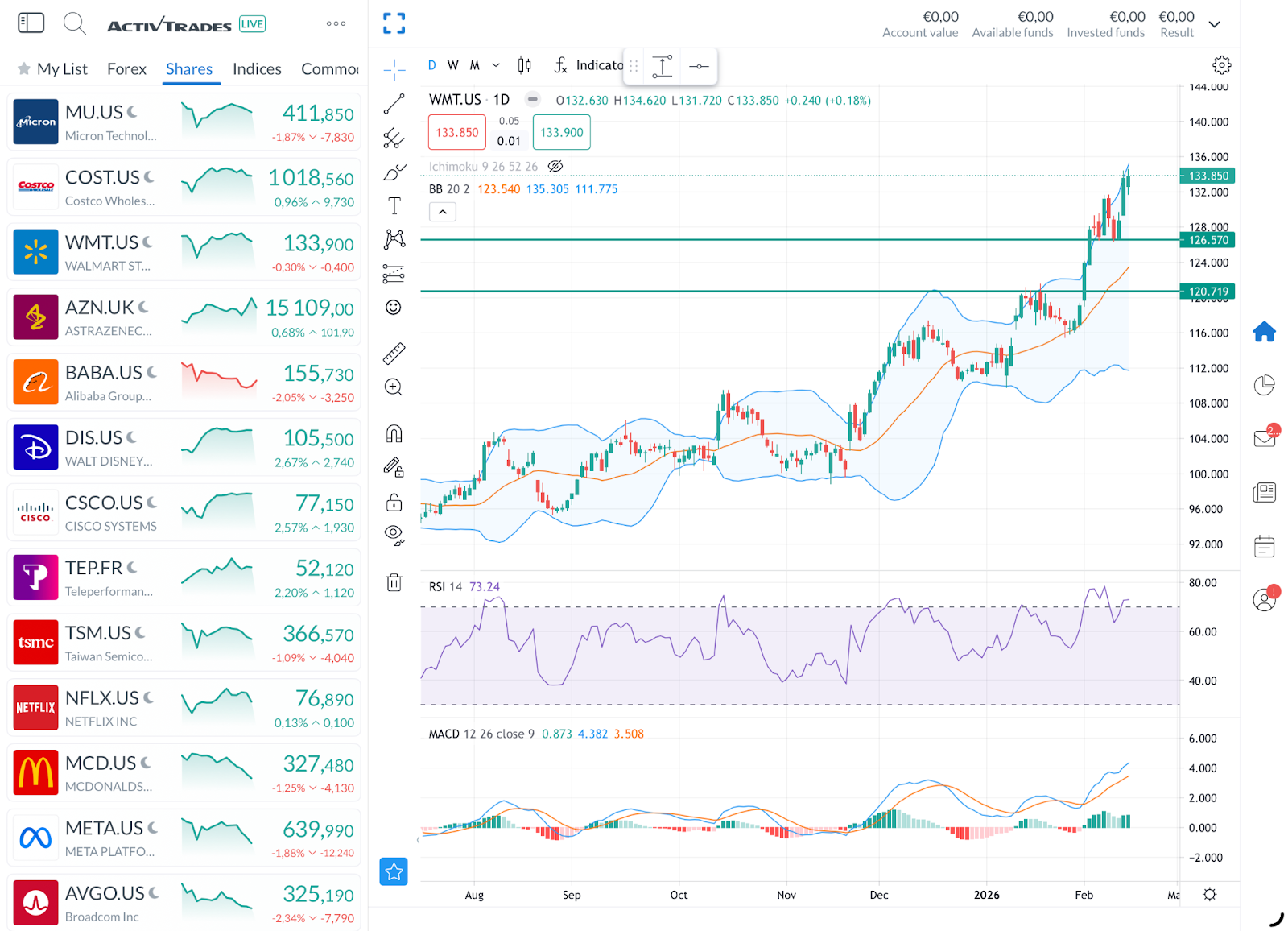
As Walmart will release its earnings report on February 19, 2026, investors wonder whether the stock can continue its upward trajectory and reach new highs. The answer is probably yes—but only if the company delivers results that exceed its already elevated guidance and provides forward-looking commentary that reinforces confidence in sustained growth.
The company has built significant momentum across multiple dimensions: AI-driven operational excellence, explosive e-commerce and advertising growth, successful capture of higher-income consumers, and a consistent track record of beating expectations. This momentum has already driven the stock to impressive gains.
However, success has also raised expectations. The market has largely embraced Walmart’s transformation narrative and has revalued the stock accordingly. For shares to reach new highs, the company will need to demonstrate not just that it can meet its twice-raised guidance, but that the growth trajectory remains intact and may even accelerate further.
Also, not everything is entirely positive heading into the earnings report. The company faces questions about quality control on its third-party marketplace following a lawsuit filed by Estée Lauder alleging that Walmart’s platform hosts counterfeit beauty products. The lawsuit accuses Walmart of trademark infringement and inadequate oversight of sellers.
While this issue is unlikely to significantly impact near-term financial results, it raises broader questions about Walmart’s ability to maintain brand quality and consumer trust as it rapidly expands its marketplace. During the earnings call, investors should listen carefully for management’s response to these concerns and any plans to enhance marketplace oversight.
No longer a simple brick-and-mortar discounter, Walmart has pivoted into a technology-heavy omnichannel platform, leveraging diverse, fast-growing revenue streams to drive its next phase of growth. But can this transformation continue to drive its stock appreciation at the same pace? Or has the market already priced in much of the upside?
Investors will be focusing on hard numbers on e-commerce profitability expansion, concrete examples of AI-driven margin improvements, data on the sustainability of high-income shopper gains, and guidance that suggests the company sees continued momentum ahead.
Sources: Walmart, Investopedia, The Wall Street Journal, CNBC, CBS News, Reuters
The information provided does not constitute investment research. The material has not been prepared in accordance with the legal requirements designed to promote the independence of investment research and as such is to be considered to be a marketing communication.
All information has been prepared by ActivTrades (“AT”). The information does not contain a record of AT’s prices, or an offer of or solicitation for a transaction in any financial instrument. No representation or warranty is given as to the accuracy or completeness of this information.
Any material provided does not have regard to the specific investment objective and financial situation of any person who may receive it. Past performance is not a reliable indicator of future performance. AT provides an execution-only service. Consequently, any person acting on the information provided does so at their own risk. Forecasts are not guarantees. Rates may change. Political risk is unpredictable. Central bank actions may vary. Platforms’ tools do not guarantee success.