XRP slides on Tuesday, January 20, extending its losing streak to seven consecutive days – the second in the month.
US President Trump’s threat of 10% tariffs on eight European members of NATO fueled demand for safe-haven assets. President Trump announced a 10% tariff on January 17, raising fears of an all-out trade war between the US and the EU.
Meanwhile, surging Japanese Government Bond (JGB) yields added to the risk aversion, as markets reacted to Japanese Prime Minister Sanae Takaichi calling a snap election.
Risk-off sentiment led to XRP-spot ETF market outflows for only the second time since its launch in November.
Despite the current losing streak, the medium-term outlook remains bullish. XRP-spot ETF net inflows, increased XRP utility, and optimism over the Senate passing crypto-friendly legislation are likely to lift sentiment. Macro risk aversion is overshadowing fundamentals.
Below, I will explore the key drivers behind recent price trends, the medium-term (4-8 weeks) outlook, and the key technical levels traders should watch.

US XRP-Spot ETF Market Signals Risk-Off Sentiment
On Tuesday, January 20, the US XRP-spot ETF market reported $53.32 million in net outflows, leaving total net inflows since launch at $1.22 billion.
The Grayscale XRP ETF (GXRP) saw net outflows of $55.39 million. Crucially, the US XRP-spot ETF market recorded only its second day of net outflows since XRPC launched on November 14.
Tuesday’s outflows reflected investor concerns about Trump’s determined push to acquire Greenland and the snap election in Japan.
Ripple Price Forecast
Every new Ripple analysis as it publishes, today's technical signal and key levels, live price — on one page.
See all Ripple forecasts10-Year Japanese Government Bond Yields Soar Ahead of Snap Election
This week, Japan’s Prime Minister Sanae Takaichi announced a snap election on February 8. Prime Minister Takaichi looked to take advantage of strong opinion polls. A strong majority would enable her to push her fiscal policy goals.
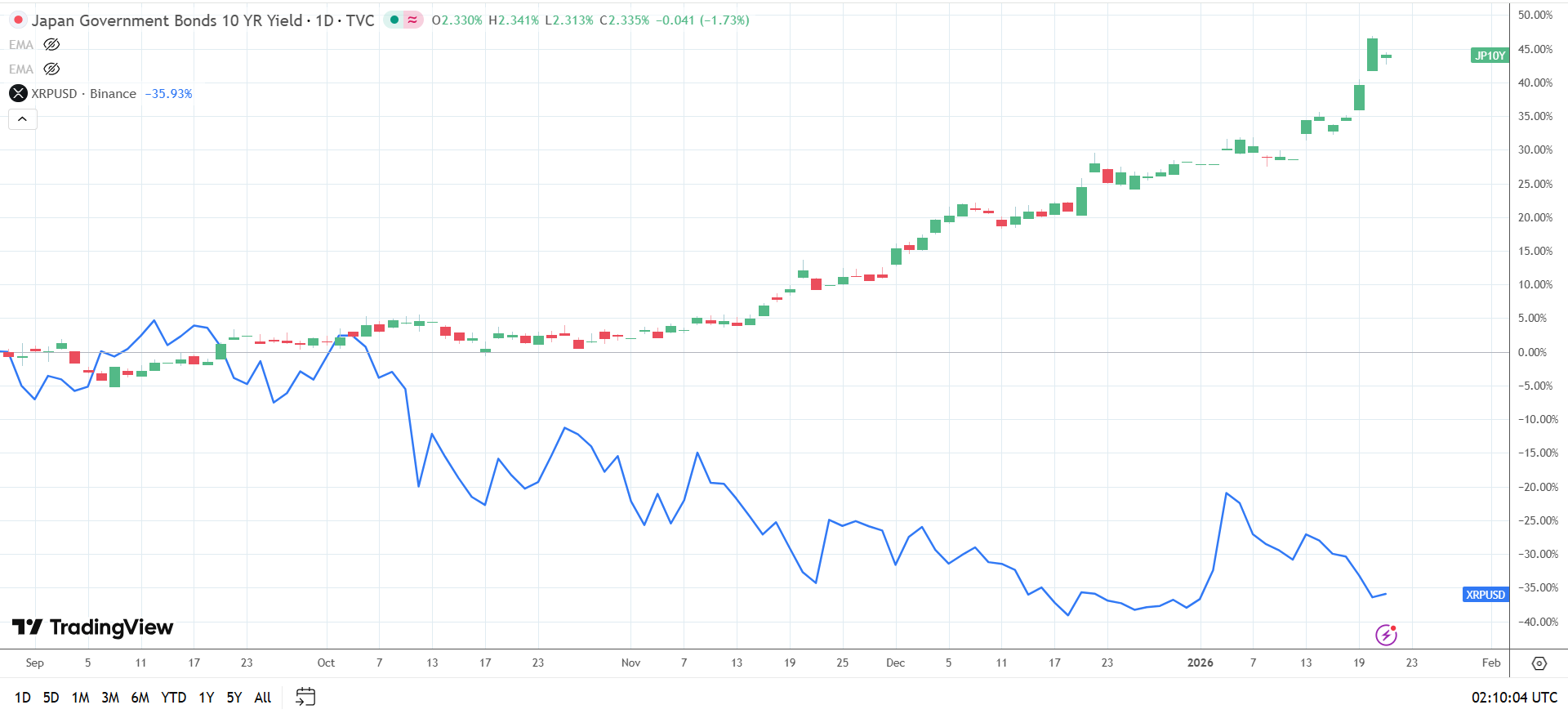
XRP’s correlation with 10-year JGBs has underscored market sensitivity to rising yields. Higher JGB yields could dry up global market liquidity as JGBs become more attractive, impacting demand for risk assets. For context, concerns about Prime Minister Takaichi’s fiscal spending plans and Japan’s 240% debt-to-GDP ratio have sent the risk premium on holding JGBs sharply higher.
Notably, XRP’s inverse correlation with 10-year JGB yields recoupled after reports of delays to the progress of the Market Structure Bill on Capitol Hill.
US-EU Trade War Threat Adds to Market Uncertainty
While soaring 10-year JGB yields weigh on demand for XRP, fears of a full-blown trade war between the US and the EU have contributed to the reversal. US President Trump announced a 10% tariff on eight European NATO members on Saturday, January 17, triggering a flight-to-safety.
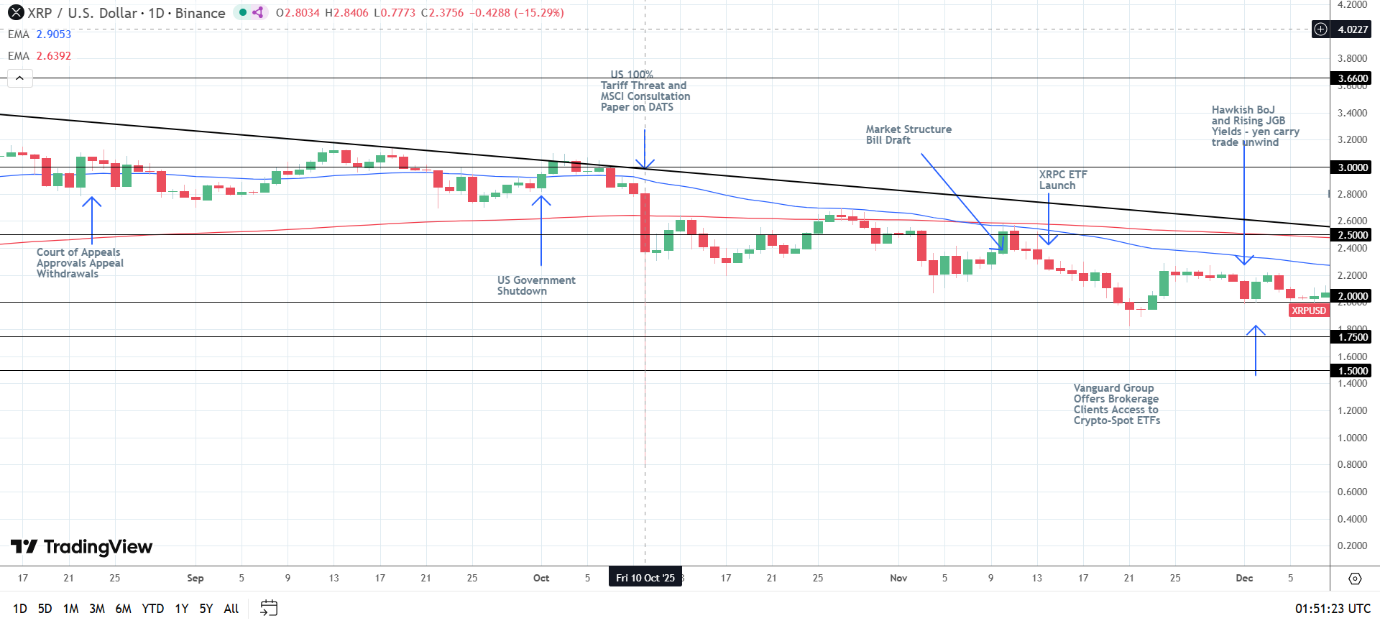
XRP and the broader crypto market remain highly sensitive to global trade developments. XRP experienced a flash crash in October, plunging from $2.8406 to $0.7773 before recovering to close the session down 15.29% at $2.3756. President Trump’s threat of a 100% tariff on China triggered the sell-off.
On Wednesday, January 21, President Trump will deliver a speech at the World Economic Forum in Davos.
XRP would face increased selling pressure if Trump intensifies his tariff threats. Conversely, XRP could recover its losses if the US President dials back his tariff rhetoric. The Kobeissi Letter shared White House Q&A with President Trump. When asked how far he would be willing to go to acquire Greenland, he stated:
“You’ll find out.”
XRP Price Forecast: Short-, Medium-, and Long-Term Targets
Despite the market risk aversion, the short-term (1-4 weeks) outlook remains cautiously bullish, with a target price of $2.5. Increased XRP utility and robust demand for XRP-spot ETFs remain key drivers.
Additionally, US lawmakers’ optimism that they will pass crypto-friendly legislation reaffirmed the bullish longer-term price targets:
- Medium-term (4-8 weeks): $3.0.
- Longer-term (8-12 weeks): $3.66.
Key Downside Risks to the Bullish XRP Outlook
Several events could challenge the positive outlook. These include:
- US President Trump increases tariff threats to acquire Greenland.
- The Bank of Japan announces a hawkish neutral interest rate (potentially 1.5%-2.5%), signaling multiple rate hikes. A higher neutral rate could trigger a yen carry trade unwind, similar to events in mid-2024. A yen carry trade unwind would invalidate the short-term outlook.
- US economic indicators and the Fed are dampening bets on an H1 2026 rate cut.
- US lawmakers roadblock the Market Structure Bill, delaying crypto legislation.
- XRP-spot ETFs report outflows.
These events would weigh on risk assets, pushing XRP below $1.85, which would signal a bearish trend reversal.
Technical Analysis: Levels to Watch
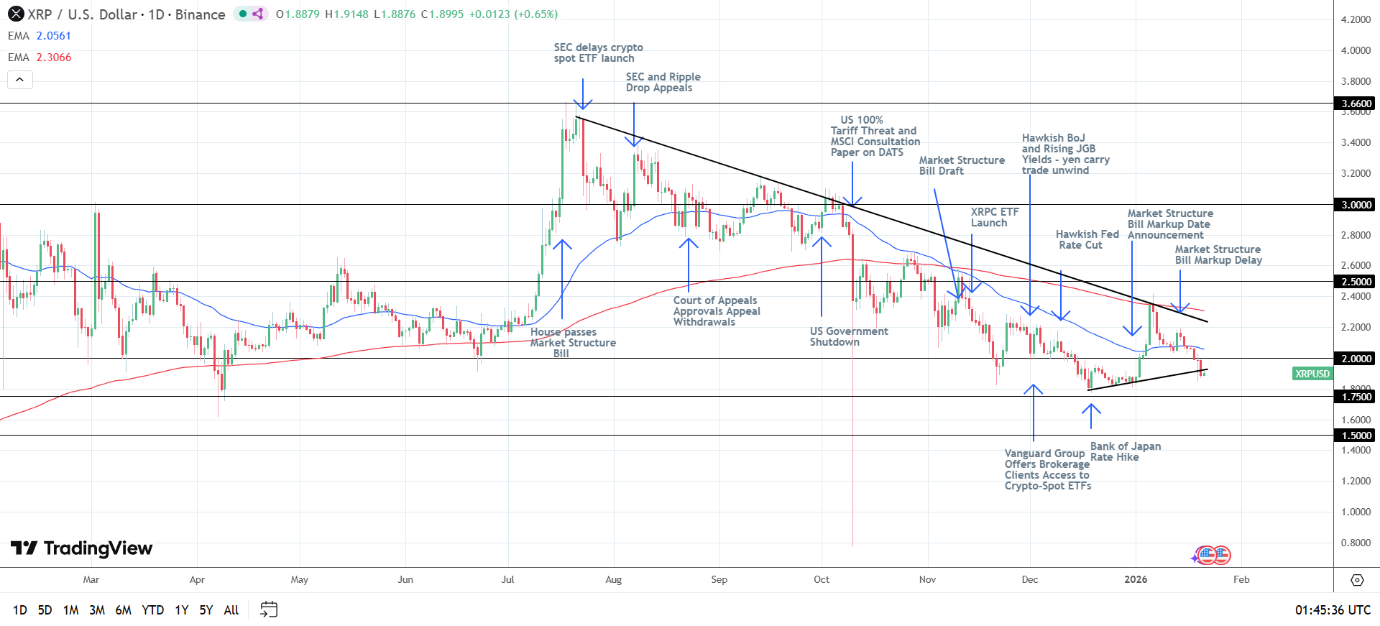
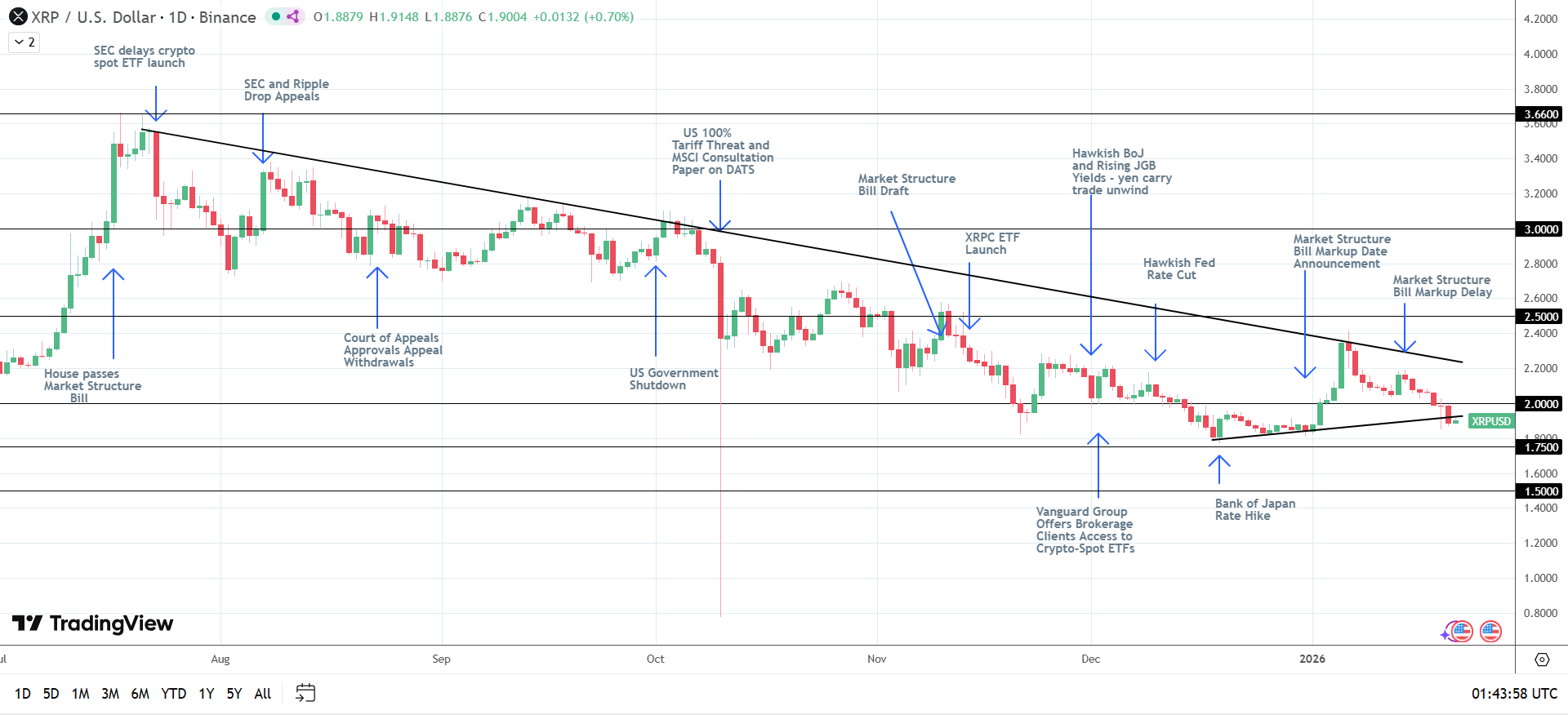
XRP slid 4.86% on Tuesday, January 20, following the previous day’s 0.39% loss, closing at $1.8872. The token tracked the broader crypto market cap, which dropped 4.67%.
A seven-day losing streak left XRP trading below its 50-day and 200-day EMAs, signaling a bearish bias. However, the bullish fundamentals continue to counter technicals, keeping the token above key support levels.
Key technical levels to watch include:
- Support levels: $1.85, $1.75, and then $1.50.
- 50-day EMA resistance: $2.0561.
- 200-day EMA resistance: $2.3066.
- Resistance levels: $2.0, $2.5, $3.0, and $3.66.
Viewing the daily chart, a break above $2.0 would enable the bulls to target the 50-day EMA. A sustained move through the 50-day EMA would indicate a near-term bullish trend reversal. Meanwhile, a bullish trend reversal would pave the way toward $2.2. A breakout above $2.2 would bring the 200-day EMA into play.
Importantly, a sustained move through the EMAs would reaffirm the bullish medium- and longer-term price targets.
Fundamental Events That Could Influence XRP Price Action Near Term
Near-term price drivers include:
- XRP-spot ETF flows.
- US economic data and the Fed’s rate path.
- US crypto-related regulatory developments.
- US-EU trade headlines.
Avoiding Sub-$1.85 Is Key for XRP’s Bullish Structure
Holding above $1.85 will be crucial for the short- to medium-term outlook. Bullish fundamentals, including increased XRP utility and demand for spot ETFs, continue to counter bearish technicals, indicating a near-term rebound. The token’s rally from a December low of $1.7712 and January gains of 3.05% reinforced the bullish structure and short- to medium-term price projections.
A move through the lower trendline and $2.0 would bring the upper trendline into play. A breakout above the upper trendline would reaffirm the bullish trend reversal and validate the bullish structure, supporting the price targets:
- Medium-term (4-8 weeks): $3.0.
- Longer-term (8–12 weeks): target of $3.66.
However, a sustained break below the lower trendline to sub-$1.85 levels would invalidate the bullish structure, indicating a bearish trend reversal.
XRP Outlook Hinges on Trump, ETFs, and Central Banks
Looking ahead, trade-related developments and crypto-related regulatory headlines are likely to influence XRP’s price outlook.
Traders should closely monitor crypto-related updates from Capitol Hill. The Agriculture Committee is set to release its draft text on the Market Structure Bill on January 23. The Agriculture Committee is then scheduled to hold a markup vote on January 27.
Meanwhile, President Trump’s speech, central bank chatter, and XRP-spot ETF flows will also affect the near-term price outlook.
Easing geopolitical tensions, rising bets on a March Fed rate cut, and a dovish BoJ neutral rate (potentially 1%-1.25%) would lift sentiment. Additionally, strong demand for XRP-spot ETFs, increased XRP utility, and the progress of the Market Structure Bill would reaffirm the constructive bias.
In summary, these events support a medium-term (4–8 weeks) move to $3.0. Importantly, the US Senate’s passing the Market Structure Bill would reinforce the longer-term (8–12 weeks) price target of $3.66.
Looking beyond the 12-week timeline, positive headlines are likely to drive XRP to its all-time high of $3.66 (Binance). A breakout above $3.66 would support a 6- to 12-month price target of $5.