2025 proved to be a choppy year for XRP, rallying to a July record high of $3.66 before reversing. However, momentum turned in the third quarter, with XRP plunging to an October low of $0.7773. While technicals deteriorated into year-end, improving fundamentals point to a constructive outlook for 2026.
Below, I will explore the key drivers behind recent 2025 trends, the medium-term (8-25 weeks) and longer-term (25-52 weeks) outlooks, and the key technical levels traders should watch.

2025 in Review: From Record Highs to Reversal
XRP had a hot and cold 2025, rallying to an all-time high of $3.66 in July, before a flash crash sent the token tumbling to an 11-month low of $0.7773 in October.
Several key events unfolded, sending XRP to its July high, including:
- US President Trump’s election victory and pro-crypto stance.
- SEC Chair Gary Gensler stepped down.
- Hopes of the US Administration to include XRP as a Strategic Reserve Asset.
- A resolution of the SEC vs. Ripple case.
- US House of Representatives passed the Market Structure Bill to the US Senate.
- Anticipation of XRP-spot ETF launches.
These events sent XRP from its January 1 level of $2.0809 to a record high of $3.66 on July 18, a 76% gain.
However, events through the remainder of 2025 triggered a reversal. These events included:
- The SEC delayed XRP-spot ETF launches.
- An escalation in the US-China trade war.
- The US government shutdown delayed the progress of the Market Structure Bill.
- The MSCI consultation paper on digital asset treasury (DAT) company listings.
- A hawkish Fed policy outlook.
- Fears of a yen carry trade unwind.
These events left XRP down 7.71% year-to-date in December, signaling a bearish trend reversal. Crucially, the pullback left XRP below the $2.0 psychological level as the year-end approached.
Ripple Price Forecast
Every new Ripple analysis as it publishes, today's technical signal and key levels, live price — on one page.
See all Ripple forecasts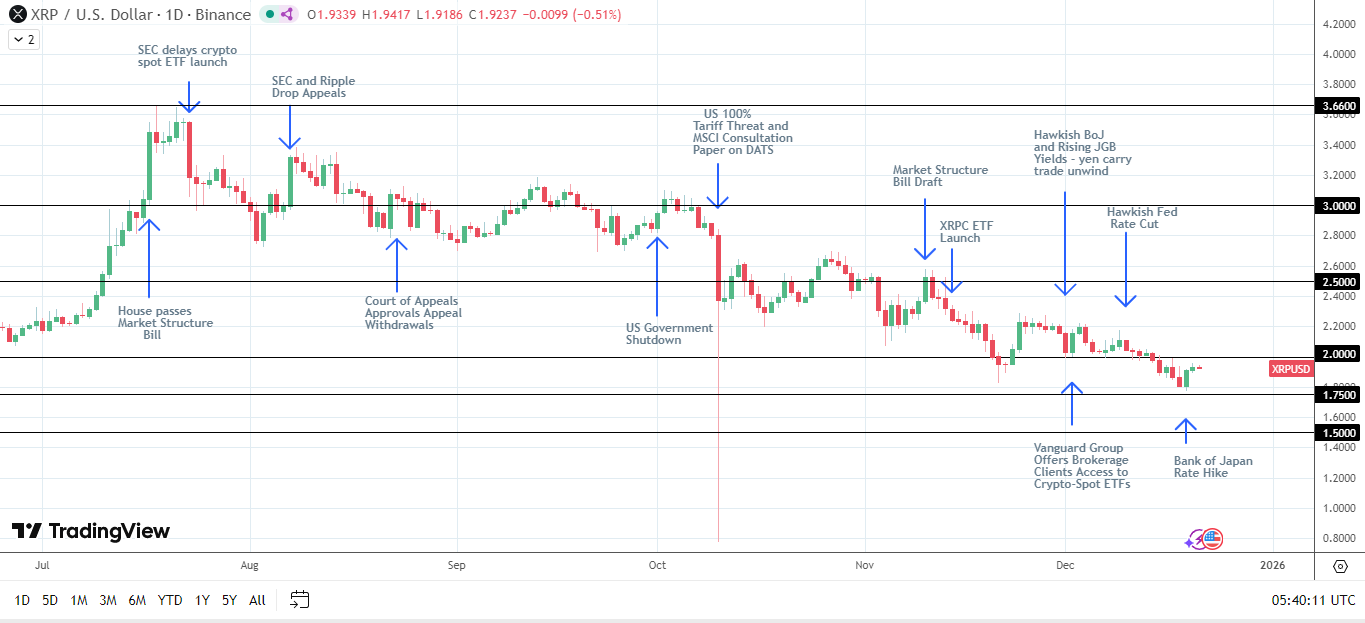
Improving Fundamentals Set the Stage for 2026
Despite the bearish trend reversal and technical indicators signaling a bearish bias, fundamentals have improved, outweighing the technicals. Previous headwinds have turned to tailwinds, setting the stage for a bullish 2026.
Key scenarios supporting a bullish short- (1-8 weeks), medium- (8-25 weeks), and longer-term (25-52 weeks) outlook include:
- Crypto-friendly legislation passes the Senate, including the Market Structure Bill.
- Ripple’s US-chartered banking license.
- Increased XRP utility on Main Street, legitimizing the token’s real-world value.
- Robust institutional demand for XRP-spot ETFs.
- New XRP-spot ETF launches.
- Vanguard Group’s U-turn on crypto-spot ETFs.
- Removal of restrictions on uninsured US banks, allowing crypto engagement.
- Select blue-chip companies show greater interest in XRP as a treasury reserve asset.
- New Fed Chair signaling a more dovish policy stance.
- A cautious Bank of Japan monetary policy outlook, easing fears of a yen carry trade unwind.
Several events are likely to have a far greater influence on XRP’s 2026 price trajectory, including legislative developments.
Market Structure Bill: A Critical Catalyst
The US government shutdown ended hopes for crypto-friendly legislation reaching President Trump’s desk in 2025. However, the progress of the Market Structure Bill in the Senate suggests that crypto legislation would be in effect before the end of Q1 2026.
XRP remains sensitive to legislative developments, given Ripple’s lengthy legal battle with the SEC. Its resolution and XRP’s classification as a non-security have led to increased XRP utility. The passing of the Market Structure Bill is likely to legitimize XRP, opening the door to a wider investor base and boosting institutional demand.
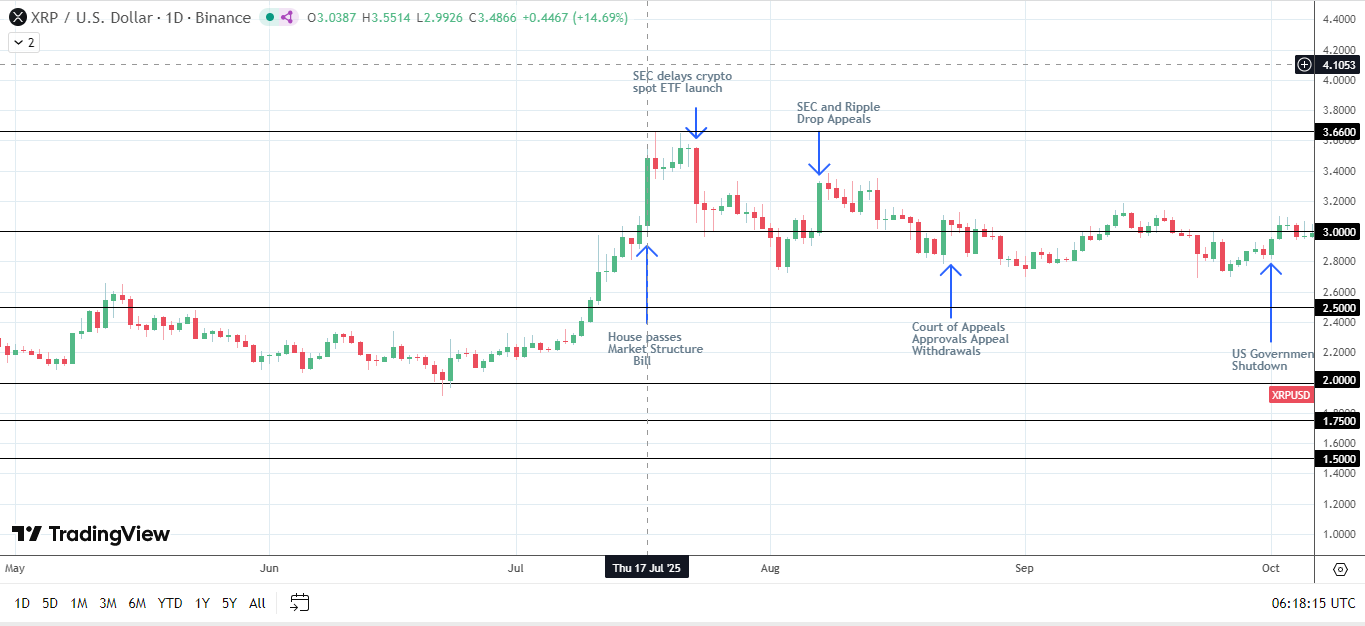
For context, XRP soared 14.69% on July 17 as the US House of Representatives passed the Market Structure Bill to the Senate. Meanwhile, XRP has fallen 33% since the government shutdown and delays to the Bill’s passage to a Senate floor vote. These price trends underscore the potential upside, supporting the bullish price outlook for 2026.
White House Crypto and AI Czar David Sachs provided an update from the Senate before the holidays, stating:
“We had a great call today with Chairmen Senator Tim Scott and John Boozman, who confirmed that a markup for Clarity is coming in January. Thanks to their leadership, as well as Republican French Hill and Congressman Glenn ‘GT’ Thompson in the House, we are closer than ever to passing the landmark crypto market structure legislation that President Trump has called for. We look forward to finishing the job in January!”
XRP-Spot ETF Launches Poised to Accelerate Demand
The anticipation of a crypto-friendly regulatory backdrop is likely to boost institutional and retail demand for XRP. Analysts expect the US crypto-spot ETF floodgates to open in 2026, tilting the supply-demand balance firmly in XRP’s favor.
This month, Bitwise Invest predicted more than 100 crypto-linked ETFs will launch in the coming year. Currently, 125 crypto-related ETFs are sitting with the SEC. XRP is likely to be a beneficiary of crypto-spot ETF launches, with WisdomTree’s XRP ETF the next in line to launch in the new year.
The SEC greenlit the Generic Listing Standards (GLS) in October, allowing issuers to launch after a 2-day waiting period. Importantly, the GLS removes the need for spot ETFs to pass the SEC’s typically 240-day review process. The revised process, allowing Commodity-Based Trust Shares to list and trade under a standardized framework, is likely to bring more ETF issuers to the XRP-spot ETF market.
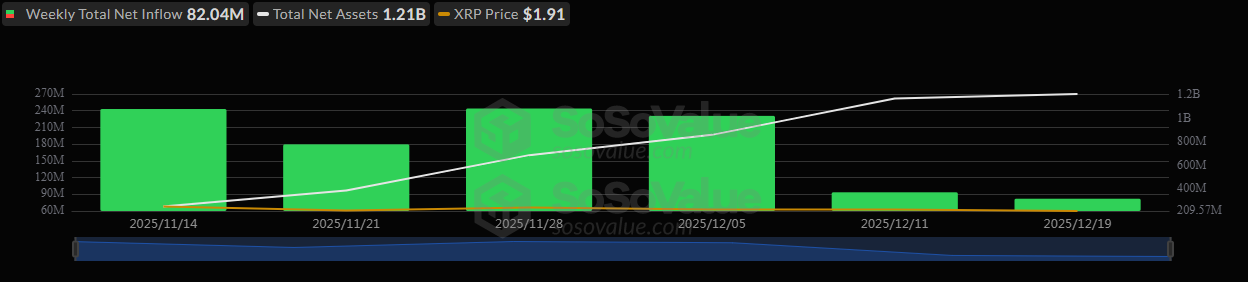
The Canary XRP ETF (XRPC) was the first pure-spot ETF to launch in the US. Benefiting from a first-to-market advantage, XRPC has total net inflows of $335.87 million. However, three other ETFs are catching up, with the Grayscale XRP ETF (GXRP) reporting total net inflows of $235.03 million.
Crucially, the US XRP-spot ETF market has reported total net inflows of $1.07 billion from just five issuers in the first month of trading. These flow trends suggest robust demand. Strong inflows through H1 2026 would reinforce the bullish price outlook.
Ripple’s US Banking and XRP Utility
Clear rules of the road and institutional demand are likely to be crucial to XRP’s 2026 price outlook. However, increased XRP utility would boost institutional demand as XRP-spot ETFs hit the market.
The US Office of the Comptroller of the Currency (OCC) announced the conditional approval of Ripple’s US-chartered banking license applications in December. Analysts expect the approval to boost XRP utility, given that institutions using XRPL may convert to XRP for cross-border payments, FX bridging, and liquidity operations.
Bullish Medium- and Long-Term Outlook Remains Constructive
The convergence of institutional demand for spot ETFs, the Market Structure Bill’s progress on Capitol Hill, and increased utility underpins a bullish outlook.
- Short-term (1-8 weeks): Bullish bias, target $2.5.
- Medium-term (8-25 weeks): Constructive, target $3.66.
- Longer-term (25-52 weeks): Bullish, target $5.0.
A more dovish Fed rate path and a cautious Bank of Japan policy stance would further support sentiment.
Downside Risks to the 2026 Outlook
Several scenarios could derail the bullish outlook for the year ahead. These include:
- The Market Structure Bill stalls in the Senate.
- BoJ turns hawkish, announcing a neutral interest rate of between 1.5% and 2.0%.
- Fed pivots to a hawkish policy stance on sticky inflation and a resilient labor market.
- XRP-spot ETFs see net outflows on central bank pivots from doves to hawks.
- MSCI delists DATs. Delistings would likely reduce interest in XRP as a treasury reserve asset.
- An escalation in the US-China trade war.
- Geopolitical tensions intensify, triggering risk aversion.
These events would likely push XRP toward $1.5, invalidating the bullish outlook.
In summary, the short-term outlook has turned cautiously bullish as fundamentals begin overriding the bearish technicals. Meanwhile, the medium- to longer-term outlooks are constructive.
Financial Analysis
Technical Outlook: EMAs Signal Caution
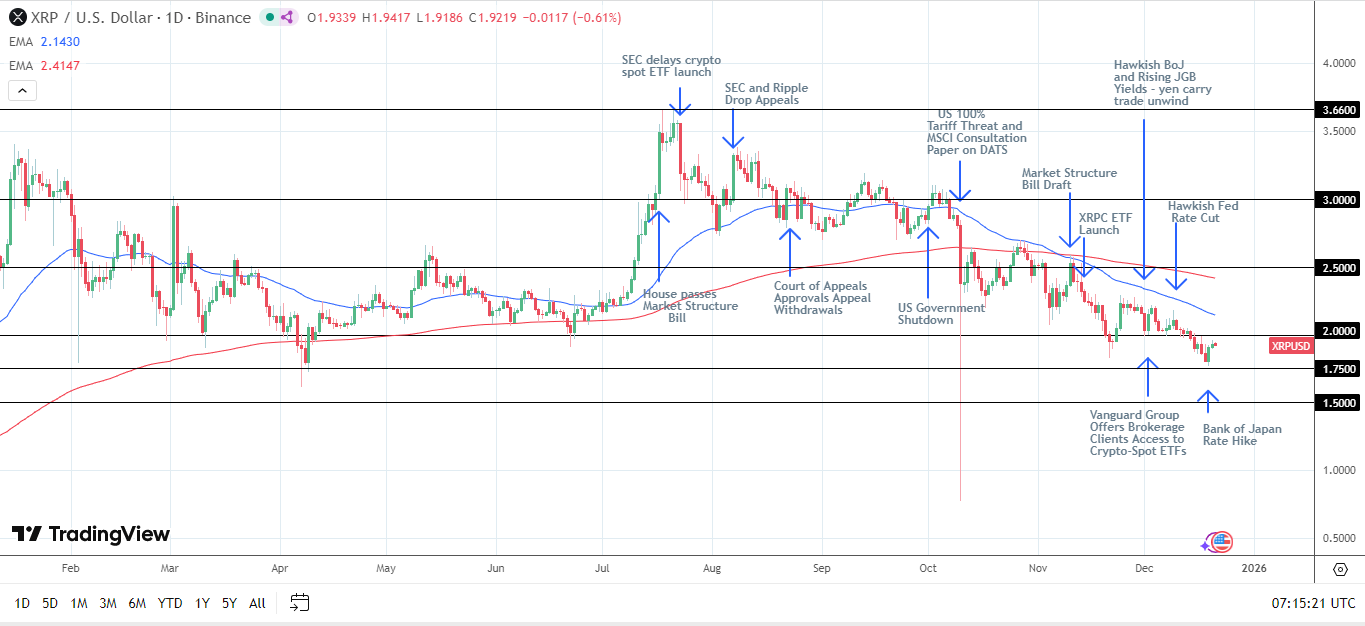
XRP has fallen 10.89% in December, following the previous month’s 14.09% loss, leaving the token down 7.71% year-to-date (YTD). The token has tracked the broader market, which dropped 7.28% (YTD).
A three-month losing streak has left XRP trading well below the 50-day and 200-day Exponential Moving Averages (EMAs). The EMAs signal a bearish bias. While technicals remain bearish, fundamentals are increasingly outweighing the technical structure.
Key technical levels to watch include:
- Support levels: $1.75, and then $1.50.
- 50-day EMA resistance: $2.1430.
- 200-day EMA resistance: $2.4147.
- Resistance levels: $2.5, $3.0, and $3.66.
Looking at the daily chart, a breakout above the $2 psychological level would bring the 50-day EMA into play. A sustained move through the 50-day EMA would open the door to retesting the 200-day EMA and the $2.5 resistance level.
A breakout above the EMAs would indicate a bullish trend reversal, supporting the medium-term outlook and the longer-term $5 price target.
Fundamental Drivers to Watch
Key variables influencing XRP’s price outlook include:
- Crypto-related regulatory developments.
- XRP-spot ETF flows.
- XRP utility.
- US economic indicators and the Fed rate path.
- The BoJ’s neutral interest rate.
Conclusion: $2.0 as the Inflection Point
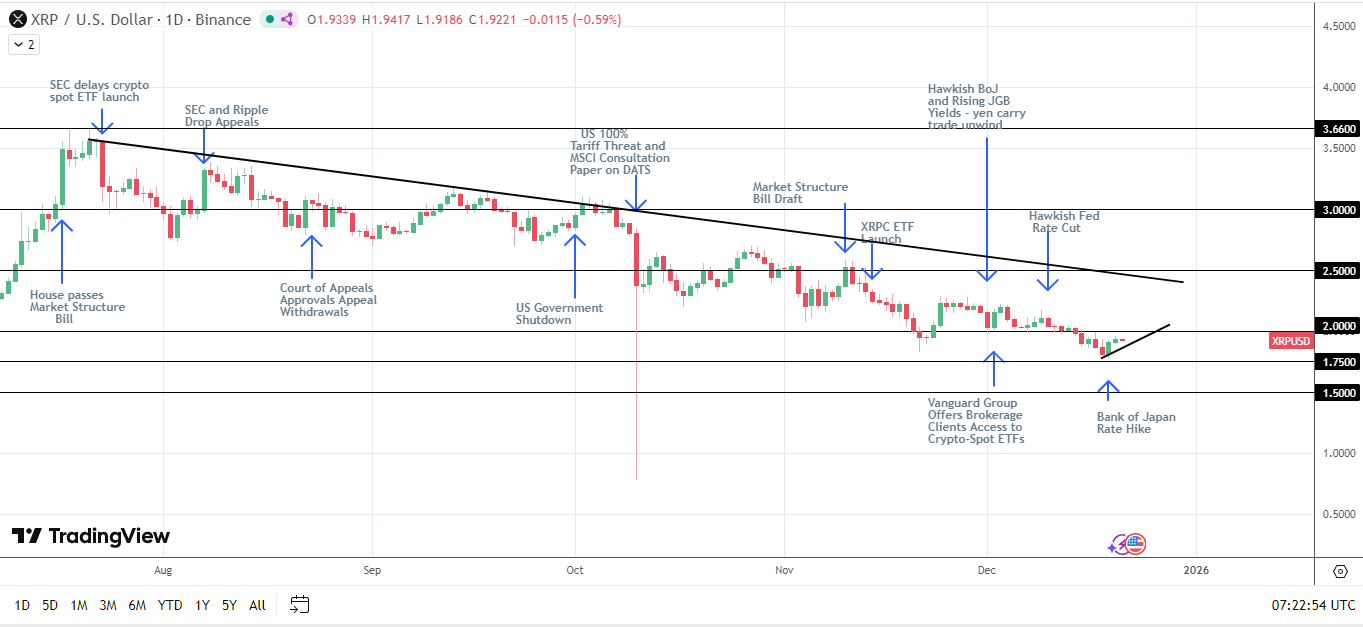
Despite the fourth quarter’s losses, a bullish structure is forming, aligning with the 2026 price outlook. A breakout above $2.0 would pave the way to the upper trendline. A sustained move through the upper trendline would signal a bullish trend reversal, reinforcing the 2026 price targets.
- Medium-Term (8-25 weeks); $3.66.
- Longer-term (25–52 weeks) target of $5.0.
However, rejection at the $2.0 psychological level and a sustained drop below the lower trendline to $1.75 would invalidate the bullish outlook and affirm the fourth quarter’s bearish trend reversal.
Outlook: $2.0 Remains the Key Level
Looking to 2026, US XRP-spot ETF market flows, and updates from Capitol Hill will dictate price trends. Crucially, the Market Structure Bill could fuel retail and institutional demand, tilting the supply-demand balance firmly in XRP’s favor. Increased XRP utility would add to the positive narrative.
In summary, strong institutional demand for XRP-spot ETFs, a Q1 Fed rate cut, and the Senate passing the Market Structure Bill support the medium-term (8–25 weeks) move to $3.66. Increased XRP utility, multiple XRP-spot ETF launches, and strong inflows would support the longer-term (25–52 weeks) price target of $5.0.