



Bitcoin (BTC) fell toward $73,000 this week as a weak technical rebound and renewed Strategy selling fears pressured market sentiment.
Bitcoin Bear Flag Puts $50,000 Back in Play
Bitcoin’s weekly chart shows a bearish continuation setup, with BTC trading near $73,000 after rebounding inside a rising channel from its $60,000–$65,000 lows.
The structure resembles a bear flag, a pattern that often forms before sellers regain control. BTC remains below its 20-week exponential moving average (20-week EMA; green) near $77,700 and 50-week EMA (red) near $84,700, keeping the broader trend under pressure.
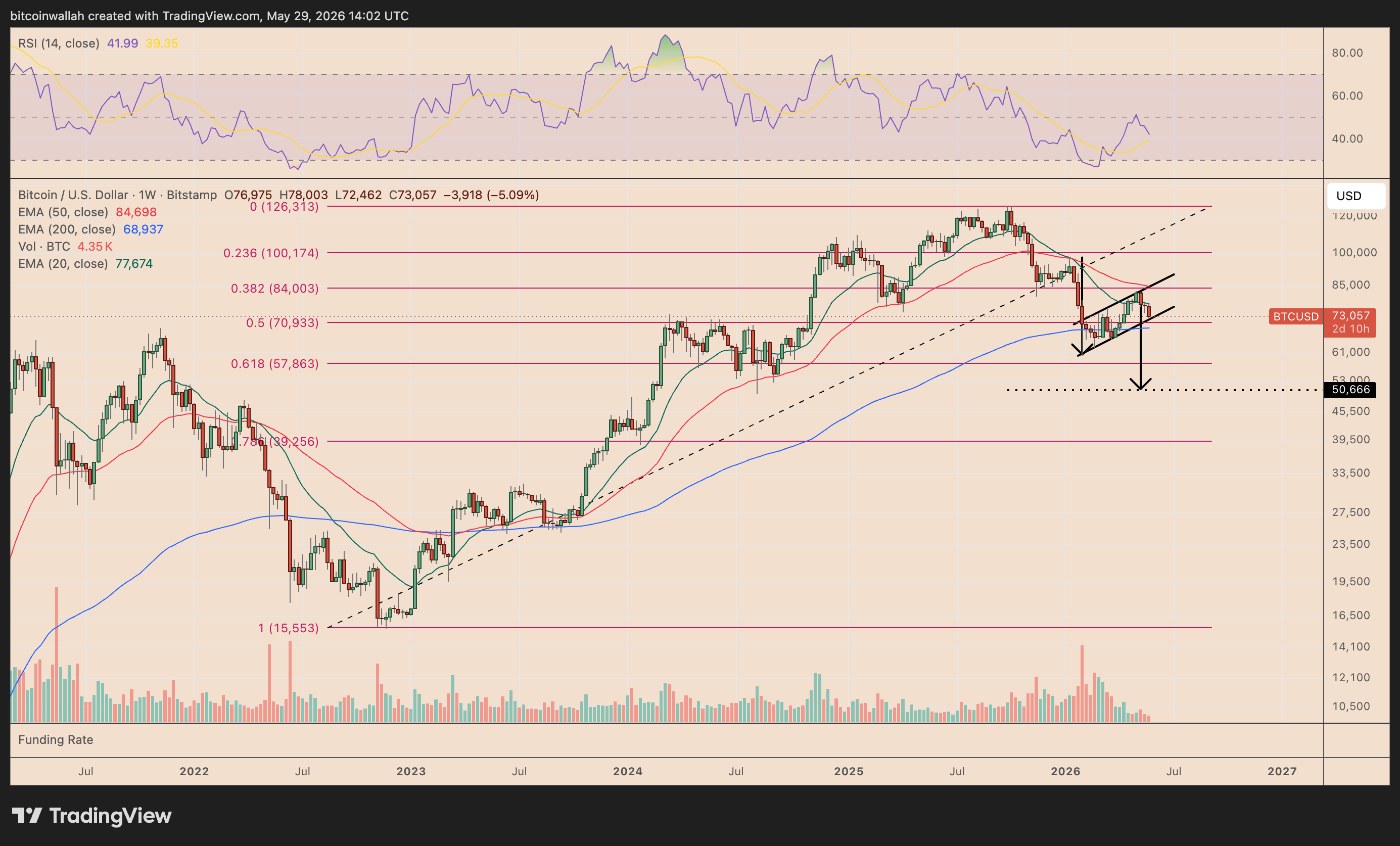
A confirmed breakdown below the flag’s lower trendline and the 200-week EMA near $68,900 could expose the 0.618 Fibonacci level near $57,900, followed by the bear-flag target near $50,600.
The weekly relative strength index (RSI) near 42 also suggests momentum remains weak. BTC must reclaim the $77,000–$85,000 resistance zone to invalidate the bearish setup.
Bitcoin Price Forecast
Every new Bitcoin analysis as it publishes, today's technical signal and key levels, live price — on one page.
See all Bitcoin forecastsStrategy Transfer Adds to Bitcoin Selling Fears
The technical breakdown risk is arriving as traders grow nervous about Michael Saylor’s Strategy, Bitcoin’s largest corporate holder.
On Friday, the wallet associated with Strategy deposited 411.48 BTC, worth roughly $30.3 million, into Coinbase Prime, sparking speculation that the company may be preparing to sell some Bitcoin.
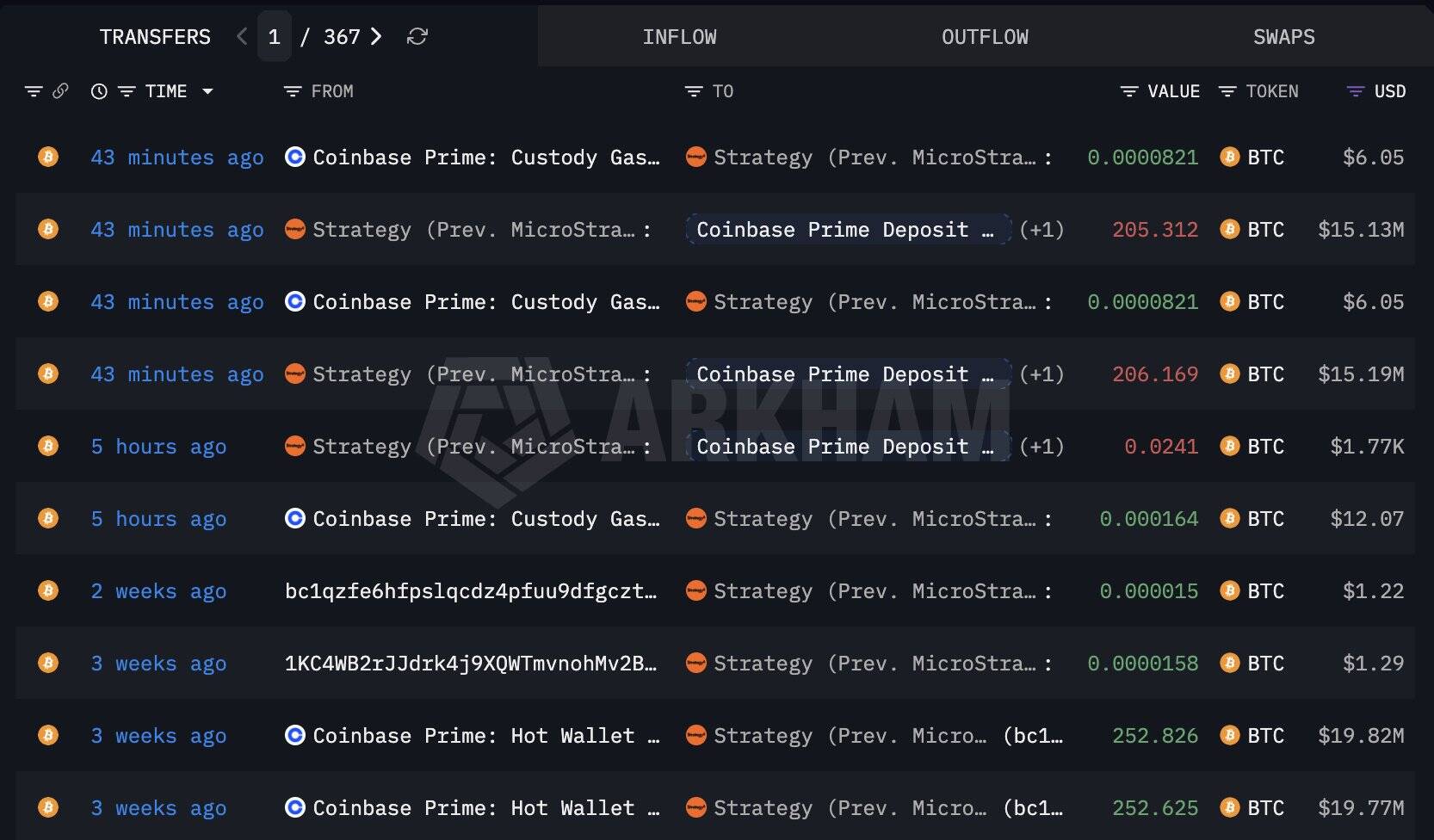
The transfer matters because Strategy is no longer viewed purely as a one-way Bitcoin accumulator.
During Strategy’s Q1 2026 earnings call on May 5, CEO Phong Le said the company is no longer just buying Bitcoin and holding it forever. Instead, Strategy wants to manage its Bitcoin pile more actively to increase how much BTC each shareholder effectively owns.
Strategy has said selling BTC could make sense when it is more attractive than issuing new equity, including to fund preferred dividends, repurchase convertible debt, build US dollar reserves, or harvest tax losses.
Still, Strategy has bought nearly 222 times Bitcoin’s new supply in 2026, recently lifting its holdings above 840,000 BTC.
Bitcoin ETF Outflows Signal Recovery Ahead
The bearish pressure is also visible in US spot Bitcoin ETFs.
Since May 7, the funds have recorded more than $4.01 billion in cumulative net outflows, signaling weaker institutional demand as Bitcoin struggles to hold its recovery.
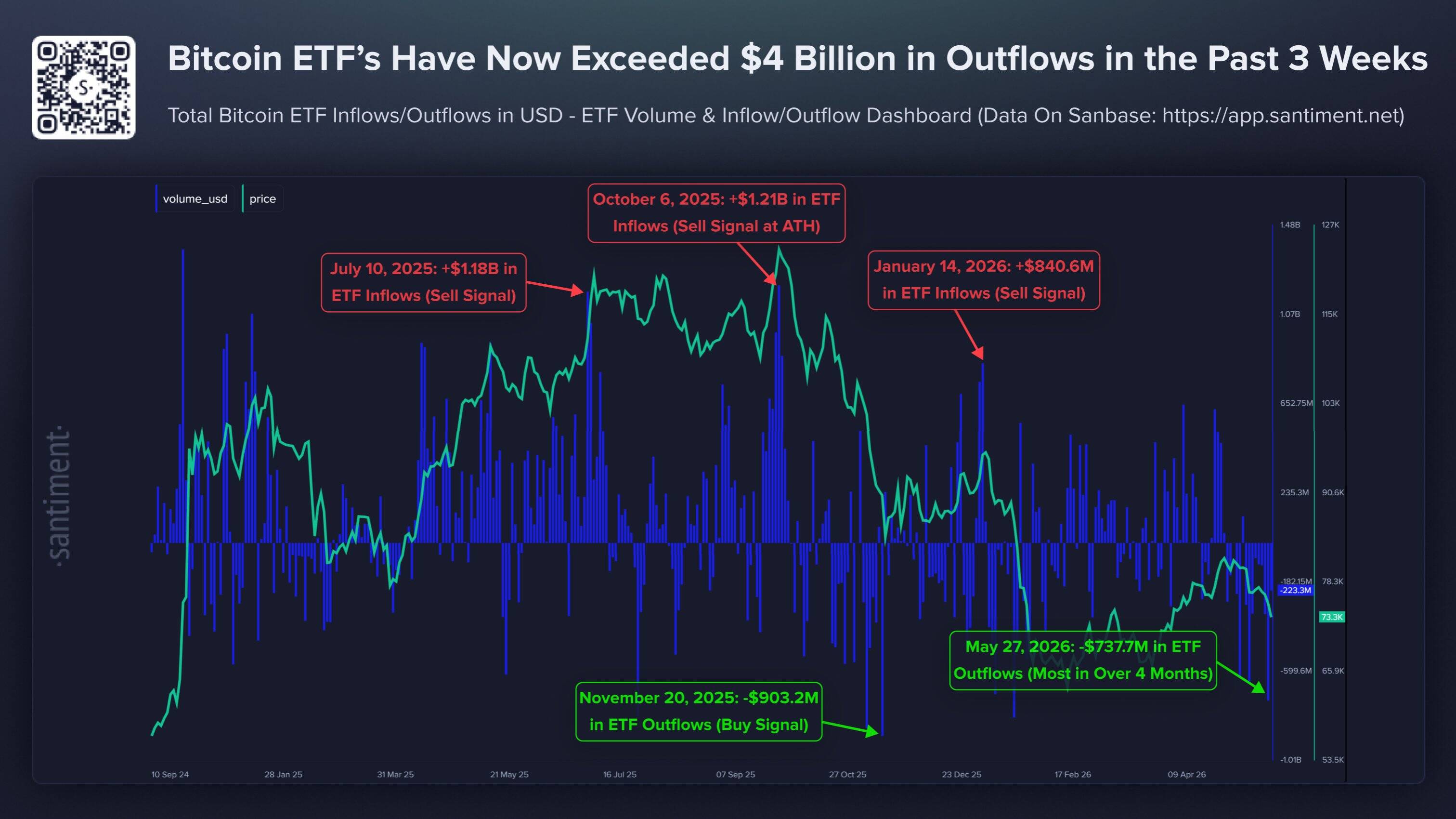
The withdrawals suggest mainstream investors have turned more cautious during the latest market drawdown, reducing one of BTC’s key support pillars from earlier in the cycle.
But heavy ETF outflows are not always purely bearish, argues Santiment analysts.
“When large amounts of money leave Bitcoin ETFs over a short period, it often reflects peak fear, frustration, or risk aversion among retail and institutional investors alike, they wrote in a Friday post, adding:
“Previous examples, such as the nearly $904 million outflow day in November 2025, occurred close to major market lows before prices recovered.”
For now, ETF flows remain one of the clearest real-time gauges of institutional demand. A return to net inflows would strengthen the recovery case, while continued withdrawals could keep BTC vulnerable to a deeper move toward the $57,900–$50,600 downside zone.