
China Mainland equity markets are eyeing fresh 2026 highs as tariff developments and robust external demand signal a strong first quarter for the Chinese economy.
This week, the People’s Bank of China (PBoC) kept loan prime rates unchanged, underscoring confidence in the Chinese economy. Strong external demand and lower US tariffs on Chinese goods support a positive economic outlook, fueling demand for Mainland-listed stocks.
Despite China’s housing crisis, optimism about further policy support from Beijing and external demand reinforces the bullish medium-term outlook for Mainland and Hong Kong-listed stocks.
Below, I will explore the key drivers behind recent gains, the medium-term (3-6 months) market outlook, and the key technical levels traders should watch.

People’s Bank of China Stands Pat on Monetary Policy
This week, the PBoC left one-year and five-year loan prime rates at 3% and 3.5%, respectively. Typically, decisions to stand pat on monetary policy weigh on investor sentiment. However, February’s monetary policy stance underscored policymakers’ confidence in the Chinese economy, bolstering demand for Mainland-listed stocks.
Dr. Christopher Barraud, Head of Discretionary Management and Research at LIOR GP, commented on the PBoC’s policy stance, stating:
“Chinese banks held the Loan Prime Rates (LPR) for a ninth consecutive month on Tuesday, indicating that strong exports and narrow net interest margin render little urgency for lowering borrowing costs, the China Securities Journal reported citing experts.”
Chinese exports unexpectedly rose 6.6% year-on-year in December, up from 5.9% in November. Economists had forecasted a 3% increase.
Nevertheless, economists expect the PBoC to ease monetary policy this year. Lower five-year loan prime rates would provide much-needed support to the Chinese housing market, which remains in a slump.
Barraud quoted Golden Credit Rating chief macro economist Wang Qing, who reportedly stated:
“Regulators may also guide a relatively sharp decline in the 5-year-plus LPR separately, and combine it with fiscal subsidies on the interest rate, to push household mortgage rates lower.”
The prospect of fiscal and monetary policy stimulus remains key to the bullish short- to medium-term outlook for Mainland Indexes. Bolstering the housing market could boost consumer sentiment, which is currently near record lows. A pickup in sentiment would drive domestic consumption, soften margin pressures on Chinese firms, and ease reliance on external demand for economic momentum.
Hong Kong Hang Seng Price Forecast
Every new Hong Kong Hang Seng analysis as it publishes, today's technical signal and key levels, live price — on one page.
See all Hong Kong Hang Seng forecastsUS Tariffs and the Looming President Trump-President Xi Summit
Last week’s US Supreme Court ruling that declared President Trump’s tariffs under the International Emergency Powers Act (IEEPA) illegal put US-China relations in the spotlight. US President Trump reacted to the Supreme Court decision, initially imposing a sweeping 10% tariff on imports before raising it to 15%.
However, Beijing warned against imposing further tariffs under 301. CN Wire reported:
“China Commerce Ministry, on US Greer remarks: China has fulfilled its obligations of China-US phase one agreement. China warns of all necessary measures if US advances 301 probe, imposes tariffs over phase one deal.”
Notably, President Trump was silent on China during his State of the Union speech, suggesting no plans to restart a trade war with China. China Beige Book remarked:
“Trump’s State of the Union speech was the 1st time in 2 decades a US president didn’t directly mention China in the annual speech to Congress, despite Tuesday’s address being the longest in modern history.”
While China has found alternative trade partners and routes to bypass US tariffs, an escalation in trade tensions would weigh on Mainland-listed stocks. Trump’s silence on China and Beijing’s adherence to the phase one agreement set the stage for a constructive Trump-Xi summit in April. Markets are pricing in an extension of the trade war truce.
However, one bone of contention could be China’s purchasing of Russian oil. According to The Kobeissi Letter, China has boosted Russian oil imports following the Trump-Modi trade deal, which pressured India to cut oil shipments from Russia. Meanwhile, the US has been trying to influence Beijing to cut oil shipments from Iran, another potential stumbling block for a trade war truce extension.
Key Downside Risks to the Bullish Outlook
Despite the positive sentiment, downside risks could derail the positive outlook. These include:
- US-China trade tensions reignite.
- Global trade partners roll out tariffs on Chinese goods, and/or external demand weakens.
- Beijing delays fiscal and monetary policy measures.
- Domestic demand weakens further.
- Chinese housing market headwinds linger.
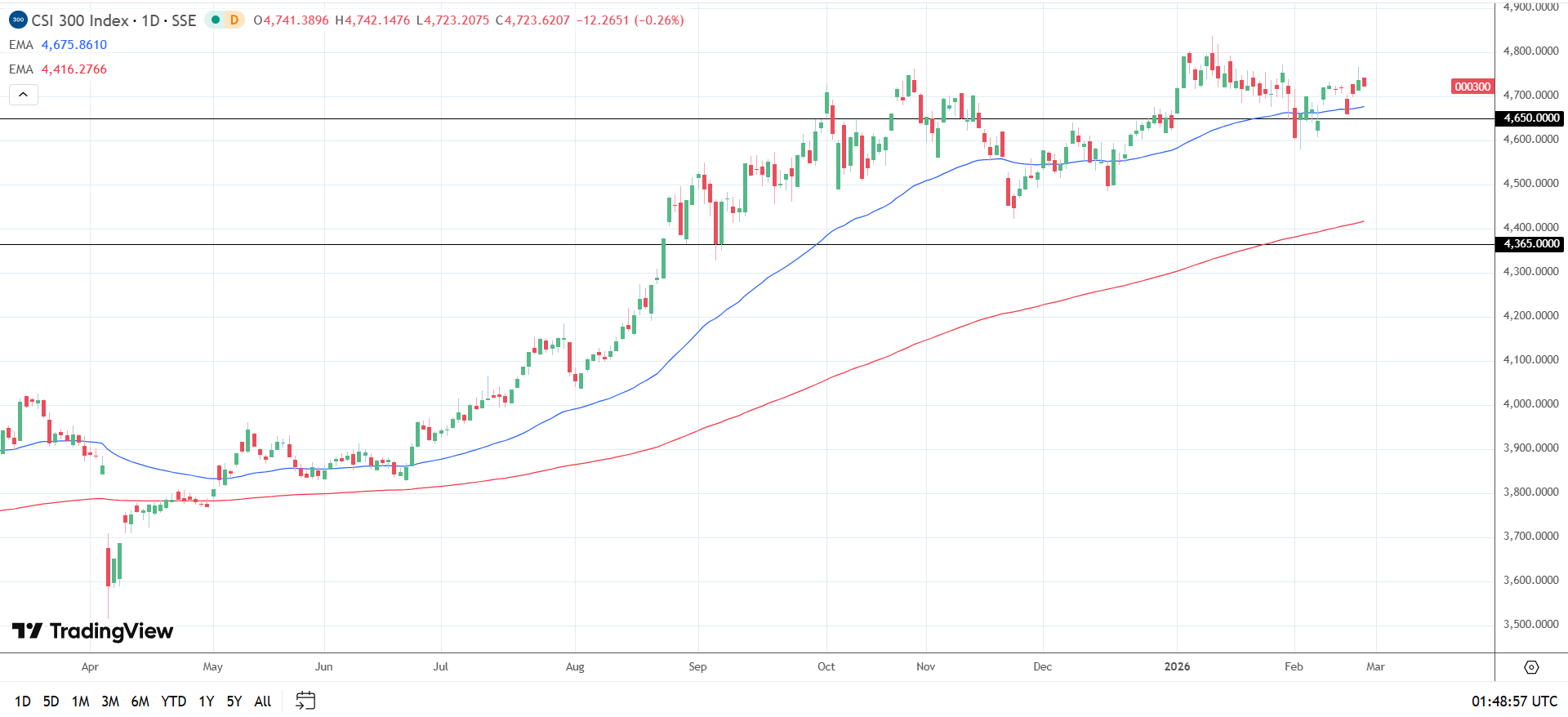
These scenarios would send the CSI 300 and the SSE Composite Index below their 50-day EMAs, indicating bearish near-term trend reversals.
However, China’s AI push, improving chip production capabilities, and strong external demand reaffirm a bullish short- to medium-term bias for Mainland China indexes and the Hang Seng Index.
CSI 300 – Technical Outlook: Resistance Levels in Focus
Chart technicals and fundamentals are aligned on Thursday, February 26. Looking at the daily chart, the CSI 300 trades above its 50-day and 200-day EMAs. The EMA positions signal a bullish bias. Notably, the CSI 300 has gained 2.29% year-to-date, outperforming the Nasdaq Composite Index, which has fallen 0.39%.
A CSI 300 Index breakout above this week’s high of 4,767 would bring the January high of 4,837 into play. A sustained move through 4,837 would open the door to testing 5,000. Reclaiming 5,000 could pave the way toward the February 2021 all-time high of 5,931. Trading above the EMAs affirms the bullish trend.
Hang Seng Index: Bullish Outlook Intact
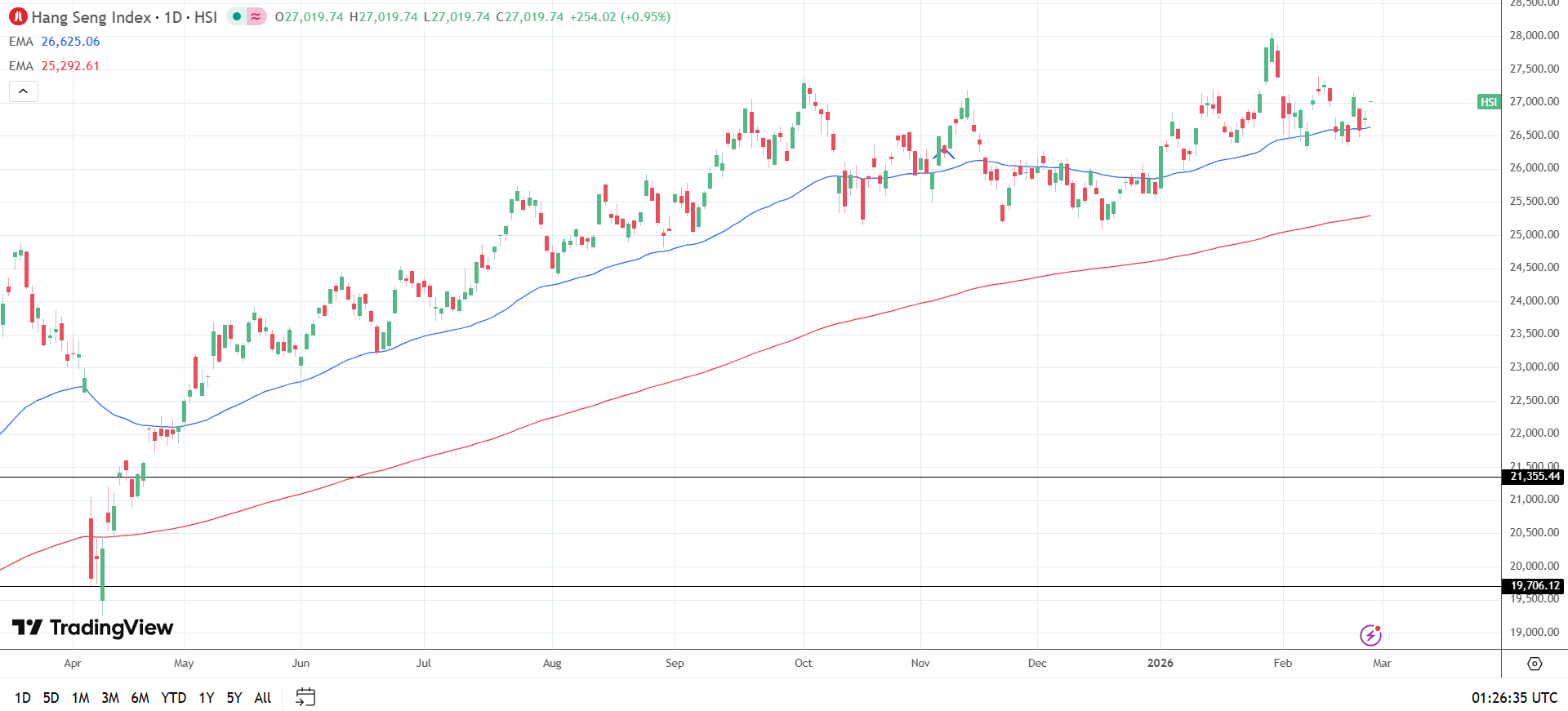
The Hang Seng Index’s outlook aligns with the CSI 300, with the Index holding above its 50-day and 200-day EMAs. The EMA positions also signal a bullish bias, supported by positive fundamentals.
A break above the February 10 high of 27,398 would enable the bulls to target the January high of 28,056. A sustained move through 28,056 would bring 30,000 into play for the first time since 2021.
Conclusion:
To summarize, the short- and medium-term outlook remains constructive. Expectations of policy support from Beijing, China’s push for AI dominance, and strong external demand are tailwinds for Mainland China and Hong Kong-listed stocks.
However, global trade developments, China’s housing sector, and consumer confidence trends remain pivotal for domestic demand. Effective policy measures improving sentiment and domestic demand would likely drive the CSI 300 Index toward 5,931. April’s President Trump-Xi Summit will likely be key for market trends in Q2.
Discover strategies to navigate this week’s market trends here.