
Mainland China indices eye decade highs amid improved sentiment toward the Chinese economy and easing US-China trade tensions.
As the dust over Venezuela settled, market focus returned to the US-China trade war truce and Chinese economic data, which continued to signal strong momentum at the turn of the year. The CSI 300 edged closer to its five-year high, while the Shanghai Composite Index climbed to its highest level since July 2015 in early trading on Tuesday, January 13.
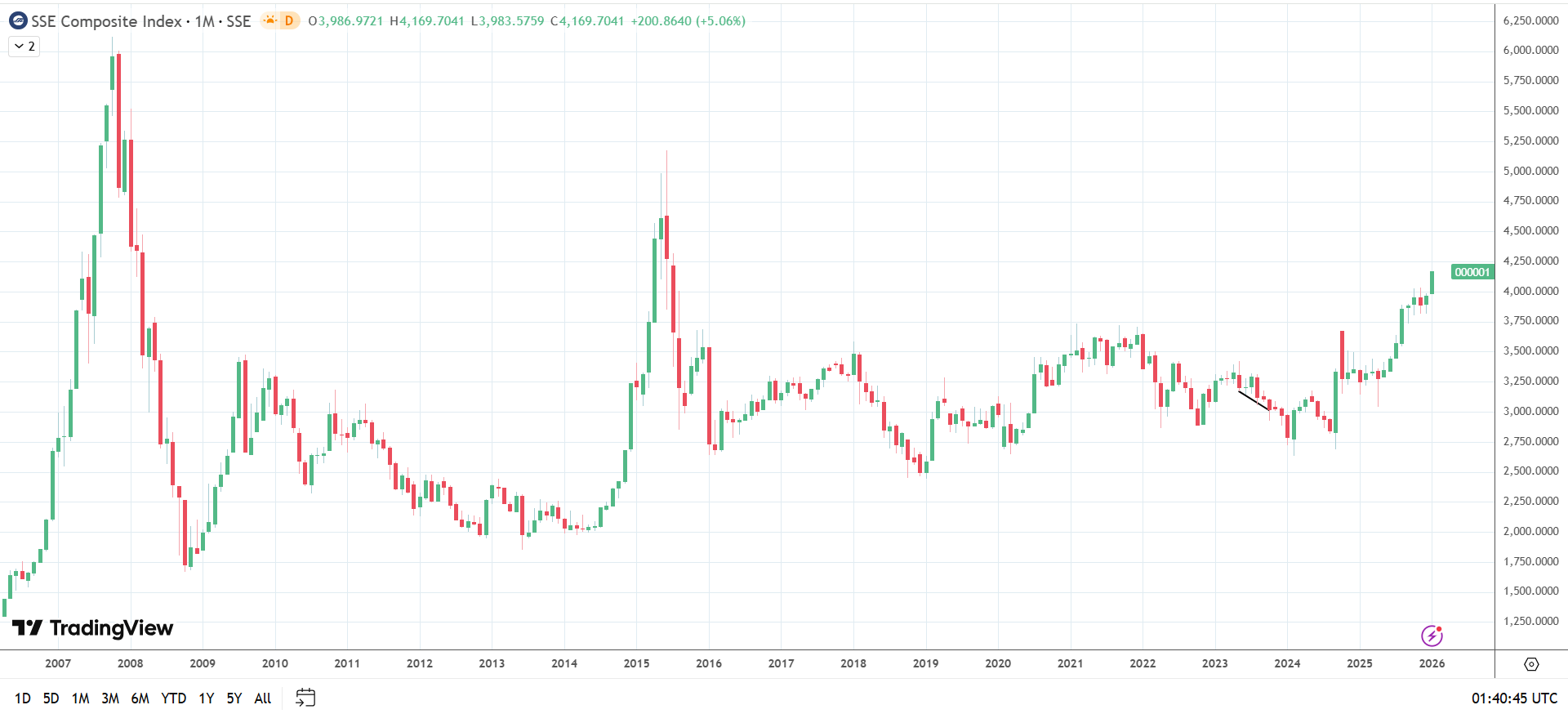
This week’s gains, combined with expectations of further stimulus from Beijing, continue to support a positive medium-term outlook for Mainland China indices.
Below, I will explore the key drivers behind recent gains, the medium-term (3-6 months) market outlook, and the key technical levels traders should watch.

Trading Volumes Hit Record Highs as Momentum Builds
This week, Mainland stock turnover hit record highs as more stable market conditions and extended gains from 2025 and early 2026 boosted investor confidence. The CSI 300 and the Shanghai Composite have risen 3.46% and 4.95%, respectively, in January after gains of 17.66% and 18.41% in 2025.
Notably, Mainland China indices have outperformed their US counterparts in January, suggesting a potential rotation from US to Mainland-listed stocks. For context, the Nasdaq Composite Index has advanced 2.12% in January after rallying 20.36% in 2025.
CN Wire reported:
“Stock turnover in Shanghai and Shenzhen hit a record 3.6 trillion yuan ($516 billion) on Monday, surpassing the prior peak set in October 2024. Trading has surged as Chinese equities advance for over three weeks, with the Shanghai Composite up 8.9% from its December low. Earlier gains were driven by inflows into A500-tracking ETFs, while low volatility and steady rises have since encouraged broader buying.”
Improved US-China trade relations, China’s AI developments, upbeat Chinese economic indicators, and the prospect of fresh policy support have boosted demand for Mainland-listed stocks. These factors support the bullish short- to medium-term outlook for Mainland China indices, aligning with Goldman Sachs’ view.
In December, Goldman Sachs signaled a positive outlook for Mainland stocks and a potential rotation from US to Chinese stocks. CN Wire reported:
Hong Kong Hang Seng Price Forecast
Every new Hong Kong Hang Seng analysis as it publishes, today's technical signal and key levels, live price — on one page.
See all Hong Kong Hang Seng forecasts“2026-2027 forecasts: Expect continued bull run, but at a slower pace. Projected gains: +38% by end of 2027, supported by 14% profit growth in 2026E and 12% in 2027E. […] AI breakthroughs have redefined the narrative for tech equities. […] Widespread AI adoption could drive ~3% annual earnings growth over the next decade via cost savings, productivity, and new revenue streams. Valuations in China’s AI tech sector have re-rated, but remain cheaper than U.S. peers.”
Chinese Economic Indicators Boost Optimism
Recent Chinese economic indicators have fueled hopes of a pickup in momentum. The RatingDog China General Composite PMI rose from 51.2 in November to 51.3 in December, amid a pickup in manufacturing sector activity.
Meanwhile, deflationary pressures subsided, with consumer prices increasing 0.2% month-on-month in December after falling 0.1% in November. Notably, producer prices fell 1.9% year-on-year in December, following a 2.2% decline in November, which suggests improving margins.
East Asia Econ recently commented on China’s economy, stating:
“One reason for thinking China’s economy might be bottoming out is the property. For sure, that remains extremely weak. But with property starts down an amazing 75% from the peak, a lot of the negative impact on the economy of the drop in construction has already been seen.”
Notably, the housing crisis has been a key contributor to weak consumer sentiment and a slump in domestic demand. China’s House Price Index fell 2.4% year-on-year in November after declining 2.2% in October. However, the rate of decline eased in late 2025 after sharper declines earlier in the year, suggesting a bottoming out.
Despite improved sentiment, incoming data and Beijing’s monetary and fiscal policy measures will be key in the shorter term.
On Wednesday, January 14, trade data will give insights into the demand environment. Economists forecast exports to rise 3% year-on-year in December, down from 5.9% in November. Stronger-than-expected external demand would likely send Mainland China indices higher.
However, next week’s GDP, retail sales, industrial production, house price data, and unemployment numbers will be crucial. Upbeat figures would reaffirm the bullish outlook over the short to medium term.
Beyond the data, traders should closely monitor signals from Beijing on monetary and fiscal policy.
Considering the current market dynamics, fundamentals and technicals remain aligned, reinforcing the positive outlook.
Key Downside Risks to the Bullish Outlook
However, downside risks remain, potentially unraveling the positive outlook. These include:
- Deteriorating US-China relations and a breach in the trade war truce. This week, US President Trump announced a 25% tariff on nations doing business with Iran.
- Increased global tariffs on Chinese goods. The EU and China are in the midst of reaching a trade deal.
- Beijing delays rate cuts and fresh fiscal stimulus.
- Softer demand for Chinese goods and services would squeeze margins, affecting wage growth, the labor market, and private consumption.
- Chinese housing market crisis intensifies.
Despite these risks, China’s competitiveness in the AI space and increased self-reliance on chip manufacturing reinforce the constructive short- to medium-term bias for Mainland China indices.
Furthermore, markets remain optimistic that Beijing can drive domestic demand through subsidies and lower borrowing rates, while bolstering the housing market.
Medium-Term Outlook: Bullish, Hinged on Beijing
Recent economic data has lifted sentiment toward China’s economy. Fresh stimulus targeting the housing sector, the labor market, and domestic consumption would bolster the economy in 2026.
Given the macroeconomic backdrop and Beijing’s pledges to deliver fresh policy support, the outlook for Mainland China’s indices remains bullish.
CSI 300 Technical Outlook: Resistance Levels in Focus
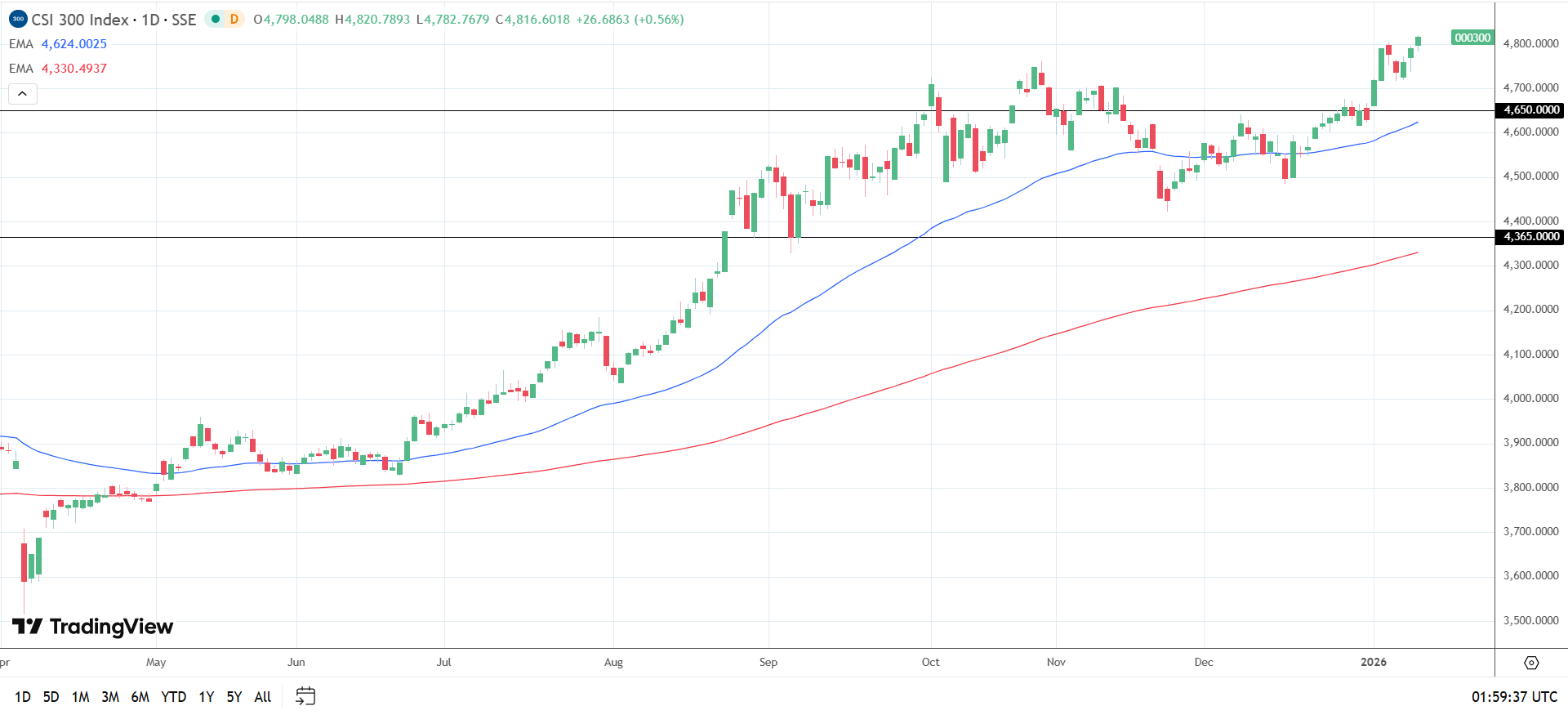
Technicals and fundamentals remain aligned in early trading on Tuesday, January 13. Viewing the daily chart, the CSI 300 trades above its 50-day and 200-day EMAs, signaling bullish momentum.
A breakout above the January 13 high of 4,821 would open the door to testing 5,000. A sustained move through 5,000 would pave the way toward 2021’s all-time high of 5,931. Holding above the 50-day EMA would be pivotal.
Hang Seng Index Forecast: Bullish Bias Intact
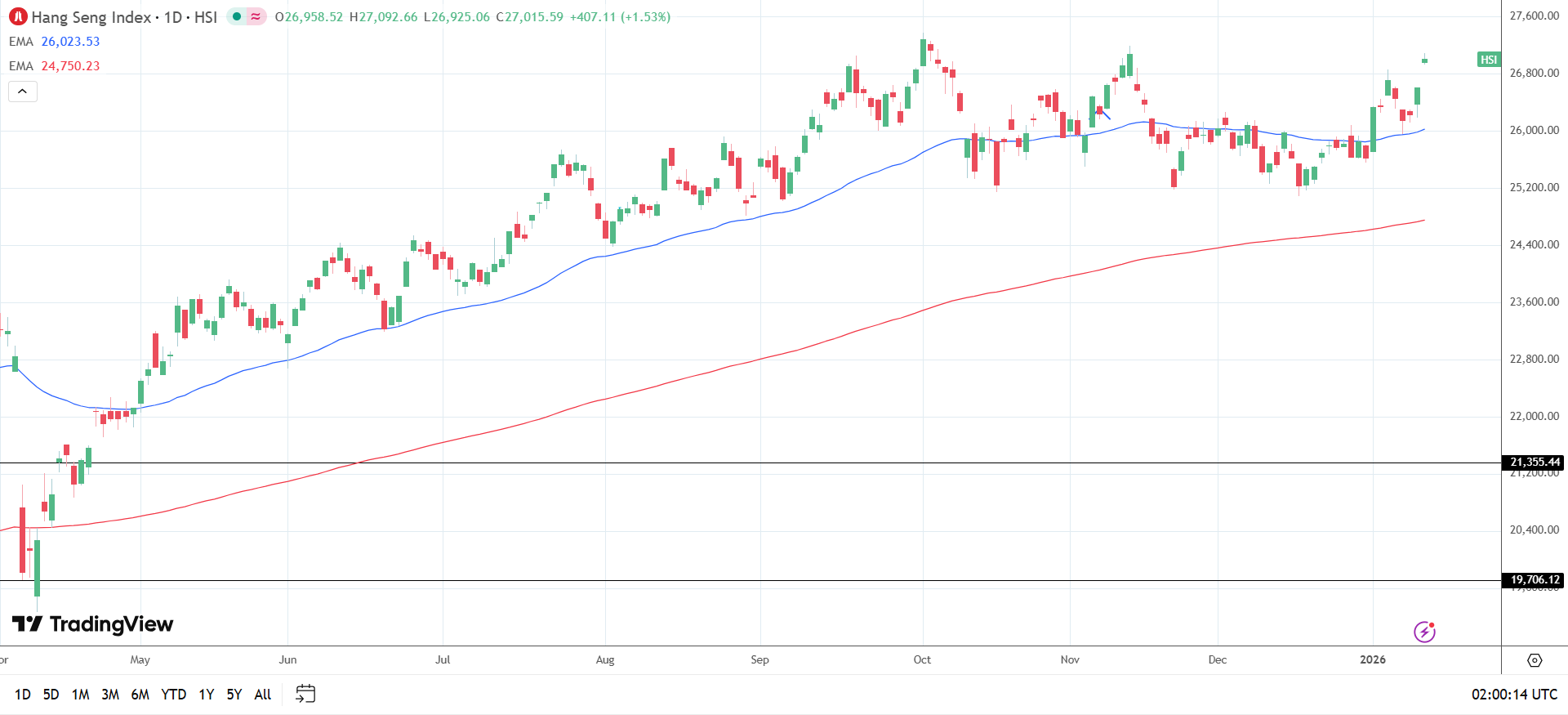
The Hang Seng Index’s outlook aligns with the CSI 300’s, with the index holding above its 50-day and 200-day EMAs. The EMAs suggest bullish momentum, complementing positive fundamentals.
A break above the October 2025 high of 27,382 would bring 28,000 into play. A sustained move through 28,000 would pave the way toward 30,000 for the first time since 2021.
Conclusion: Can Beijing Extend Market Gains?
To summarize, the short- and medium-term outlook remains constructive. Beijing’s pledges for more policy support, China’s advancements in the AI space, and the US-China trade war truce are likely to fuel demand for Mainland China and Hong Kong-listed stocks.
However, stabilizing the housing sector, global trade developments, and company margin squeezes remain considerations for consumers and private consumption. Meaningful policy measures would likely send the CSI 300 to its 2021 all-time high of 5,931.
Discover strategies to navigate this week’s market trends here.