
DAX Slides as China Ramps Up Trade War with the US
German equities retreated on Friday, April 11, as China raised tariffs on US goods to 125%, up from 84%. Escalating fears of a full-scale US-China trade war and deepening economic decoupling weighed on demand for German-listed stocks. The DAX fell 0.92%, partially reversing Thursday’s 4.53% gain to close the week down 1.30% at 20,384.
Although President Trump lowered tariffs on EU imports to 10%, down from 20%, the elevated levels still fueled demand concerns.
Fred Ducrozet, Head of Macroeconomic Research at Pictet Wealth Management, commented:

“Fat tail removed but a new era still: 125% tariffs on China; 14% average on the rest of the world; more sector tariffs likely. Trade war narrows but deepens; doesn’t raise revenues. Full decoupling from China. USD reserve currency and UST safe-haven status questioned.”
Aerospace and Tech Stocks Lose Their Shine
Tariff-related uncertainty continued to pressure risk assets. Aerospace and tech stocks led the losses, with MTU Aero and Airbus Group sliding 5.81% and 3.33%, respectively. Tech giant SAP ended the session down 2.26%.
Auto stocks posted mixed results. Daimler Truck Holding dropped 1.28%, while Volkswagen, Mercedes-Benz Group, Porsche, and BMW advanced on expectations of upbeat earnings.
German Inflation Eases
Germany’s annual inflation rate softened to 2.2% in March, down from 2.3% in February, aligned with preliminary estimates. The March figures supported bets on a 25-basis point ECB rate cut on Thursday, April 17.
However, uncertainty surrounding the ECB’s views on trade tensions and their potential economic impact limited the inflation data’s influence on the DAX.
DAX Price Forecast
Every new DAX analysis as it publishes, today's technical signal and key levels, live price — on one page.
See all DAX forecastsUS Markets Rise on Fed Optimism
US equity markets advanced on April 11 after softer-than-expected producer prices supported expectations of a June Fed rate cut. The Nasdaq Composite Index rallied 2.06%, while the Dow and the S&P 500 gained 1.56% and 1.81%, respectively.
US producer prices rose 2.7% year-on-year in March, down from 3.2% in February. As a leading inflation indicator, the reading indicated an easing demand environment. Weakening demand may dampen inflationary pressures, supporting a more dovish Fed rate path.
However, consumer sentiment and inflation expectations capped Friday’s gains. The Michigan Consumer Sentiment Index fell from 57.0 in March to 50.8 in April. Meanwhile, inflation expectations surged to 6.7%, up from 5% in March.
EU-US Trade Talks Take Center Stage
On Monday, April 14, all eyes will be on EU-US trade negotiations. EU Trade Commissioner Maros Sefcovic will reportedly meet with US officials. Early developments could influence German-listed stocks, particularly if talks stall.
While US-EU trade talks are crucial, investors must monitor US-China trade headlines.
On April 11, the US government lowered tariffs on selected computers and laptops, routers, and smartphones from China to 20%, raising hopes of a softer stance on China. However, President Trump warned of upcoming tariffs on semiconductors and all electronics in a shift from reciprocal to national security tariffs.
Despite the prospect of fresh tariffs, Asian markets responded positively to the news. The tariff news set the DAX up for a Monday, April 14, rebound.
Near-Term Outlook: DAX Sensitivity to Macro Risks
The DAX’s near-term trajectory hinges on trade developments, inflation trends, and central bank commentary.
Potential DAX Scenarios:
- Bullish Case: Favorable US-EU trade talks, softer inflation, or dovish central bank rhetoric could drive the DAX toward 21,000.
- Bearish Case: Renewed trade tensions, higher inflation, weak US data, or hawkish central bank commentary may drag the DAX toward the April 7 low of 18,490.
As of Monday morning, the DAX futures were up 446 points, while the Nasdaq 100 mini gained 248 points, indicating a positive start to the session.
Technical Warning Signs Flash
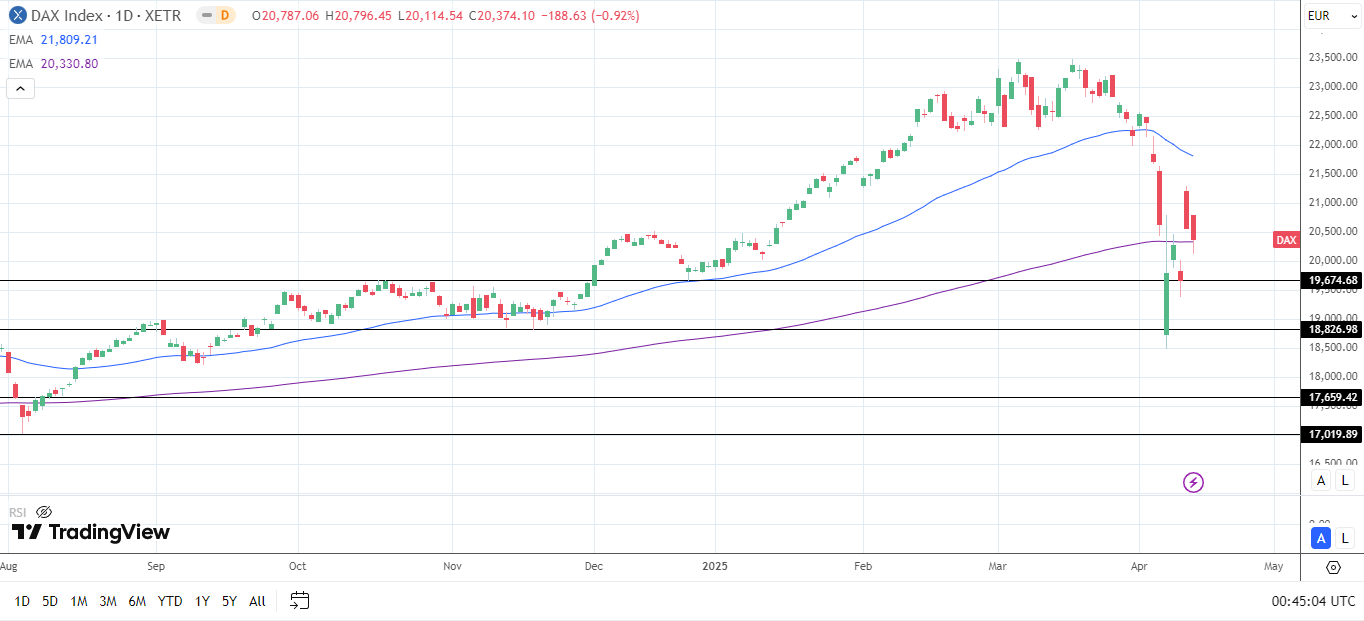
Daily Chart:
Despite Friday’s losses, the DAX trades above the 200-day Exponential Moving Average (EMA) while remaining below the 50-day EMA, suggesting near-term downside risks.
- Upside Target: A break above 20,500 could enable the bulls to target 21,750. A sustained move above 21,750 would open the path to the 50-day EMA.
- Downside risk: A drop below the 200-day EMA may signal a return to sub-20,000 levels.
Conclusion: Monitor Macro Themes
Investors should closely follow trade negotiations and central bank commentary. These factors will likely steer near-term DAX trends.
Explore our latest research here for more insights into the DAX, macro trends, and emerging market opportunities.