
US stock futures declined on Wednesday, January 14, extending their losses from the previous day. Investors turned cautious as JPMorgan’s earnings raised concerns about upcoming earnings from other US banking giants.
Increased geopolitical risks contributed to the morning pullback. This week, President Trump announced a 25% tariff on countries that maintain business relations with Iran amid growing concerns over the US-China trade war truce. President Trump’s threats to seize Greenland and events in Venezuela have tested US-China relations.
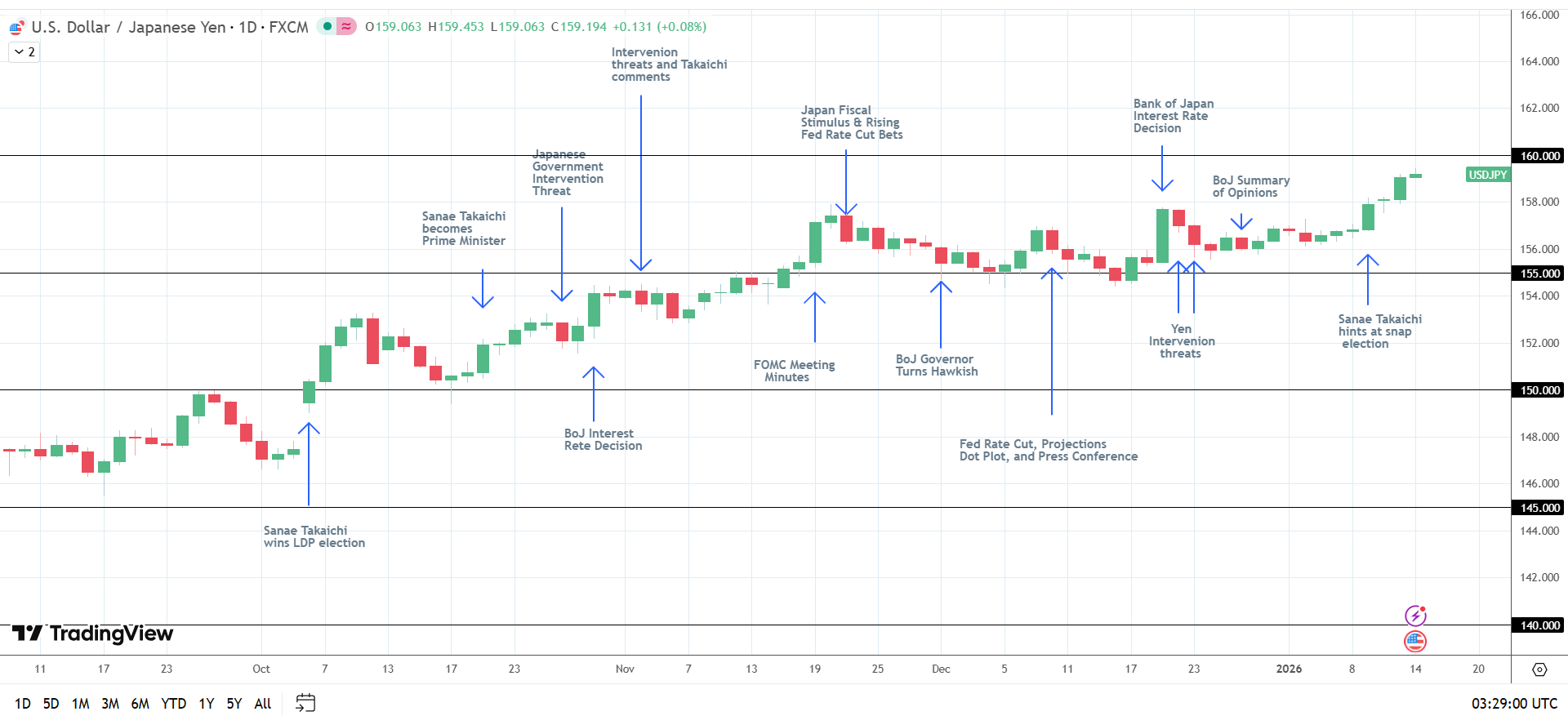
Meanwhile, Japanese political uncertainty and Japanese Prime Minister Sanae Takaichi’s fiscal stimulus plan sent USD/JPY to a morning high of 159.453, its highest level since July 2024. The weaker yen fueled yen carry trades into US risk assets, limiting the downside for US equity futures.
Despite the pullback, optimism about the AI earnings season, hopes for multiple Fed rate cuts in 2026, and a robust US economy support a bullish medium-term outlook for US stock futures.
Below, I’ll outline the key market drivers, the medium-term outlook, and the key technical levels traders should watch.

USD/JPY Eyes 160 on Political Uncertainty and Fiscal Spending
Market concerns over a snap election in Japan weakened the yen and sent 10-year Japanese Government Bonds (JGB) yields to their highest level in decades.
Japanese Prime Minister Takaichi hinted at a snap national election, potentially in February. Takaichi enjoys a high approval rating in contrast with the Liberal Democratic Party’s rating, raising uncertainty over an election. A resounding victory would strengthen Takaichi’s case for increased spending, which would further impact Japan’s debt-to-GDP ratio.
Notably, the Nikkei 225 rallied 1.61% in morning trading despite USD/JPY gains fueling speculation about the Japanese government intervening in the FX markets. A weaker yen and Nikkei 225 gains signal yen carry trades into risk assets.
Dow Jones Price Forecast
Every new Dow Jones analysis as it publishes, today's technical signal and key levels, live price — on one page.
See all Dow Jones forecasts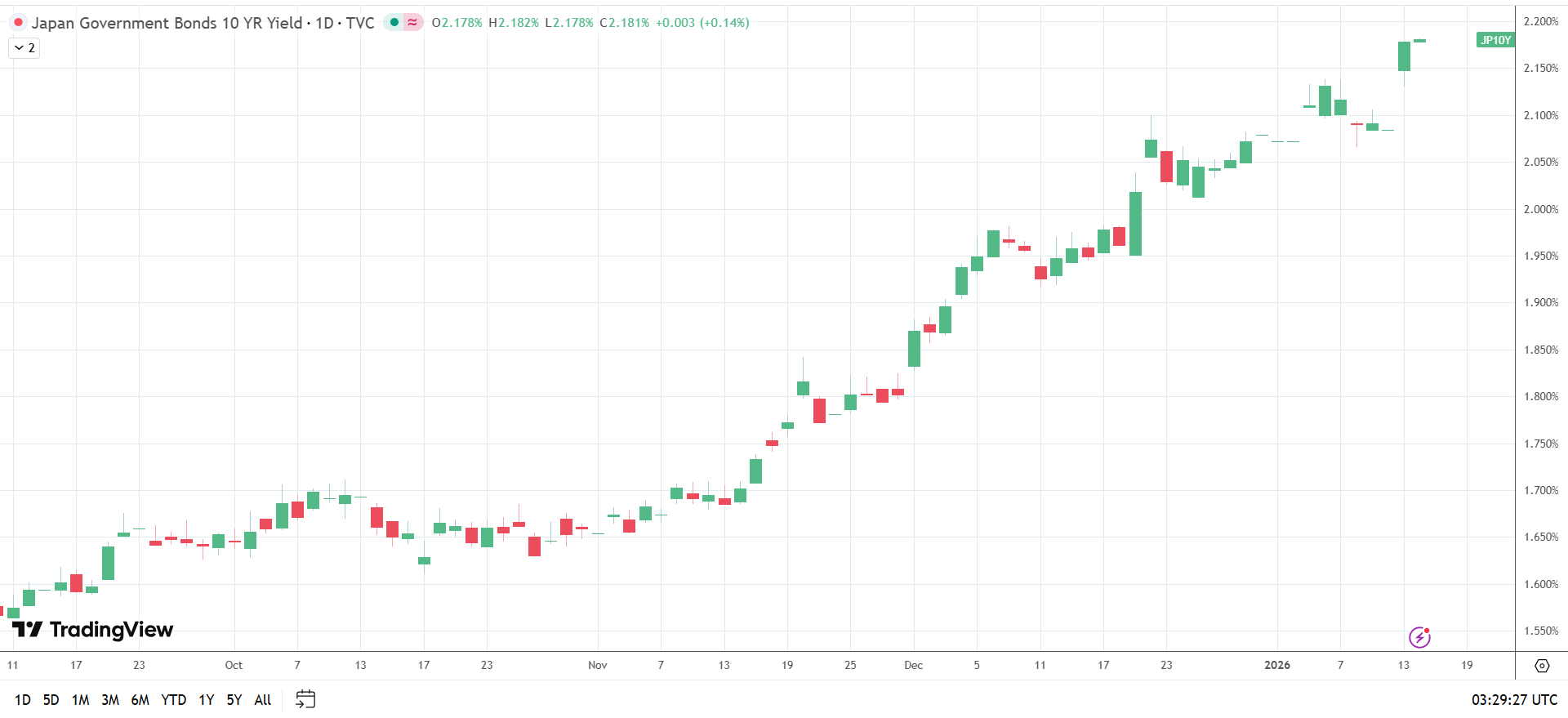
Chinese Trade Data Impresses
While concerns about Japan’s debt levels weakened the yen, strong Chinese trade data boosted optimism about the Chinese economy. Chinese exports rose 6.6% year-on-year in December, up from 5.9% in November, while imports increased 5.7% (November: 1.9%).
December’s trade data signaled a strong global demand backdrop, lifting sentiment.
US Producer Prices, Retail Sales, and Earnings in Focus
US futures dipped during the Asian morning session on Wednesday, January 14. The Nasdaq 100 E-mini and the S&P 500 E-mini declined 15 points and 8 points, respectively, while the Dow Jones E-mini fell 102 points.
Later Wednesday, US producer prices and retail sales figures will influence the Fed rate path. Economists forecast retail sales will increase 3% year-on-year in November, down from 3.5% in October. Meanwhile, economists expect producer prices to rise 2.7% YoY in November, mirroring September’s increase.
Softer producer prices and retail sales growth would likely raise bets on an H1 2026 Fed rate cut, boosting demand for US stock futures. Typically, lower borrowing costs improve earnings and equity valuations.
While the economic data will influence sentiment, traders should closely monitor earnings announcements. Bank of America (BAC), Wells Fargo (WFC), and Citigroup (C) will release their earnings. Weaker-than-expected earnings would likely overshadow the economic data and weigh on risk appetite.
The current dynamics, including market optimism over AI-linked corporate earnings and bets on an H1 2026 Fed rate cut, affirm a cautiously bullish near-term and bullish medium-term price outlook.
Key Technical Levels for Dow Jones, Nasdaq 100, and S&P 500
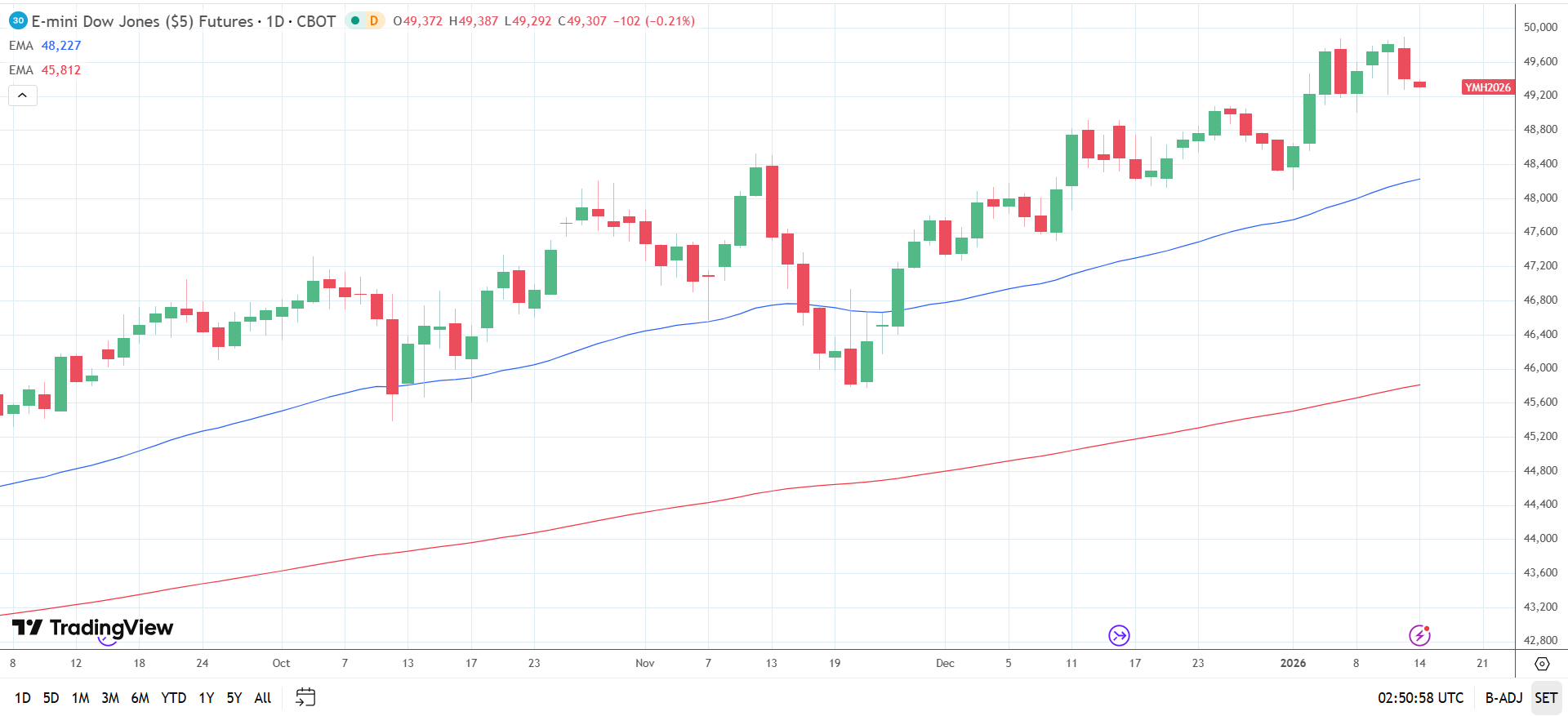
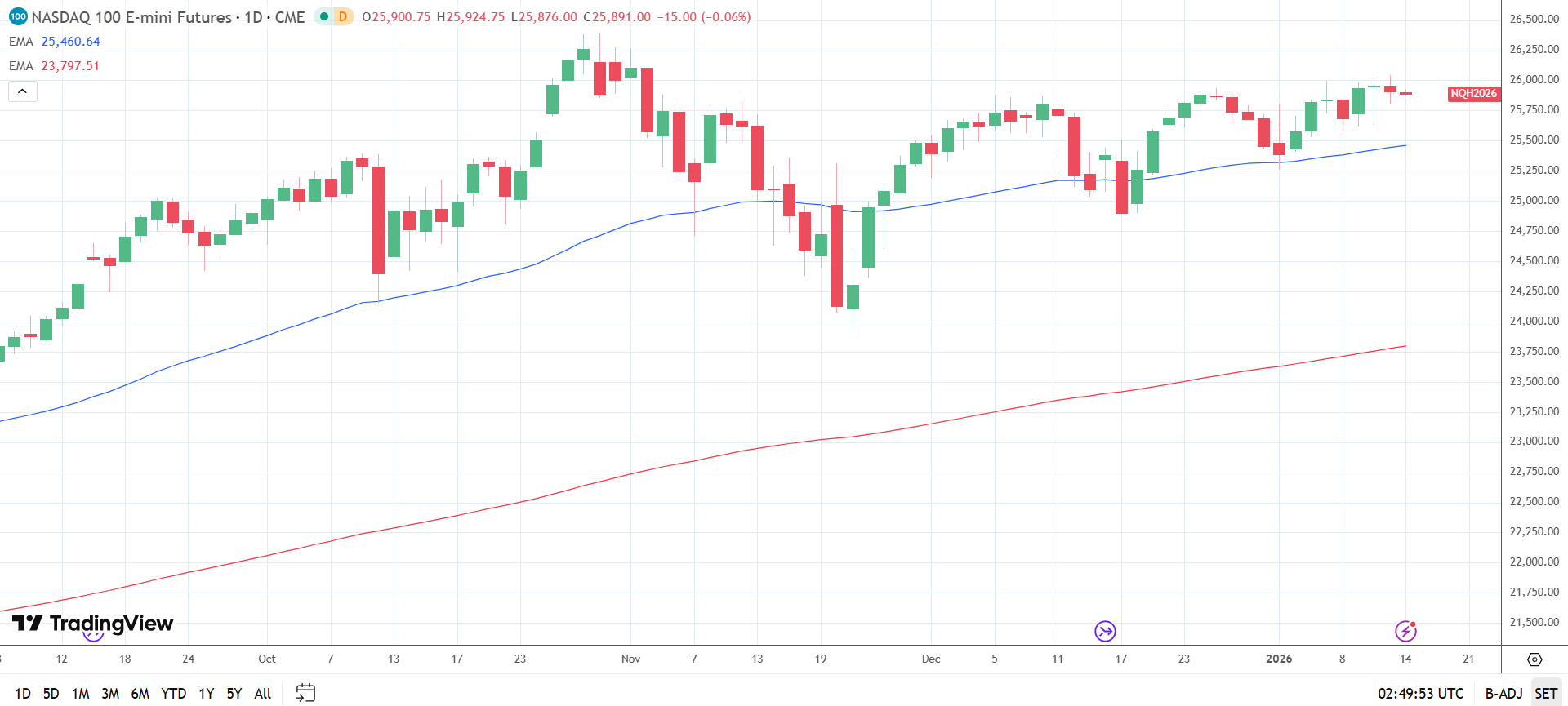
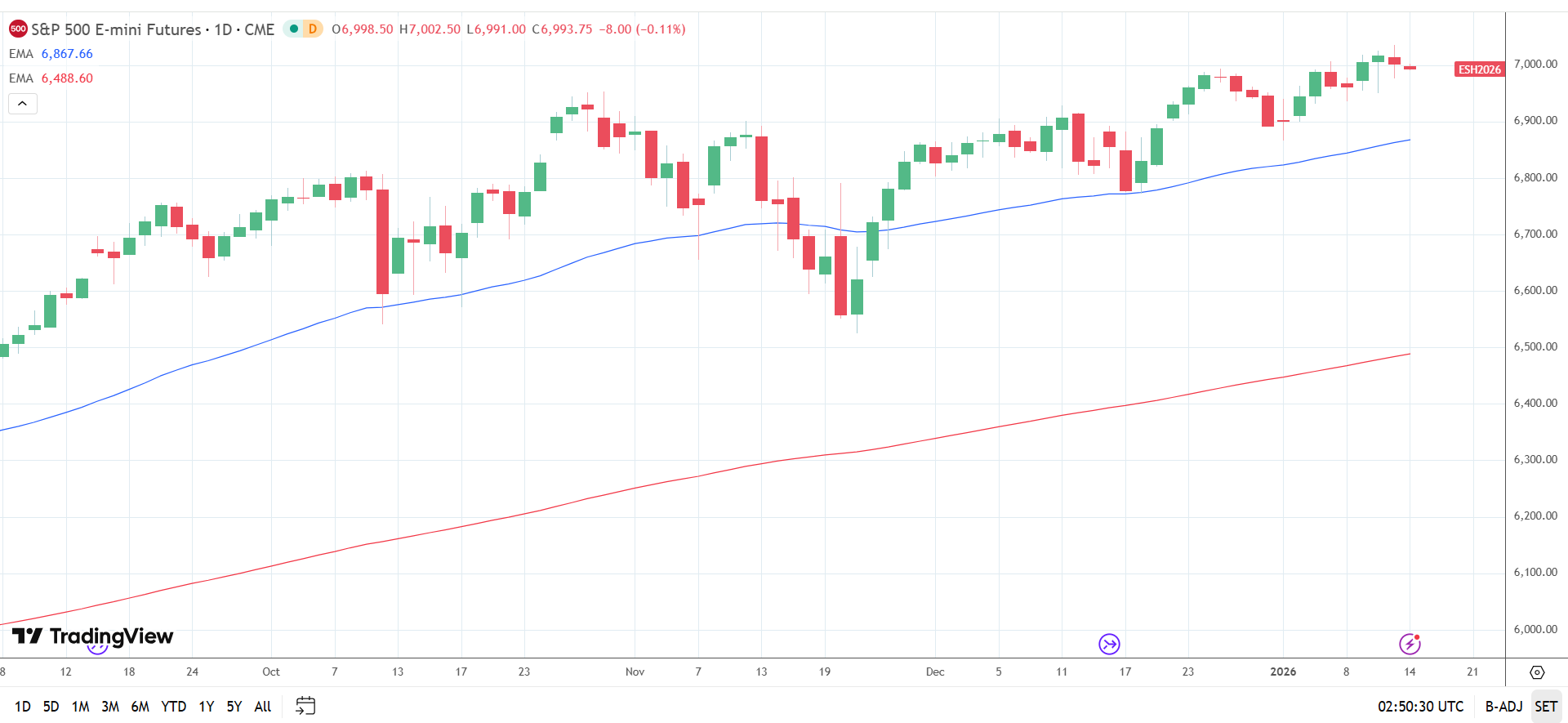
Despite the latest losses, the Dow Jones E-mini, the Nasdaq 100 E-mini, and the S&P 500 E-mini remained above their 50-day and 200-day EMAs. The EMAs signaled bullish momentum, aligning with positive fundamentals.
Near-term trends will hinge on geopolitical tensions, US economic data, corporate earnings, and Fed chatter. Key levels to monitor include:
Dow Jones
- Resistance: the January 13 record high of 49,901, and then 50,000.
- Support: 49,000 followed by the 50-day EMA (48,227).
Nasdaq 100
- Resistance: 26,000 followed by the October 30 record high of 26,399.
- Support: the 50-day EMA (25,461) and then 24,500.
S&P 500
- Resistance: the January 13 high of 7,036, followed by 7,500.
- Support: the 50-day EMA (6,868) and then 6,500.
Bullish Medium-Term Outlook: The Fed, US Data, and Earnings
In my opinion, the short-term price outlook remains cautiously bullish, supported by bets on an H1 2026 Fed rate cut and strong AI-linked corporate earnings. These fundamentals align with constructive technicals.
Furthermore, speculation that the incoming Fed would be willing to lower interest rates in a sticky inflation backdrop reaffirms the constructive medium-term bias.
However, several events would derail the bullish medium-term outlook, including:
- The Bank of Japan announces a hawkish neutral interest rate (potentially 1.5%-2.5%), signaling a narrower US-Japan rate differential. Narrower differentials may trigger a yen carry trade unwind, challenging the short-term outlook.
- Stronger US economic data and hawkish Fed rhetoric would reduce bets on a Fed rate cut.
- Corporate earnings and outlooks disappoint.
- Geopolitical tensions intensify.
- US Supreme Court rules tariffs unlawful, triggering market uncertainty and concerns over US debt.
Conclusion: Bullish Outlook Intact
In summary, a robust US economy, a dovish Fed rate path, AI-linked earnings, and a cautious BoJ reaffirm a cautiously positive short-term and a bullish medium-term outlook for US stock futures.
However, traders should continue to monitor 10-year JGB yields, USD/JPY trends, and the Nikkei 225, given the effects of yen carry trades on market liquidity. Warnings of a yen intervention and hawkish BoJ chatter may raise concerns over a yen carry trade unwind.
Key levels to watch include a USD/JPY drop below 150, 10-year JGB yields climbing to new highs, and a sharp Nikkei sell-off. These would be early signs of an unwind, weighing on buyer appetite for US risk assets.
Despite markets expecting the BoJ to raise interest rates gradually, US stock futures are likely to reach new highs, with corporate earnings and the Fed being the key price catalysts.
Follow our live coverage and consult the economic calendar for real-time market updates.