The Federal Reserve (Fed) interest rate decision is due this Wednesday at 6:00 p.m. UTC, followed by Fed Chair Kevin Warsh’s press conference at 6:30 p.m. UTC. The market broadly expects the Fed to leave the rates unchanged in the 3.50–3.75% range, but confidence is slim. The decisions to hold or hike rates are equally possible, which makes this upcoming announcement potentially one of the most consequential Fed decisions in recent years. Meanwhile, gold (XAUUSD) faces an exceptionally complicated environment, as bullion prices are pulled in opposite directions by conflicting forces. Indeed, investors are forced to balance safe-haven demand driven by central bank purchases and geopolitical instability against rising real yields (driven by an oil-fueled inflation scare).
Macro Factors
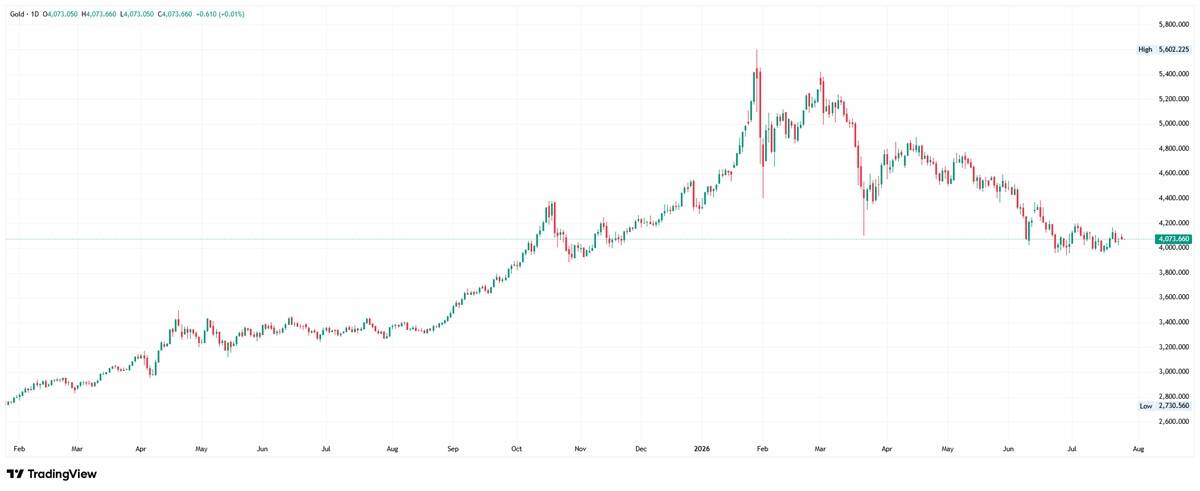
Gold is under acute bearish pressure heading into the 29 July Fed decision. At the time of writing, XAUUSD was trading near $4,090 per ounce (oz), down more than 17% since mid-April and more than 25% below its January 2026 all-time high near $5,600. The dominant forces driving gold are two powerful, yet entirely conflicting drivers. The interplay between them is creating an unusually complex backdrop for bullion.
On one hand, safe-haven demand provides bullish support for gold. Middle East escalation and general geopolitical uncertainty drive XAUUSD higher as investors flock to safe assets. Additionally, structural buying on the part of sovereign wealth funds and global central banks continues to support prices.
On the other hand, rising interest rates and Treasury yields create severe headwinds for non-yielding gold. Tensions in the Persian Gulf have disrupted oil supply and pushed crude oil benchmarks higher. Higher oil prices raise future inflation expectations and increase the probability of rate hikes, thus strengthening the U.S. dollar and weighing on gold. In fact, 30-year real yields recently hit 2.987%, the highest since 2008. This is a critical point for gold, as rising real yields directly erode its relative attractiveness vis-à-vis other assets.
And this is not a U.S.-only story. The cost of capital is rising in other economies as well. The European Central Bank (ECB) recently held its rate at 2.25%, but markets are pricing in an 80% chance of a September hike. In its statement, the ECB noted that ‘uncertainty remains high and the full inflationary impact of the energy shock has yet to play out’. The Reserve Bank of Australia (RBA) is also expected to raise rates after a strong employment report showed that an addition of 76,000 jobs were created in June. Elsewhere, 2-year Japanese Government Bond (JGB) yields reached a 31-year high on rate-hike expectations, while the German 10-year Bund yield surpassed 3.2% for the first time since 2011.
All of this shows that monetary policy is tightening across the globe, and gold is likely to suffer as a result.
Gold Price Forecast
Every new Gold analysis as it publishes, today's technical signal and key levels, live price — on one page.
See all Gold forecastsKey scenarios for XAU/USD
Although the market expects the Fed to leave rates unchanged, interest-rate swap market data indicate that the chances of a 25-basis-point rate hike are around 33%. This means that a rate hike is more than likely, which could trigger a very strong reaction, irrespective of the actual decision.
I foresee three scenarios of gold, with the bullish reaction being the least likely outcome. The decision to hold the rates is the most likely scenario, but a lot depends on the tone of the statement.
- Bearish scenario. If the Fed hikes or signals an imminent hike in September, XAUUSD will drop sharply. A hike would represent a major surprise for investors and traders, and it may trigger an extreme reaction across the financial markets, not just gold. Under this scenario, gold price will almost certainly drop below the $4,000 mark and may even test September 2025 lows near $3,600. This scenario is theoretically possible, but it is not my base case scenario.
- Neutral scenario. This is my base case scenario. In this case, the Fed holds rates steady as expected. Importantly, it will neither commit to nor rule out a September hike and will instead transmit a balanced message emphasising data dependency. Under this scenario, we could see a relief rally in gold, possibly reaching $4,300 per oz. However, any bounce would probably be short-lived, unless oil prices show a meaningful decline.
- Bullish scenario. If the Fed keeps the rates on hold and leans dovish in a statement (for instance, by describing oil or inflation shock as transitory and pushing back against market expectations for a September hike), XAUUSD will rally sharply. This is the least likely scenario. Still, under this scenario, rate-hike probabilities will be repriced sharply lower, pushing gold’s price above $4,300 per oz and towards $4,500 per oz.
Summary
Markets are currently pricing a 35-38% chance of a rate hike at the 29 July meeting, up from just 11% a week ago. Meanwhile, gold faces a highly challenging and predominantly bearish macroeconomic environment. While Middle East escalations typically support safe-haven gold, the current dynamic is inverted: the conflict has driven oil prices higher, spurring inflation expectations and reinforcing the case for higher interest rates, which ultimately pressures gold lower. Crucially, new Fed Chair Kevin Warsh has refrained from offering explicit forward guidance, leaving markets guessing. That is why I believe this week’s Fed decision may be one of the most consequential in years. Traders should prepare for above-normal volatility.
Disclaimer: This article does not contain or constitute investment advice or recommendations and does not consider your investment objectives, financial situation, or needs. Any actions taken based on this content are at your sole discretion and risk—Elev8 does not accept any liability for any resulting losses or consequences.