International markets are facing competing pressures on Tuesday as technology shares started out the day fairly weak but are trying to turn things around, while oil prices and declining government bond yields have offered some relief, but oil has since turned around. The falling U.S. and Eurozone yields, alongside expectations for a Federal Reserve pause this month, all do help the situation, but we’ll have to wait and see.
The question now is whether or not cheaper financing can offset concerns about technology valuations and persistent inflation coming from the energy perspective. South Korea’s KOSPI fell more than 5%, though Europe’s STOXX 600 gained 0.4% early. Reports of advances at Chinese memory chip producer CXMT unsettled semiconductor investors, hence the problem in Seoul, South Korea.

Energy vs. Semiconductors
South Korea is all about semiconductors, while Europe worries about its energy. This contrast illustrates that regional sector exposure matters, with a technology sell-off weighing heavily on one market while another benefits from easing energy costs. That has been the game as of late.
The International Monetary Fund supplied a broader economic backdrop with its World Economic Outlook release during the session. Its official briefing projects growth around the world of 3.1% in 2026 and 3.4% in 2027, with inflation reaching 4.7% sometime this year. It does state that widening differences between economies benefiting from AI investment and countries struggling with expensive energy continue to be a mainstay.
This matters for international capital flows. Strong aggregate growth can coexist with deteriorating prospects for individual countries. Investors may increasingly differentiate between economies attracting productive investment and those paying more for imported fuel. Currency performance, therefore, depends on relative growth, financing conditions, and balances rather than the global growth headline story alone.
Energy Drifting
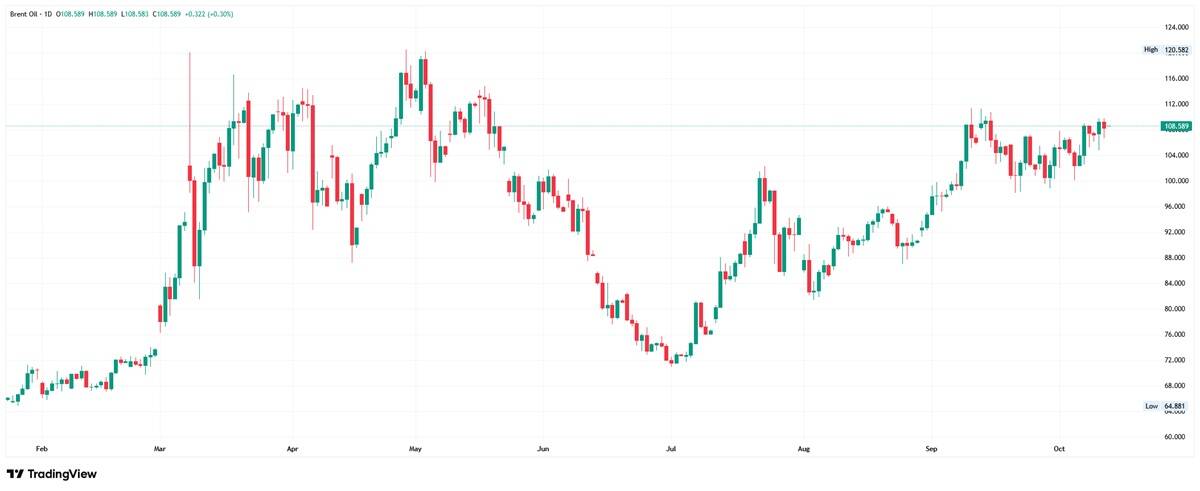
Energy has offered a little bit of relief in the early part of the session, but we have seen it turn around during New York trading. The market is starting to look at improvement in supply expectations due to additional Russian diesel while highlighting continuing disruption risks in the Middle East. For energy-importing economies, a sustained reduction in fuel costs would ease pressure on household spending, corporate margins, and, of course, inflation. However, the prospective diesel shipments do not establish that any change in regional security risk has disappeared.
Brent Oil Price Forecast
Every new Brent Oil analysis as it publishes, today's technical signal and key levels, live price — on one page.
See all Brent Oil forecastsCurrency markets reflected some of that relief, with the dollar index down 0.3%, the euro at 1.1190, and the yen at 158.04 per dollar midday. The euro’s rebound came despite continuing concerns about the French fiscal outlook and debt. The combination of France dragging down the EU while there’s a little bit of relief in the rate markets is possibly a temporary one, and it means you must be cautious in trying to make this the fundamental story.
Japan Inflation Releases
Japan also supplied fresh official inflation evidence. The Bank of Japan’s preliminary September corporate goods price index rose 6.8% from a year earlier, slowing from 7.6% in August. While falling 0.3% month over month, it shows that substantial annual price pressure can coexist with a monthly decline. Wholesale inflation is also distinct from consumer inflation and does not by itself suggest that the Bank of Japan is likely to change its policy.
The 10-year U.S. Treasury yield had dropped to 5.187%, with lower yields supporting valuations and reducing the dollar’s relative appeal. But a bond rally driven by growth concerns may accompany weaker equities, so keep in mind that if growth starts to deteriorate, you may see that play out.
US Inflation Data on Tap
The next major scheduled test is U.S. September CPI, due tomorrow at 8:30 a.m. New York time, and September PPI follows on Thursday, both released by the Bureau of Labor Statistics. Neither release is the entire picture by itself, but an inflation surprise could alter rate expectations and currency differentials when it comes to the United States.