
This hawkish stance has bolstered the dollar, increasing the opportunity cost of holding non-yielding assets like gold.
Fed Minutes Awaited for Market Cues
The Federal Reserve’s hawkish tone has exerted downward pressure on gold prices. Members emphasized the need for more convincing inflation data before considering rate cuts, suggesting that high rates may persist. This stance supports the dollar, further weighing on gold prices.
Despite the recent drop, gold’s downside may be cushioned by renewed US-China trade tensions and persistent geopolitical issues in the Middle East, which sustain some demand for the metal as a safe haven.
Geopolitical Tensions and Central Bank Demand
Despite high interest rates, demand from central banks and Asian buyers, along with geopolitical tensions, provides a supportive backdrop for gold.
Traders are closely monitoring the release of the FOMC minutes and speeches from Fed officials, including Fed Governor Christopher Waller and Atlanta Fed President Raphael Bostic, for further clues on rate policies.
US-China Trade Tensions Impact
The U.S. recently announced tariff hikes on a wide range of Chinese goods, while China is considering increasing tariffs on imported cars with large-displacement engines. This trade tension adds another layer of complexity to the economic outlook, potentially affecting market sentiment and influencing gold prices.
Short-Term Forecast
Gold remains bullish above $2410, with potential upward momentum. However, a break below this level may trigger a sharp decline towards $2400.
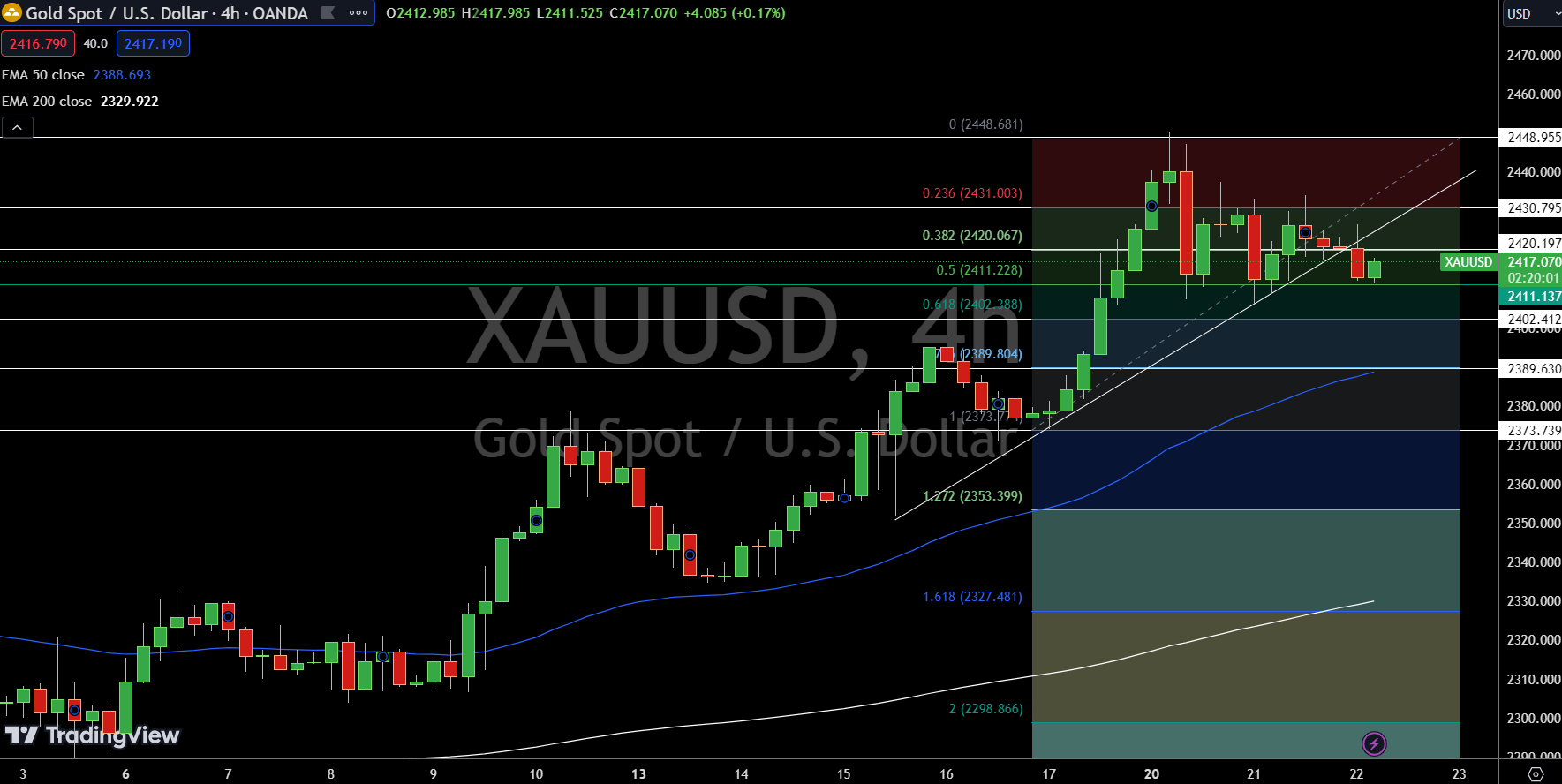
However, a bearish engulfing candle and a break below the upward trend line at $2420 could signal a downtrend. A breach of the 50% Fibonacci retracement level may lead gold prices toward the 61.8% level around $2400.
Conclusion: Gold remains bullish above $2,410, but a break below this level could trigger a sharp selling trend.