Gold News: CPI Test and Geopolitical Risks Drive Metals
Currently, markets are waiting to find how U.S. inflation figures released on Wednesday will affect the monetary policy framework of the U.S. As expected, inflation figures may ease. Based on market expectations, there are almost even chances of a holding or a tightening of interest rates. At this juncture, any positive surprise would have a bigger impact on non-yielding precious metals.
The impact of the rapid changing geopolitical environment on inflation is multiplying. Iran is tightening its grip on the Strait of Hormuz, and the Houthi group is attacking shipping and increasing U.S. military activity. Rising energy prices will slow the U.S. disinflation, but the geopolitical issues are supporting the demand for safe-haven assets.
Gold has structural demand from diversification of central banks. Purchasing levels of central banks are above historical averages, and recent reserve additions of China are seen as signaling that governments will continue to increase their gold holding allocations due the geopolitical fragmentation and their concern about currency reserves.
Silver also has a supply-demand story. According to the Silver Institute, the market will remain in deficit for the sixth year in a row in 2026, with a projected gap of 46.3 million ounces in their April report. The anticipated total demand will be 1.11 billion ounces. Consumption in industry is anticipated to decline as solar manufacturers use less silver. However, the AI data center, automotive electronics, and power grid infrastructure construction are expected to continue. Additionally, demand is expected to be higher due to physical investment. This is contrary to the weaker industrial demand, jewelry demand, and silverware demand.
On August 12, the primary influencing factor is CPI. A lower CPI will reduce the headwind due to interest rates facing precious metals. On the other hand, persistent high inflation will prompt market participants to price in more hawkish Fed policy.

Gold Technical Analysis: XAU/USD Holds Rising Channel as $4,430 Resistance Looms
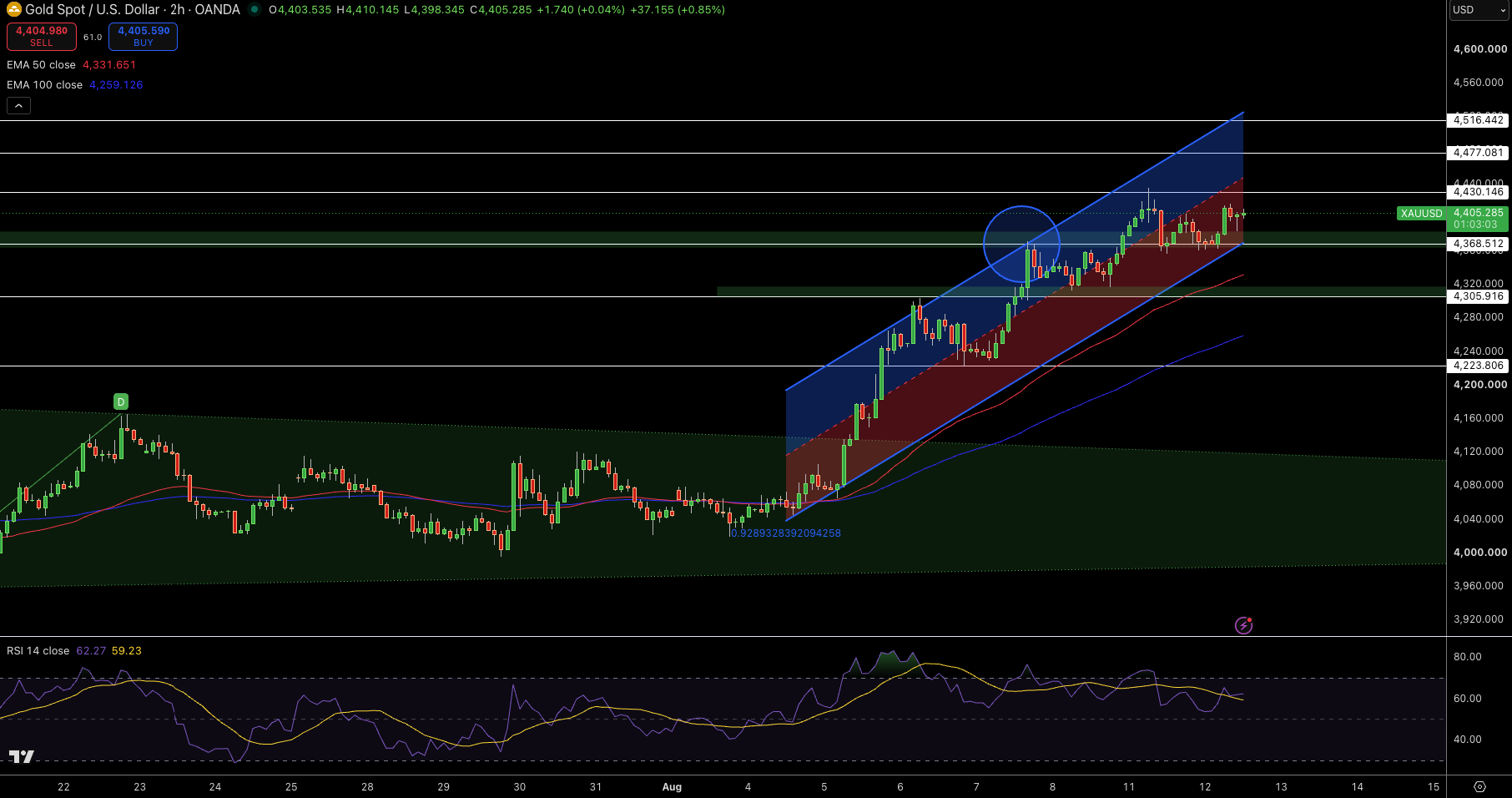
Currently trading at $4,405, Gold is trading within a rising channel that formed an upward breakout from the early-August base. Price stays above the 50-EMA ($4,332) and the 100-EMA ($4,259), with both providing support to the upward trend. Recent price action has formed consolidation just below $4,430, signaling Gold buying pressure. RSI is resting near 62 which signals bullish pressure without overbought levels.
Price is expected to hit resistance levels around $4,430, $4,477, and $4,516. The first support level is expected around the rising channel support at $4,369, with stronger support expected at $4,306 and $4,224. In my market view, the rising channel support at $4,369 will be a demand level, and a support level above $4,430 could lead to further higher demand at $4,477.
Gold Price Forecast
Every new Gold analysis as it publishes, today's technical signal and key levels, live price — on one page.
See all Gold forecastsSilver Technical Analysis: XAG/USD Rebounds From Channel Support With $66.50 in Focus
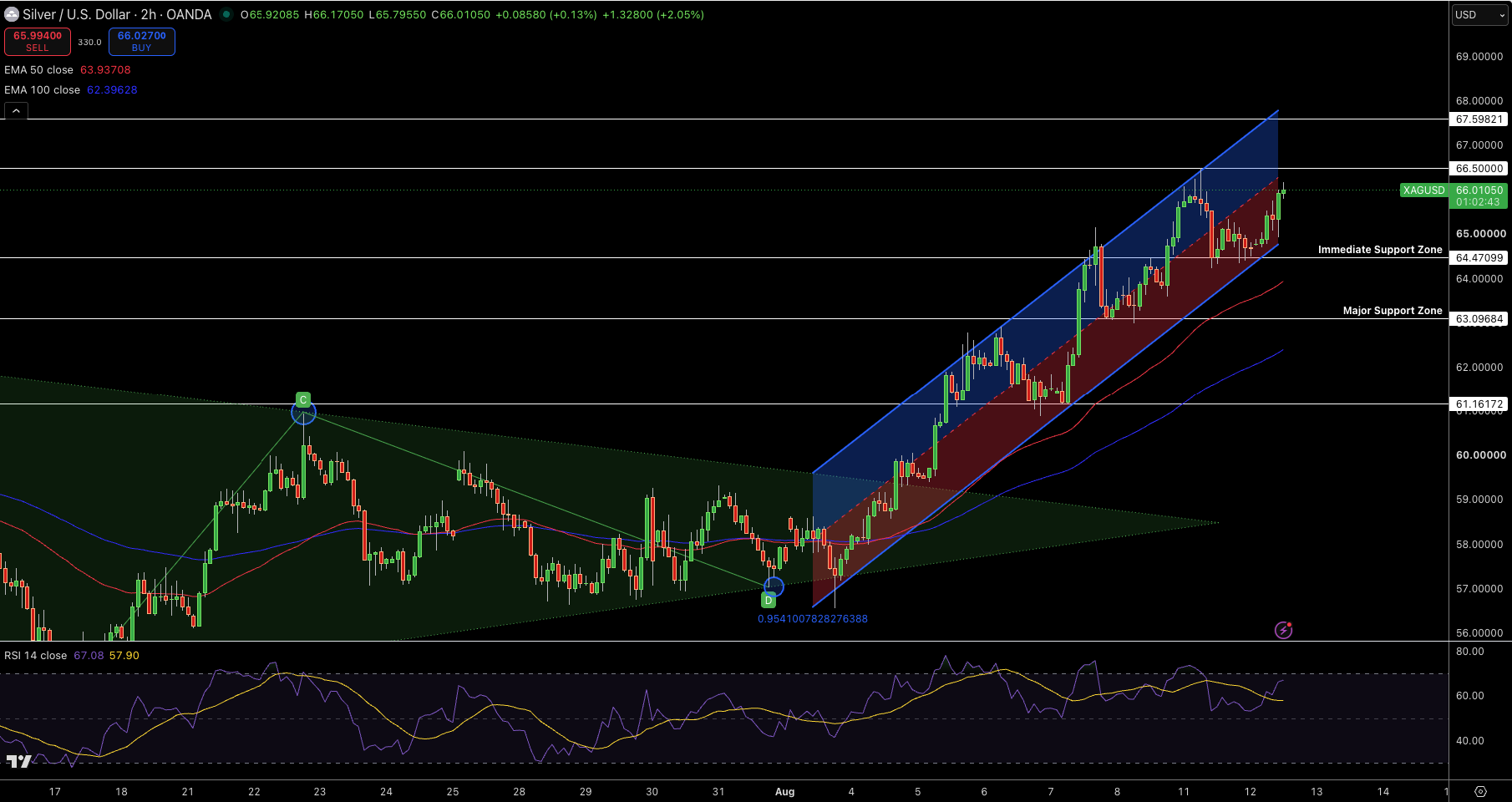
Silver trades at $66.01, jumping from the lower channel support to restore bullish trends. Price is well above the 50-EMA at $63.94 and the 100-EMA at $62.40, preserving the overall structure. Latest price action is showing buying pressure after price action broke below the $64.47 support zone. RSI at 67 indicates strong buying pressure, but is not in overbought territory.
Resistance starts at about $66.50, then at $67.60. The first key support is at $64.47, while the stronger of the two is at $63.10. The deepest support can be found at $61.16. I think this structure is bullish as long as silver trades above $64.47. A break of $66.50 opens room for further bullish momentum towards $67.60. The structure would become invalid and break to the downside if silver trades below the lower channel support.