
Pipeline Repair Hopes Knocked November Natural Gas Futures Down 4.3%
Columbia Gas Transmission said Friday it found the leak behind the West Virginia force majeure and expected repairs to be completed over the weekend. Thursday’s 9% rally was built on that outage. Friday gave most of it back. The disruption was estimated at 1.8 bcf per day, about 1.6% of total U.S. supply. That was enough to squeeze shorts through multiple resistance levels Thursday. The repair timeline was enough to send them right back Friday.
November natural gas futures settled at $3.225, down $0.145 or -4.30%. The contract traded from $3.158 to $3.300.

Daily November Natural Gas Technical Analysis
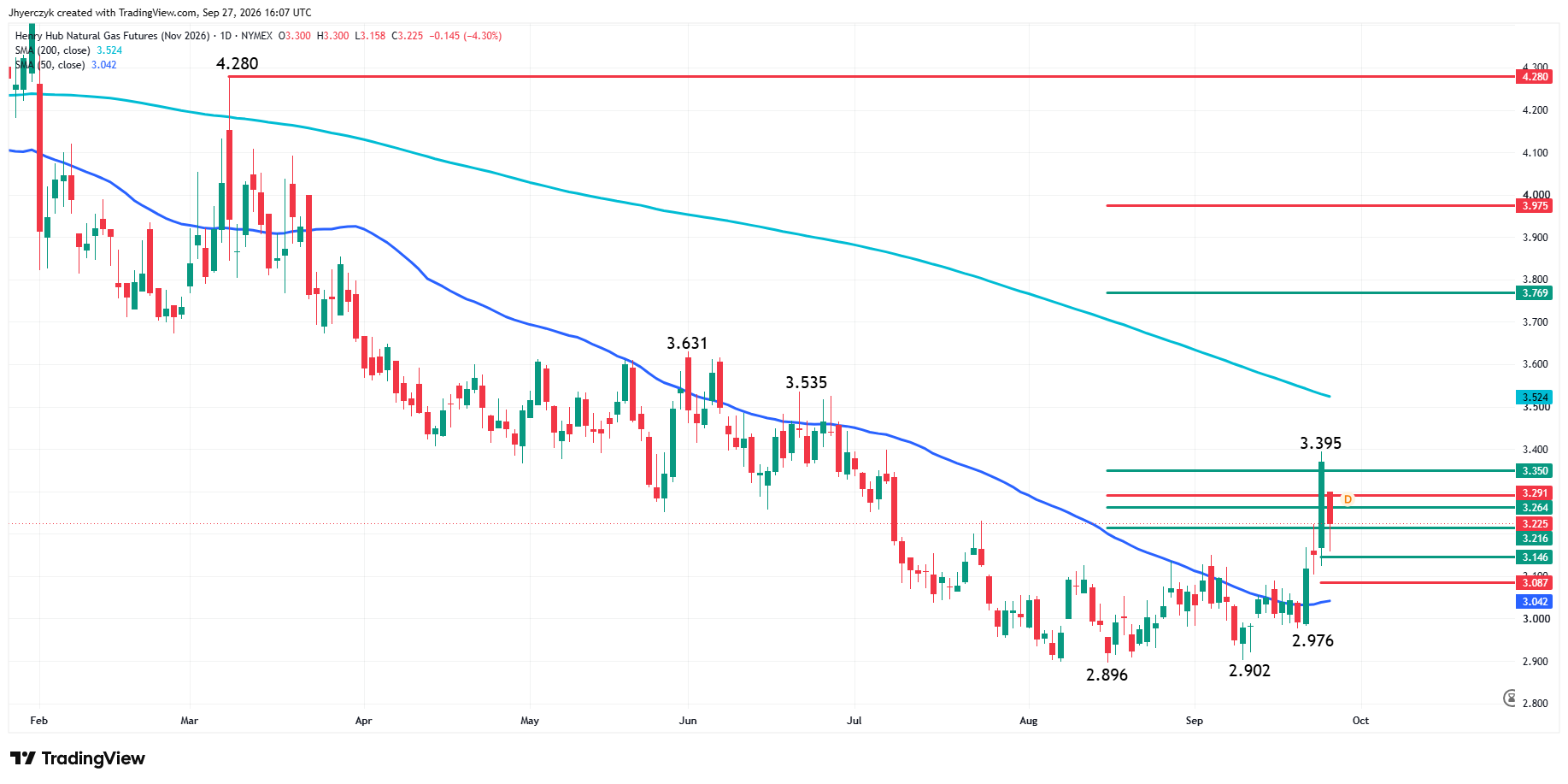
Despite Friday’s setback, November natural gas futures remain in an uptrend according to the daily swing chart. A trade through $3.395 will signal a resumption of the uptrend. The main trend will change to down if the swing bottom at $2.976 fails to hold.
Short-term momentum is strong with the market trading on the bullish side of the 50-day moving average at $3.042. Long-term momentum remains weak with natural gas trading on the weak side of the 200-day moving average at $3.524.
There is the potential for choppy, two-sided trading over the near-term with natural gas straddling a series of retracement levels. Nearby resistance is $3.264, $3.291 and $3.350. Nearby support is $3.216.
The new minor range is $2.896 to $3.395, making its retracement zone at $3.146 to $3.087.
We should find out early this week if the technical breakout on Thursday represents real buying or just short-covering by how traders react to $3.146 to $3.087.
Natural Gas Price Forecast
Every new Natural Gas analysis as it publishes, today's technical signal and key levels, live price — on one page.
See all Natural Gas forecastsThe Market Gave Back the Disruption Premium in One Session
Buyers pushed November natural gas futures to a 2.5-month nearest-futures high Thursday. They could not hold the move after the pipeline operator said the leak had been found. The rally ran through $3.216, $3.264, $3.291, and $3.350 on Thursday’s short covering. Friday’s session started giving those levels back before the morning was over.
The supply and demand data did not give buyers a reason to fight the reversal. Lower-48 dry gas production was 110.6 bcf per day Friday, down 0.5% from a year earlier according to BNEF. Demand was 69.0 bcf per day, down 7.9% from a year ago. LNG net flows to U.S. export terminals were 18.5 bcf per day, down 1.6% from the prior week. Production barely changed. Demand dropped hard. LNG flows slipped. None of those numbers support the idea that Thursday’s move was anything more than a pipeline squeeze.
The Storage and Drilling Numbers Did Not Help the Bulls Either
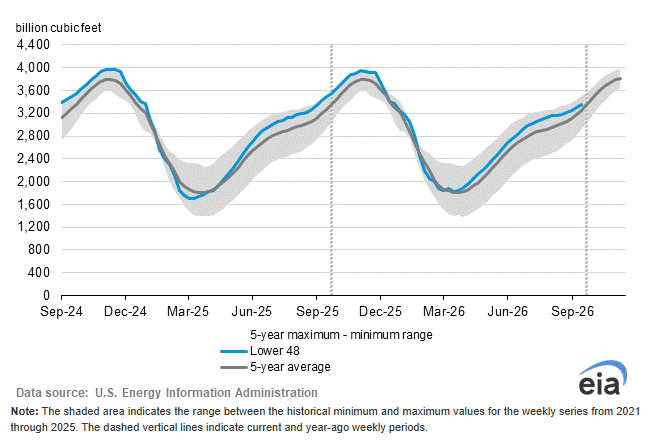
U.S. natural gas inventories rose 53 bcf in the week ended September 18. The build came in above the 51 bcf estimate but below the five-year average of 76 bcf. Inventories are down 4.5% from a year earlier and 2.9% above the five-year seasonal average.
The EIA projects end-of-October storage near 3,985 bcf, the highest in a decade and 5% above the five-year average. The EIA also raised its 2027 dry natural gas production forecast to 116.0 bcf per day from 115.3 bcf per day in July.
Baker Hughes reported Friday that active natural gas rigs rose by one to 135, a new three-year high. That is the number the market was watching. Thursday’s squeeze ran through a rig count that keeps climbing. Friday’s sell-off landed on top of a new high in drilling activity. Producers at these prices are not pulling back.
Power Demand Is Strong but It Is Not Enough
The Edison Electric Institute reported lower-48 electricity output rose 16.1% from a year earlier to 94,427 gigawatt hours in the week ended September 12. Trailing 52-week generation was up 3.3% to 4,405,549 gigawatt hours. The power numbers are the best demand figure in the report. They have not been strong enough to offset production near record levels, adequate storage, and slipping LNG feedgas.
European gas storage was 70% full as of September 23 against an 86% five-year average. That keeps U.S. LNG exports relevant heading into winter. It did not keep Friday’s sellers from pressing November natural gas futures back below $3.264.
A possible Super El Niño is the medium-term risk pressing on the deferred contracts. A warmer Northern Hemisphere fall and winter would reduce heating demand when the market is already carrying adequate supply into the season.
What to Watch
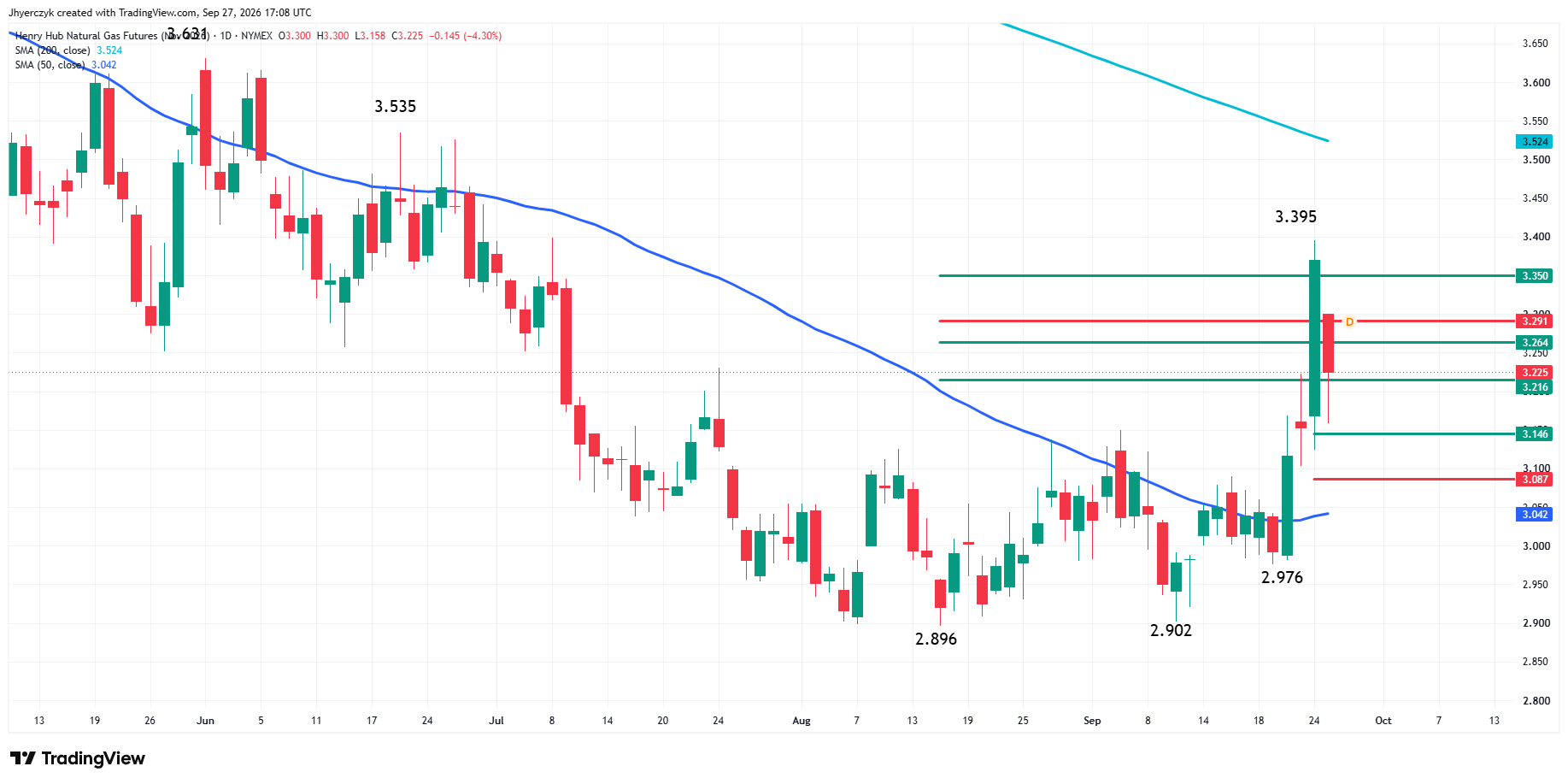
The pipeline repair outlook removed the immediate reason for buyers to stay aggressive. Columbia Gas Transmission expects the work done over the weekend. If flows normalize early next week, Thursday’s squeeze was a one-day event and November natural gas futures have to hold the $3.146 to $3.087 retracement zone on their own.
Sellers remain in control below $3.264 and $3.291 with the rig count at a new three-year high of 135, production near 110.6 bcf per day, and demand running 7.9% below a year ago. Buyers need to reclaim $3.300 and then $3.350 to show Thursday’s breakout was more than short covering into a pipeline headline. The $3.146 to $3.087 zone is where the market answers that question early next week.
More Information in our Economic Calendar.