Gold News: Warsh Holds Rates Steady as Investors Assess Precious Metals Outlook
Gold and silver markets are reacting to Chair Kevin Warsh and the Federal Open Market Committee’s (FOMC) announcement of unchanged benchmark interest rates at 3.50% – 3.75%. Writing history with an absentee vote count, 3 FOMC members called for a 25 basis point rate hike. This demonstrated that inflation fears, although showing signs of heating, remain strong.
In his press, Warsh affirmed the Federal Reserve’s (Fed) inflation target at 2% with the commitment to increase the restrictiveness of their policies if necessary. The market has turned its attention to Thursday’s July Personal Consumption Expenditures (PCE) inflation report. This will set the tone for the anticipated September meeting for the Federal Reserve.
The Fed’s position has changed with the demand for gold of an institutional character. The World Gold Council released revised numbers, showing a sharp decline in central bank gold purchases and the slowest official-sector purchases during the first half of 2023.
Although central banks continue purchasing gold, the gradual increase in reserves suggests that the strongest demand for gold purchasing has decreased. Despite this, institutional investors are buying gold to hedge their portfolios from inflation and geopolitical risks.
Despite short-term macroeconomic conditions and concerns, the long-term outlook for silver is positive because of strong industrial demand. Structural demand continues to be strong because of the consumption of silver in solar, AI, data, and EV technologies and advanced electronics.
That said, analysts believe that the sustained high interest rate environment will create a negative investment environment for gold and silver. As the focus shifts to U.S. inflation and anticipated Fed guidance, gold and silver will continue to be impacted by the balance of monetary policy and strong industrial and strategic demand.

Gold Technical Analysis: $4,000 Trendline Support Keeps Bullish Structure Intact
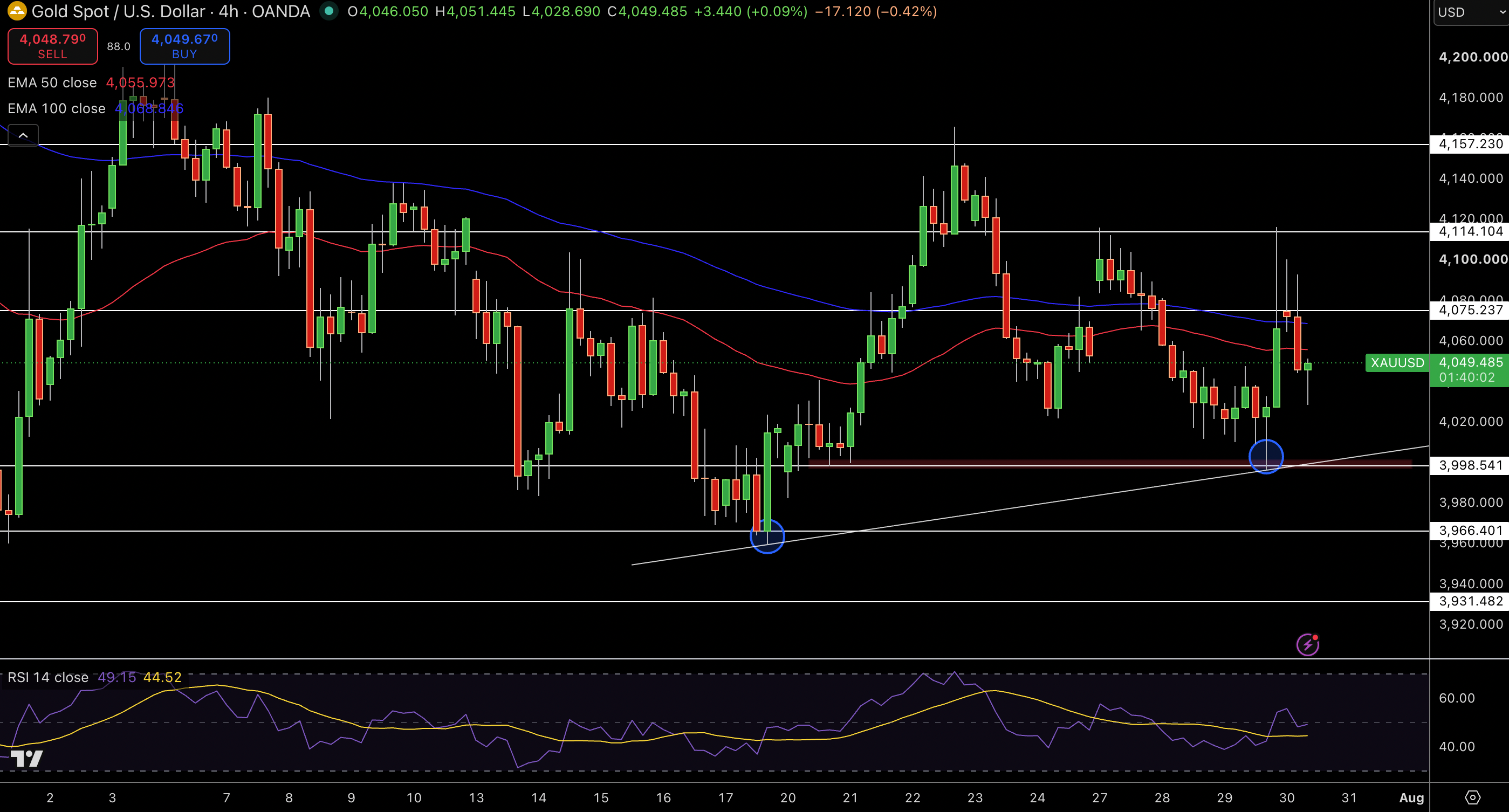
Gold is consolidating within a broad range after bouncing off the confluence of a rising trendline and horizontal support near $3,998. Demand was triggered in the support area, however, prices remain weak against the 50-EMA ($4,055.97) and 100-EMA ($4,068.85). The short-term bias remains neutral. The RSI has stabilised near 49, indicating balanced market sentiment between the two camps.
Resistance levels are $4,055, $4,075, and $4,114. Support is at $3,998, $3,966, and $3,931.
While the longer-term trend remains positive, prices need to hold above $3,998. Otherwise, there is a risk of a further drawdown to $3,966. A move above $4,055 would allow the path to $4,075 and $4,114.
Silver Technical Analysis: Triangle Support Holds as Bulls Eye Breakout
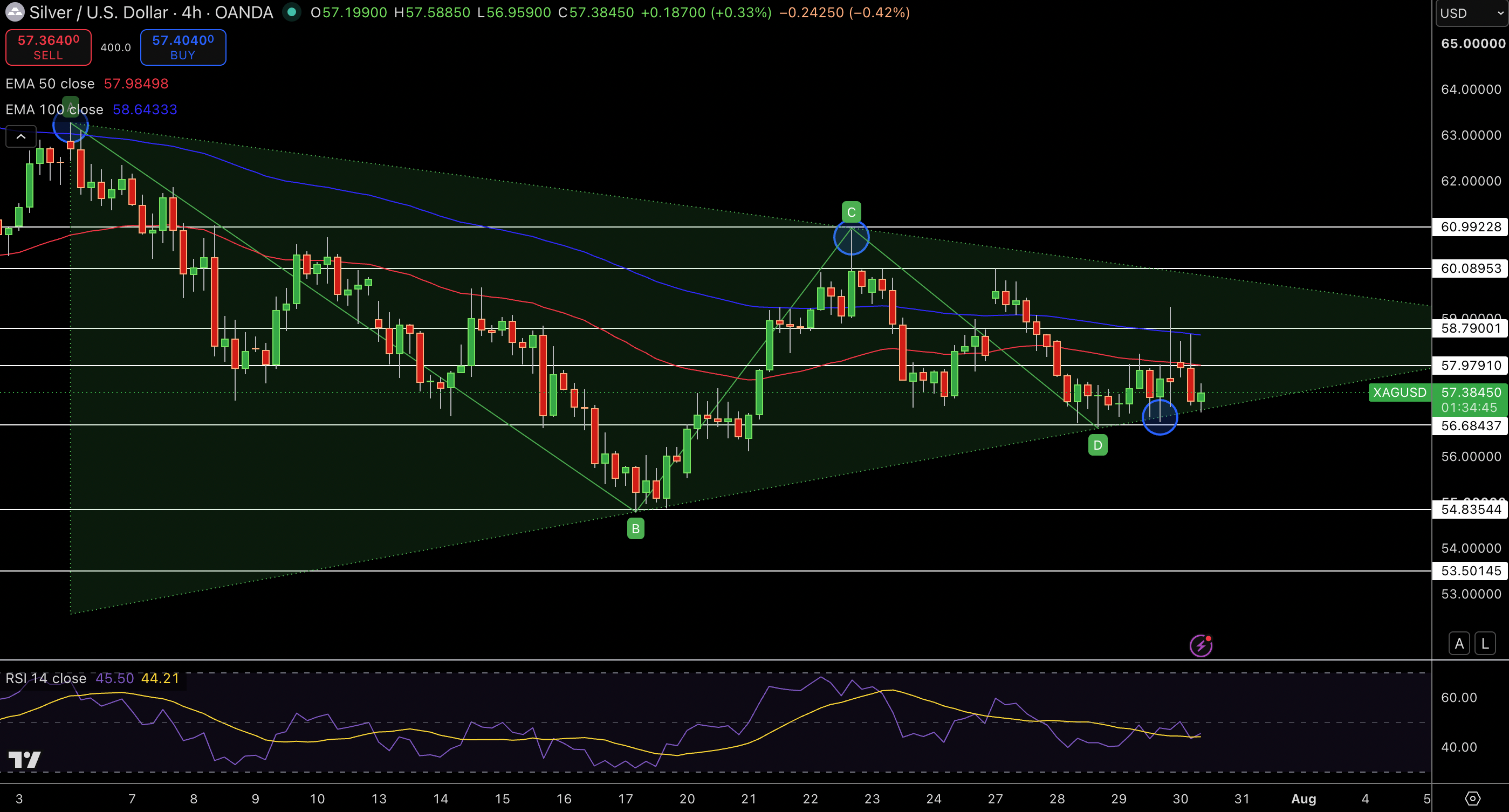
Silver continues to trade inside a large triangle pattern after finding buyers near an ascending trendline around $56.68. Prices continue to be below the 50-EMA ($57.98) and 100-EMA ($58.64), although prices have repeatedly defended the rising trendline. The short-term bias is neutral to slightly bearish. RSI is close to 45, indicating subdued momentum with the trend slowly stabilizing.
Resistance levels are $57.98, $58.79, and $60.09. Support is at $56.68 and $54.84.
The near-term outlook is positive while silver holds above $56.68. Once a level above $57.98 is breached, the next targets are $58.79 and $60.09. If prices fall below the ascending trendline, $54.84 will come into play.