Japan’s Machinery Orders to Spotlight Business Sentiment
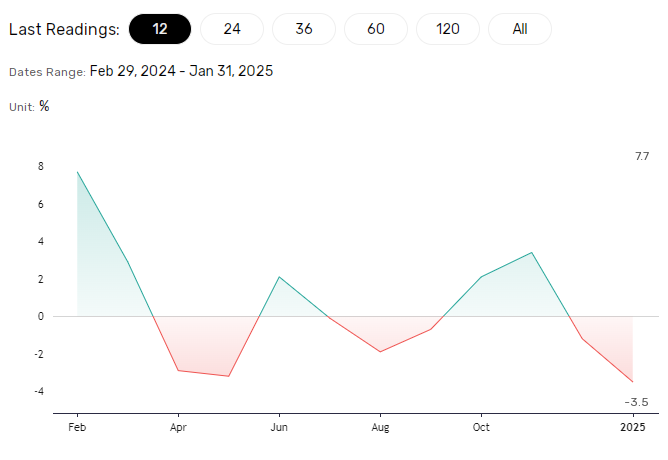
Risk sentiment continues to impact USD/JPY trends as global markets respond to President Trump’s tariff signals. However, on Tuesday, April 16, machinery orders will reflect business sentiment in Japan’s manufacturing sector. Economists forecast orders to rise 0.8% month-on-month in February after tumbling 3.5% in January.
A stronger-than-expected reading may point to improving business sentiment and supporting investment, employment, and wage growth. Higher wages may fuel household spending and demand-driven inflation. Rising inflation may increase bets on an H1 2025 Bank of Japan rate hike, boosting Yen demand.
Conversely, a softer print could reflect pre-US tariff jitters, affecting business investment. Weaker investment may impact the labor market, potentially dampening household spending and inflationary pressures. Softer inflation would support a less hawkish BoJ stance and softer Yen demand.
Investors should also monitor BoJ commentary. BoJ Governor Kazuo Uyeda recently flagged elevated uncertainty, fueling speculation about a near-term policy hold. Remarks on tariffs and their impact on Japan’s economy, inflation, and policy outlook would influence USD/JPY trends.
USD/JPY: Key Scenarios to Watch
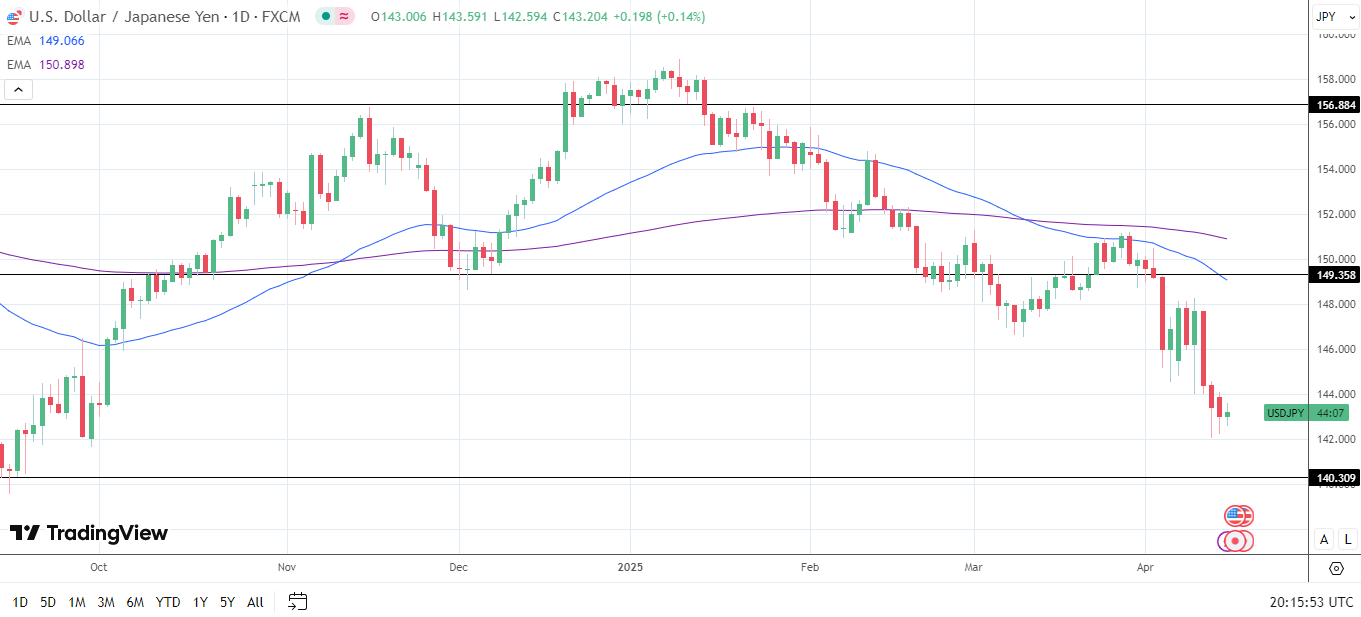
Safe-haven flows into the Yen could weigh on USD/JPY, while improving risk sentiment may lift the pair.

- Bullish Yen Scenario: US-China trade conflict, heightened risk aversion, or hawkish BoJ signals may drag USD/JPY toward the 140.309 support level.
- Bearish Yen Scenario: Trade de-escalation, risk-on flows, or dovish BoJ remarks could push USD/JPY above 145.
USD/JPY Daily Outlook: Retail Sales and Fed in Focus
Later in the US session, US retail sales figures will influence June Fed rate cut bets. Economists expect a 1.4% monthly increase in March after a 0.2% rise in February.
A sharper increase could fuel demand-driven inflation, ease recession fears, and support a less dovish Fed rate path. In this scenario, the USD/JPY pair could move toward 145, a crucial resistance level.
On the other hand, an unexpected drop in retail sales may raise recession fears, support calls for multiple Fed rate cuts, and send the pair toward the 140.309 support level.
Beyond the data, tariff-related headlines and Fed commentary will influence US dollar demand. Any dovish signals from FOMC members or renewed trade tensions could weigh on the dollar.
Potential USD/JPY Moves:
- Bullish US dollar Scenario: Strong retail sales, softer US tariff rhetoric, or hawkish Fed commentary could drive the USD/JPY pair toward 145.
- Bearish US dollar Scenario: Weak retail sales, dovish Fed signals, or worsening trade tensions may push the pair toward the 140.309 support level.
Explore expert USD/JPY forecasts and setups in our latest analysis.
AUD/USD Price Forecast
Every new AUD/USD analysis as it publishes, today's technical signal and key levels, live price — on one page.
See all AUD/USD forecastsAUD/USD Outlook: China Economy in Focus
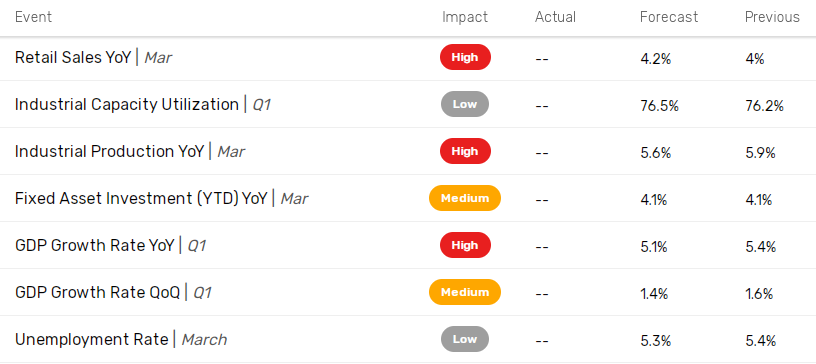
Focus shifts to the Aussie as China’s economy, trade updates, and stimulus developments from China will drive AUD/USD trends. Economists forecast China’s economy to grow 5.1% year-on-year in Q1 2025, down from 5.4% in Q4 2024.
A weaker-than-expected reading could impact risk assets, including commodity-linked currencies like the Aussie dollar. With China accounting for roughly a third of Australian exports—and a trade-to-GDP ratio above 50%—weaker growth could pressure Australia’s economy and support a dovish RBA stance.
Conversely, upbeat data would suggest a resilient demand environment, boosting Aussie dollar demand. Alongside GDP data, China’s retail sales, industrial production, and unemployment for March will give insights into the economic momentum going into Q2 2025.
Tariff headlines and stimulus updates from Beijing remain additional factors. Retaliation risks may dampen sentiment, but fresh stimulus could lift demand and support AUD/USD gains.
AUD/USD: Market-Moving Factors
- Bullish Aussie dollar Scenario: Upbeat Chinese economic data, rising US-China trade tensions, or hawkish RBA remarks may lift the AUD/USD pair above the $0.63623 resistance level, targeting the 200-day EMA.
- Bearish Aussie dollar Scenario: Weak Chinese data, easing trade frictions, or dovish RBA signals may send the pair toward the 50-day Exponential Moving Average (EMA) and possibly $0.62500.
For a comprehensive analysis of AUD/USD trends and trade data insights, visit our detailed reports here.
Aussie Dollar Daily Outlook: Retail Sales Spotlight the US Economy
In the US session, stronger retail sales could ease Fed rate cut bets and weigh on AUD/USD, potentially dragging the AUD/USD pair below the 50-day EMA toward $0.62. However, a softer print may fuel Fed rate cut bets, sending the pair above the $0.63623 resistance level to test the 200-day EMA.

Key Market Drivers to Watch Today:
- USD/JPY: Machinery orders and BoJ signals.
- USD/JPY and AUD/USD: US retail sales, Fed commentary, and tariff developments.
- AUD/USD: China GDP, Beijing stimulus moves, and US-China trade headlines.
Review today’s trade setups in our latest USD/JPY and AUD/USD reports.