
Dollar Index Outlook: Hawkish Fed Supports Dollar as EUR and GBP Face Softer Policy Paths
The U.S. dollar is expected to appreciate in the near-term due to expectations the Federal Reserve will implement a series of interest rate increases in the near-to-medium term. The Fed raised its benchmark rate by 0.75 percentage points last week and removed pledge to defend 2% inflation, thus signaling further rate increases were possible.
Investors also expect other central banks will also implement tighter monetary policies. The Eurozone and the U.K. are expected to implement more dovish monetary policies.
Lower energy prices reduce inflationary pressures and support the U.S. dollar. However, other geopolitical uncertainties, such as the situation in the Middle East, support the U.S. dollar. The Fed is expected to raise rates to make up for the lags in the monetary policy implementation.
Compared to the British Pound and the Euro, the greenback has less volatility. The European Central Bank has tightened policy this month. However, officials have indicated caution to the energy price shock and unprecedented tightening. Other geopolitical uncertainties remain following the Poor showing by Chancellor Friedrich Merz’s party in recent regional elections.
The Bank of England meeting in September kept policy unchanged, signaling further tightening. While headline inflation continued to rise, core inflation remained flat. The central bank is concerned about second round effects and rising wage inflation.
A hawkish hold by the BOE and caution by the ECB leaves the GBP and EUR relatively bearish versus the USD over the intermediate term. A more hawkish than dovish Federal Open Market Committee communication or higher than expected inflation numbers would benefit the USD over other major currencies in the short run.
Fundamental bias: DXY moderately bullish, EUR neutral-to-bearish, GBP neutral-to-bullish, with upcoming Fed communication and inflation expectations central to the next policy repricing.

U.S. Dollar Index Technical Analysis: DXY Holds Above 100.19 as 100.37 Breakout Remains in Focus
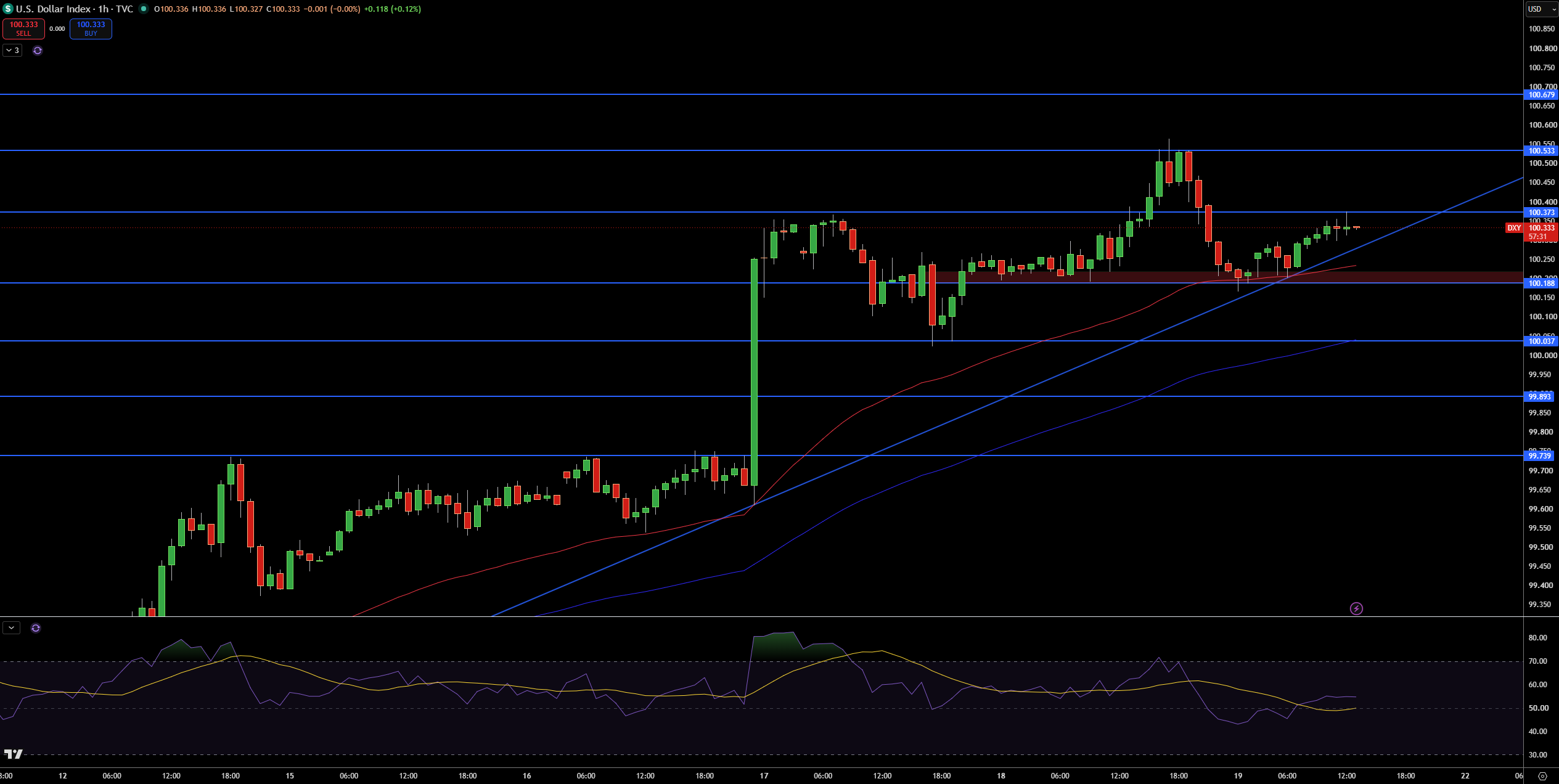
The U.S. Dollar Index is currently trading at 100.33 in the 1 hour time frame chart. DXY recently broke out above the 100.37 resistance and is in the process of forming an upward sloping trend line. The Index is above both the 50 and 100 moving averages and is being supported by the 100.19 area.
The trend line resistance is expected to be seen at 100.37, 100.53 and 100.68 successively. The lower trend line support is expected to be seen at 100.19, 100.04 and 99.89 in that order.
The Relative Strength Index (RSI) is in the neutral area and is expected to trend in the bullish zone as long as the 100.19 area is kept. The 100.04 area would change the RSI trend to bearish and a break of the 100.37 area would be needed to validate the move to the 100.53 and 100.68 areas.
EUR/USD Price Forecast
Every new EUR/USD analysis as it publishes, today's technical signal and key levels, live price — on one page.
See all EUR/USD forecastsGBP/USD Technical Analysis: Sterling Holds 1.3368 as Descending Trendline Caps Recovery
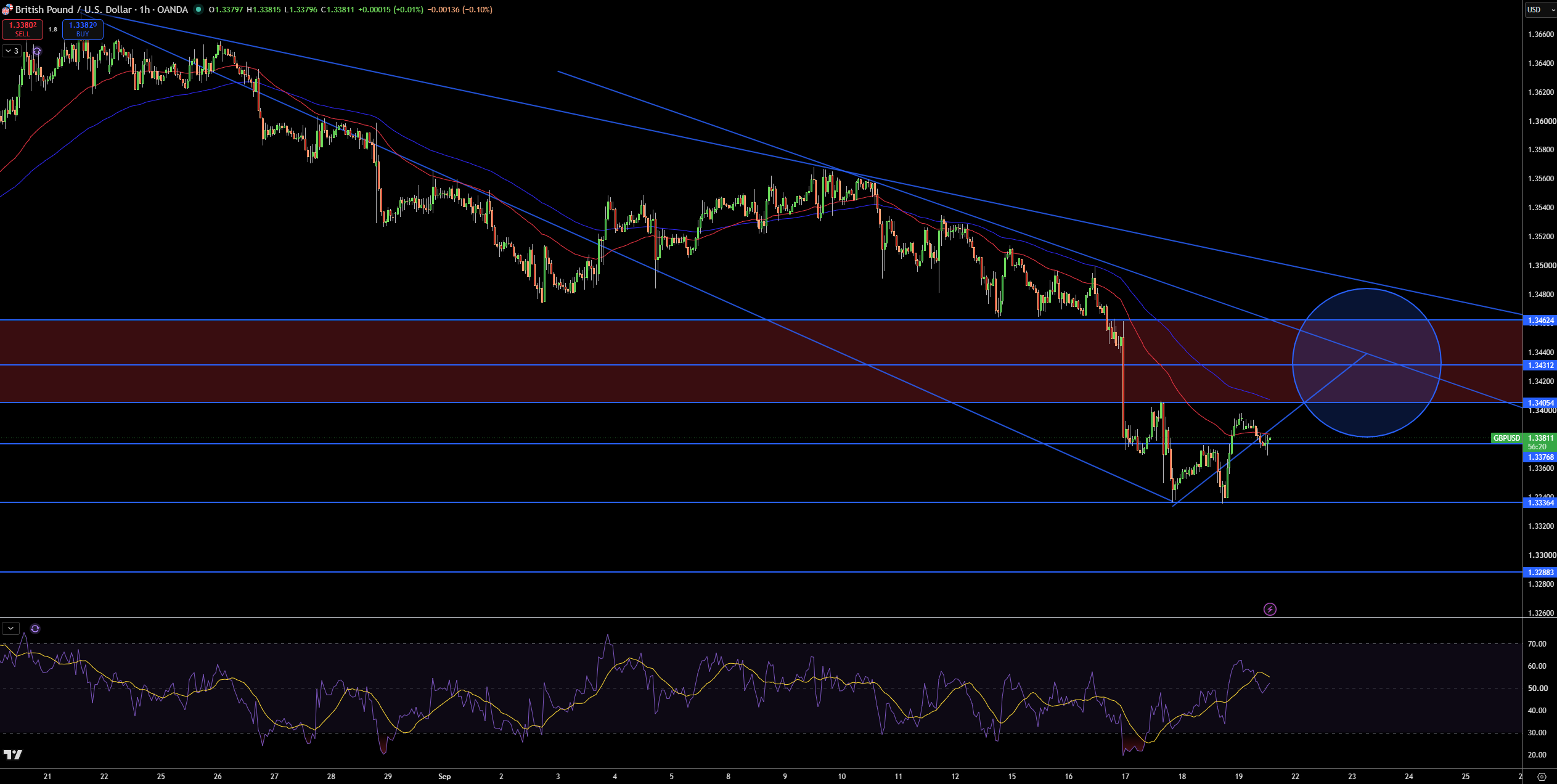
The GBP/USD pair is currently trading at 1.3381. It recently bounced from the 1.3336 support area. The pair is still below both the moving averages and the descending trendline. The price recently bounced from the 1.3377-1.3380 area and is likely to retest the support again.
I believe the 1.3405 level will act as the next resistance level. A break above that level will likely lead to a move towards the 1.3431 level. The 1.3368 level should act as support and hold. A break lower will likely lead to a move towards the 1.3336 and 1.3288 support levels.
The RSI is currently in neutral territory. I believe that support is still present and the price may move higher. I am slightly bearish and believe that the 1.3405 and descending trendline will cap any further upside. A move above the 1.3431 level would change my view. I also believe that a move below the 1.3368 support would lead to a break of the 1.3336 level.
EUR/USD Technical Analysis: Euro Stalls Below 1.1478 as 1.1456 Support Remains Exposed
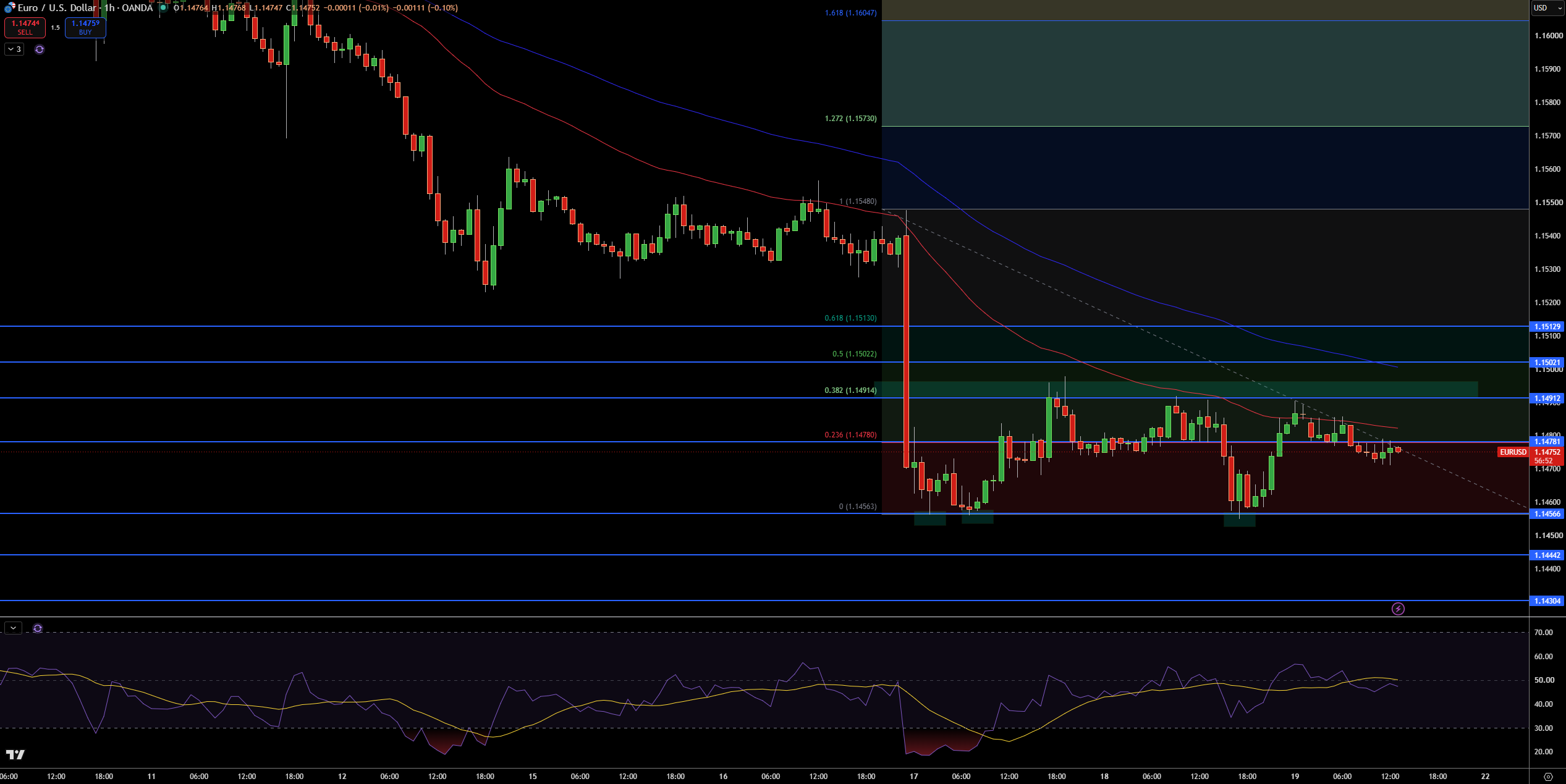
The Euro is trading at 1.1475 against the US dollar. It recently stalled at the 1.1478 resistance zone. The Euro also continues to trade below both moving averages and the falling trendline. If the 1.1478 resistance is broken, further resistance may be seen at the 1.1491, 1.1502, and 1.1513 zones. The 1.1456 support has remained intact. Possible additional support may be at the 1.1444 and 1.1430 zones.
A moving average convergence divergence (MACD) indicator on the hourly chart shows that the lines are converging and are currently flat. Currently, the trend may be considered sideways. If the 1.1491 and 1.1502 resistance zones are broken, further upward momentum may be expected. If the 1.1456 support zone is broken, the 1.1430 zone may also be broken and further downside momentum may be expected.