
Sellers Pin Natural Gas Ahead of Storage Report
Natural gas is trading at $3.216 early Thursday, up 0.4 cents, or 0.12%, as the market waits for the weekly EIA storage report.
Wednesday’s session showed who’s in control. August Nymex futures ran to a 1.5-week high after President Trump said the Iran ceasefire was over, but the market couldn’t hold the bid. Futures rolled over and settled at $3.212, down 5.3 cents, or 1.62%. Sellers used the strength to offload, not to add to positions. A rally that dies on real news tells you the shorts are in charge.

Daily August Natural Gas Futures Technical Analysis
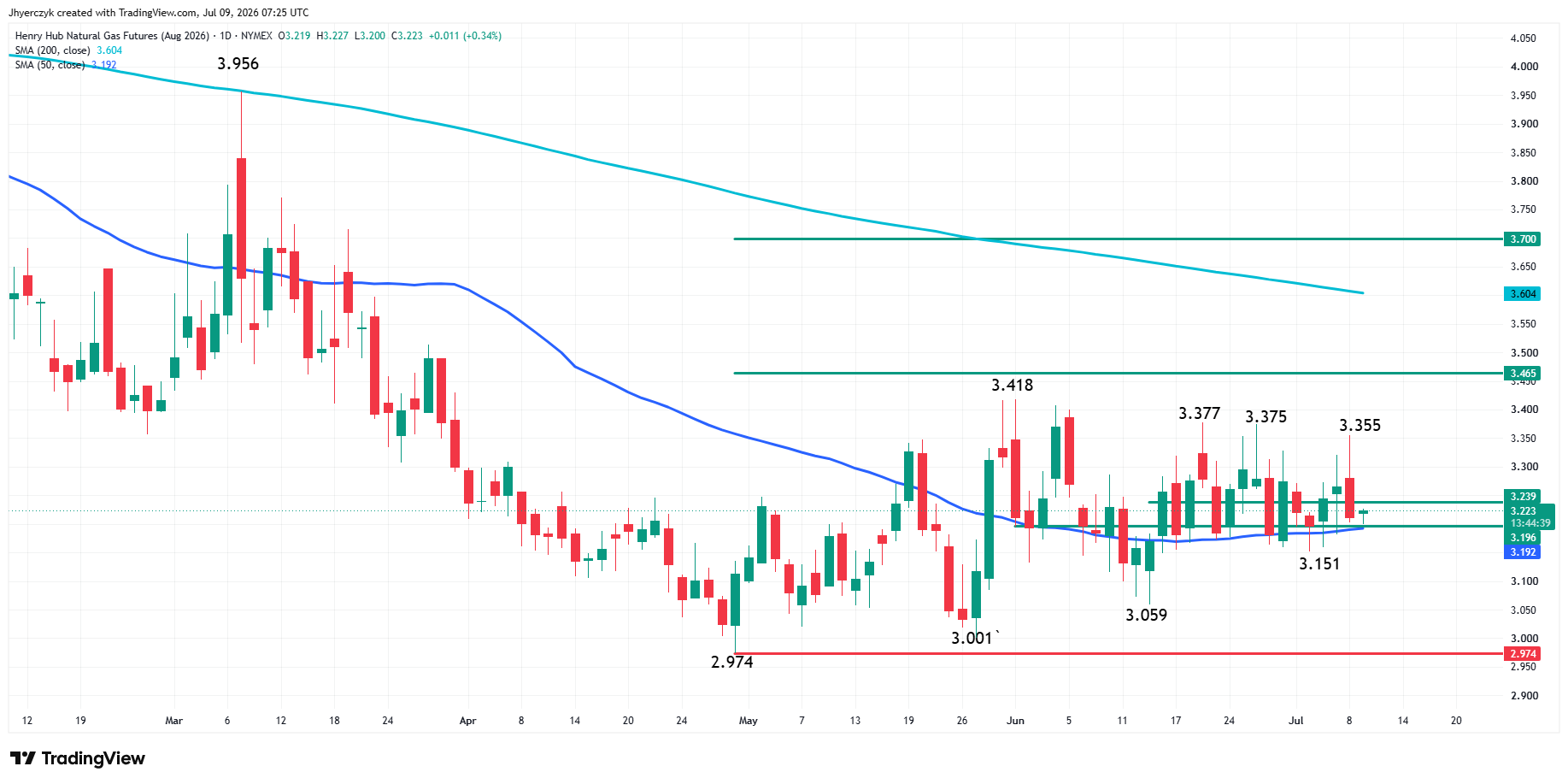
August natural gas futures are holding steady early Thursday. The market is trading inside a short-term retracement zone at $3.196 to $3.239, while sitting on the strong side of the 50-day moving average at $3.192.
This early set-up tells me that the price cluster at $3.196 to $3.192 is the area to watch today.
Holding the 50-day MA suggests the presence of buyers. Overcoming the pivot at $3.239 will indicate the buying is getting a little stronger. If it continues to generate upside momentum then the market could retest the three minor tops from $3.355 to $3.377. Overcoming these potential headwinds won’t mean that the bulls are in the clear, however. The buying still has to be strong enough to take out the main top at $3.418 and the intermediate pivot at $3.465. Accomplishing this will only take us to the 200-day moving average at $3.604 and the long-term pivot at $3.700.
Needless to say, unless the fundamentals are overwhelmingly bullish, any rally is likely to be a labored event. Additionally, it’s very likely that any rally is likely to be fueled by short-covering and aggressive profit-taking. This is because right now, the market is in the hands of strong short-sellers, which we can see from the series of tops. They clearly show that traders are selling rallies.
Hope for a heat-driven short-covering rally hinges upon the 50-day MA remaining solid support. If it fails, the first test is the minor bottom at $3.151. Breaking this level with conviction likely means the short-selling is getting stronger with potential targets at $3.059, $3.001 and $2.974.
Natural Gas Price Forecast
Every new Natural Gas analysis as it publishes, today's technical signal and key levels, live price — on one page.
See all Natural Gas forecastsDaily February Natural Gas Futures Technical Analysis
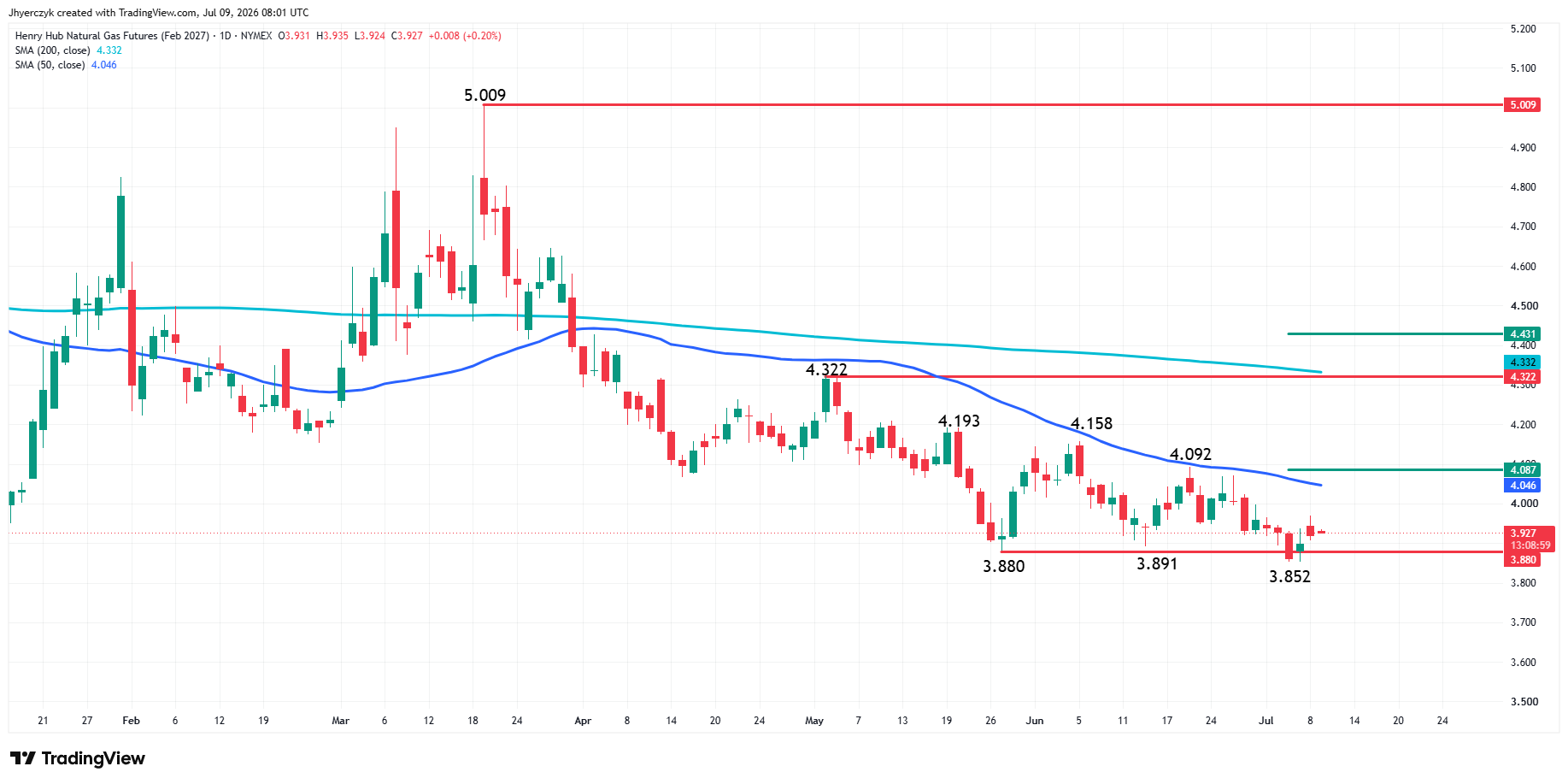
February natural gas futures are steady early Thursday. Its downtrend was reaffirmed on Monday when its late May bottom at $3.880 failed to hold. The price action serves as a sign that longer-term traders believe that there will be ample storage available this winter.
Nearby resistance is the 50-day moving average at $4.046. Until the market crosses to the strong side of this indicator, we really can’t think about a rally yet. However, a solid support base throughout the summer and fall could lay the groundwork for a strong rally later in the winter.
Injections Keep Running Hot
Thursday’s EIA report is the setup for the rest of the week. Analysts expect a 61 bcf injection for the week ended July 3, above the five-year average build of 51 bcf. Even the consensus number is bearish. Anything at or above it gives the shorts more ammunition to sell into strength.
Last week made the case. An 87 bcf build crushed the five-year average of 64 bcf and pushed total inventories to 6.4% above the seasonal norm. Surplus like that keeps a ceiling over every rally attempt.
Production is the reason those injections keep coming in heavy. Lower-48 dry gas output is running at 111.6 bcf per day, 4.2% above last year, and the EIA just raised its forecast for next year’s production to 111.2 bcf per day. Demand is going the wrong direction. Lower-48 consumption dropped to 76.2 bcf per day, off 4.9% year over year, while LNG feed gas deliveries fell to 18.4 bcf per day, down 3.7% week over week.
Summer electricity generation climbed 7.73% year over year for the week ended July 4 according to the Edison Electric Institute, but power demand alone is not big enough to close that gap. And a strong El Niño forecast is stacking the risk further out. A warmer-than-normal fall and winter would cut into heating demand right when the market normally starts drawing down storage.
Europe’s Supply Gap Is the Bullish Wildcard
European gas storage at 50% is fifteen points below where it normally sits this time of year. Utilities over there still have a lot of buying to do before winter, and the list of sellers they can call is getting shorter.
Trump killing the Iran ceasefire brought Persian Gulf shipping risk back into the conversation. Ras Laffan is still running below full capacity after the attacks, and repairs on that facility are measured in years, not months. If Gulf transit tightens on top of that, European buyers don’t have many places left to turn. U.S. LNG becomes the market of last resort, and that kind of competition for cargoes would hit domestic storage builds directly.
But here’s the disconnect. The weekly feed gas data doesn’t show any of that buying yet. Deliveries actually fell last week. Until that European pull starts showing up in the numbers, the domestic surplus is what traders are pricing.
What to Watch
Thursday’s EIA number sets the tone. If the injection comes in at 61 bcf or higher, the surplus story stays intact and sellers have no reason to cover. Output is running 4.2% above last year with no sign of slowing down, consumption is falling year over year, and inventories are already 6.4% above the five-year average.
Stack El Niño on top of that and the winter demand case gets even harder to make. Warmer temperatures through the fall would delay the seasonal drawdown the bulls are counting on. The only force that reverses the direction is Europe’s storage deficit pulling U.S. LNG exports higher, and the feed gas data says that pull has not started.
The 50-day moving average is holding for August, and that keeps a short-covering bounce toward the minor tops alive. Sellers have been defending that area all month. February already confirmed its downtrend when the late May bottom broke. Longer-term money is pricing in plenty of winter supply. Losing the 50-day on August opens the path toward $3.00.
More Information in our Economic Calendar.