
Peace Headlines Test Crude as Hormuz Risk Holds the Floor
Crude starts the week caught between two stories that do not cancel each other out. The Russia-Ukraine ceasefire and a promise of Russian diesel gave sellers a headline to work with Monday. The Strait of Hormuz attacks and the Saudi airport strikes were not part of any deal.
Sellers have the diplomatic angle, but confirmed barrels and safe shipping lanes are still missing from the trade.
December WTI crude oil futures finished 1.34% higher last week. Brent held above $100 per barrel despite the latest push to ease refined-product tightness.

Weekly December WTI Crude Oil Futures Technical Analysis
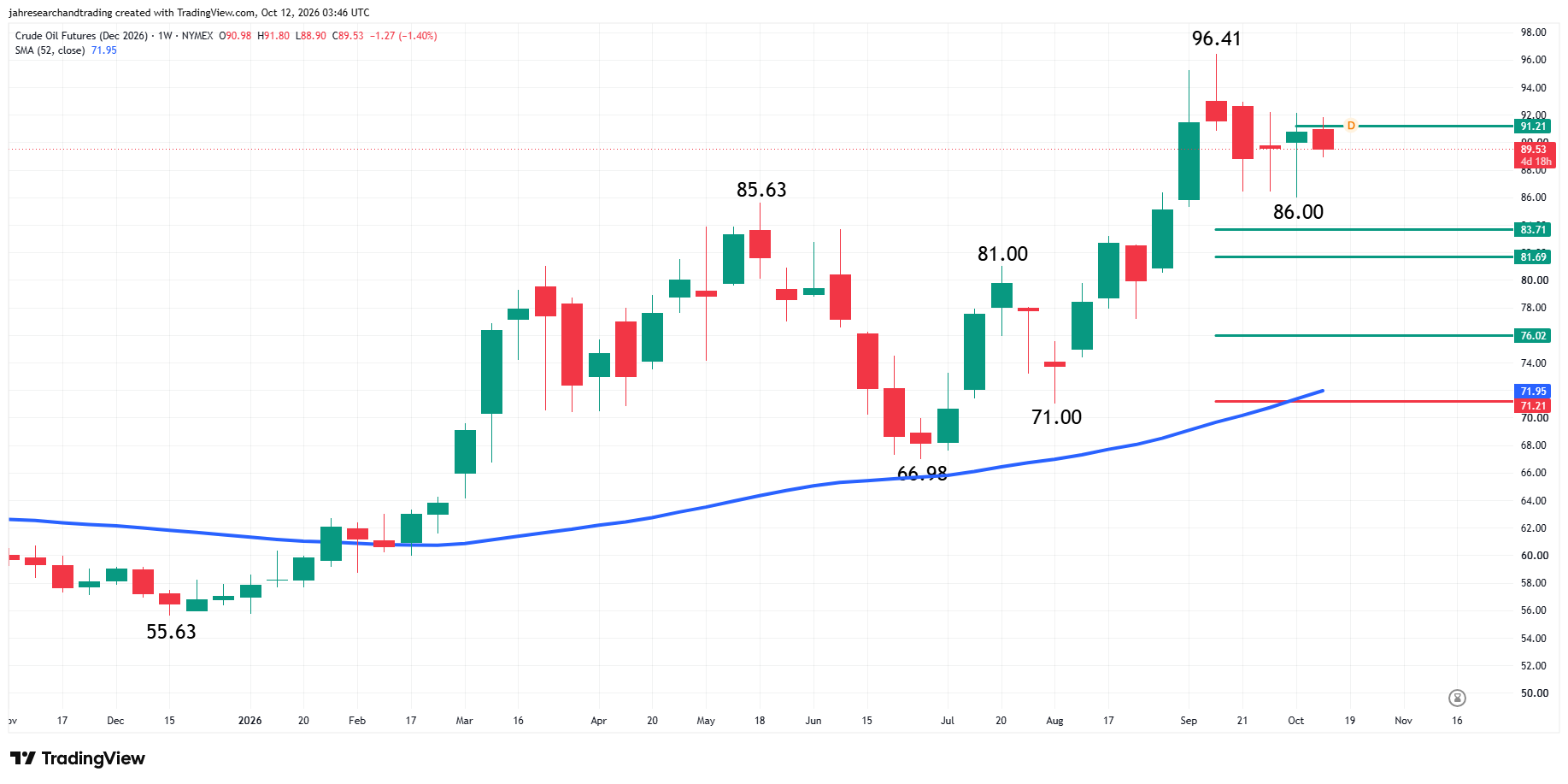
December WTI crude oil futures opened the week under pressure early Monday after finishing 1.34% higher last week. The main trend is up according to the weekly swing chart. A trade through $96.41 will signal a resumption of the uptrend. The main trend will change to down on a break through $71.00.
The minor trend is up. A trade through last week’s high at $92.14 will turn $86.00 into a new minor bottom.
The minor range is $96.41 to $86.00. Its pivot at $91.21 is likely to control the direction of the market this week.
The nearest support is a pair of 50% levels at $83.71 to $81.69. With the main trend up, buyers could show up on a pullback into this area. A failure to hold $81.69 could trigger an acceleration to the downside with $76.02 to $71.21 the next major target zone. Inside this zone is the 52-week moving average at $71.95. This indicator has been controlling the trend since late January.
Brent Oil Price Forecast
Every new Brent Oil analysis as it publishes, today's technical signal and key levels, live price — on one page.
See all Brent Oil forecastsWeekly December Brent Crude Oil Futures Technical Analysis
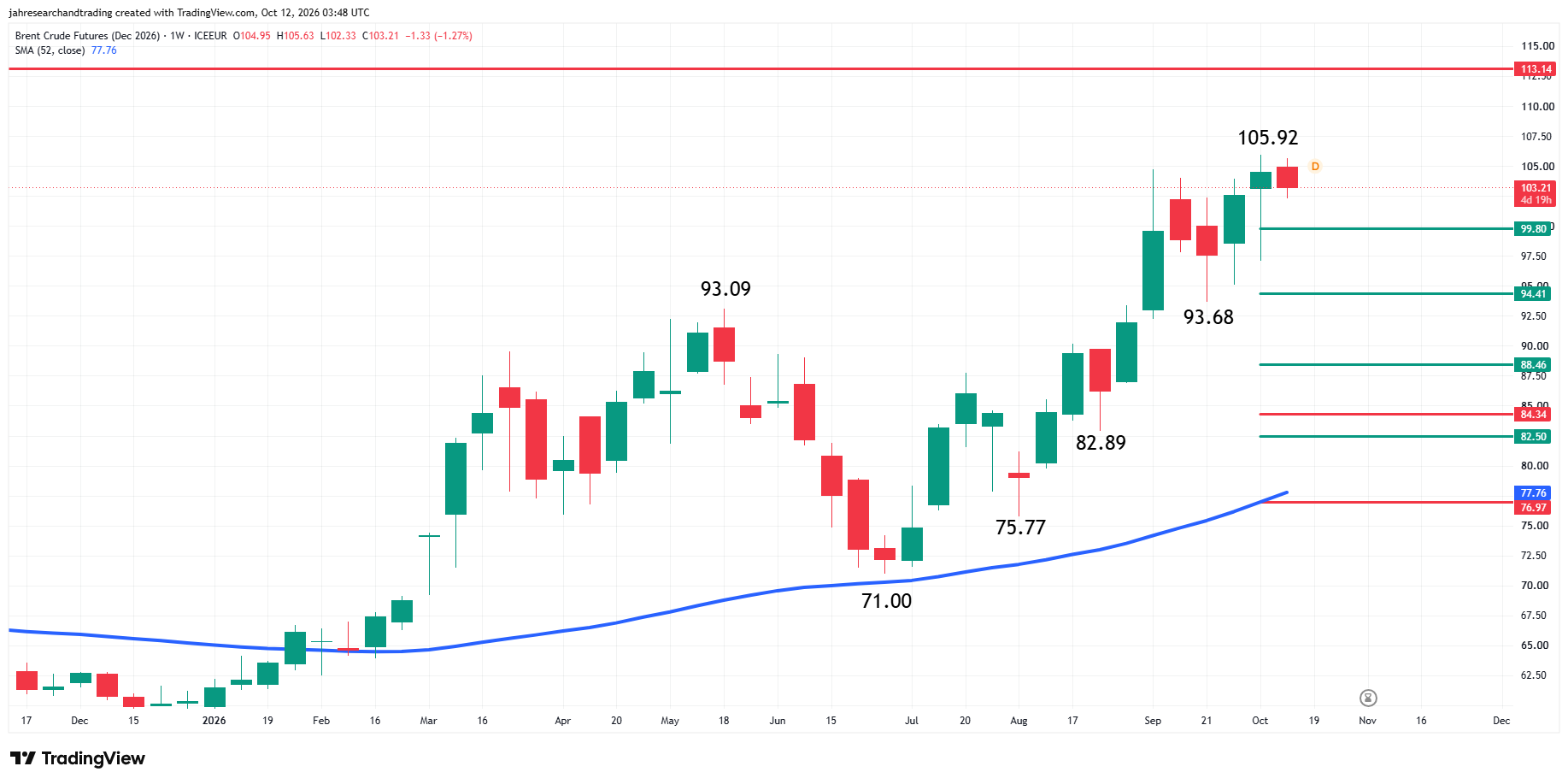
December Brent crude oil futures are lower early Monday. The market is trading inside last week’s range, suggesting trader indecision. The main trend is up according to the weekly swing chart. A trade through $105.92 will signal a resumption of the uptrend. The main trend will change to down on a trade through $75.77.
The minor trend is also up. A trade through $93.68 will change the minor trend to down and shift momentum to the downside.
A trade through $105.92 will put $113.14 on the radar. On the downside, the first pivot price to watch is $99.80. This pivot is likely to control the direction of the market this week. Buyers could step in on a pullback into this level, but if it fails as support, Brent futures will be vulnerable to a correction into the main trend 50% level at $94.41 and the minor swing bottom at $93.68.
Russian Diesel Deal Takes Some Heat Out of the Trade
Trump announced Russian diesel headed for global markets. More than 300,000 metric tons immediately, another 500,000 metric tons in November, and 1 million metric tons after that. Gasoil futures dropped 3% to $1,436 per barrel on the news.
Global diesel consumption runs near 29 million barrels per day, so the announced volumes ease some of the tightness without rebalancing the market on their own. Additionally, the International Energy Agency is pressing members to assess whether additional diesel releases are needed and to accelerate pledged volumes that have not been delivered.
The ceasefire is the same trade. Trump said both sides agreed to stop hitting energy facilities. Ukraine said it was waiting for details. Russia did not comment.
Hormuz and Saudi Attacks Keep the Supply Risk Alive
The Middle East risk has not gone away. The Houthis claimed responsibility for a strike on Riyadh’s international airport Saturday. Saudi authorities reported another attack on the airport Sunday. Trump said the United States was considering joining Saudi strikes on the Houthis.
The shipping story is just as important. United Kingdom Maritime Trade Operations reported that one tanker was struck by a drone near Sohar anchorage in Oman and another was damaged moving through the Strait of Hormuz. More attacks this month threaten the recovery in Middle East crude exports seen in September.
None of that changed with the ceasefire discussion. A Russia-Ukraine deal on energy facilities does not extend to the Red Sea or the Gulf shipping lanes.
Gulf Output Returns as the Storm Risk Fades
Shell, Chevron and BP were redeploying personnel after Hurricane Isaias made landfall Saturday. Gulf of Mexico production coming back takes away the supply story that helped WTI late last week. That puts more near-term pressure on the WTI side of the market.
Goldman Sachs said high U.S.-Europe shipping costs have widened the WTI-Brent spread. Goldman raised its December Brent forecast to $90 per barrel from $85 and estimated the geopolitical risk premium at just over $20 per barrel. The bank forecast WTI at $81 in December 2026 and $73 in 2027.
What to Watch
The ceasefire has not been verified and the diesel has not been loaded, but Gulf production restarts are already adding supply back into the market. On the other side, the Hormuz shipping risk and Saudi airport attacks are not part of any negotiation. Sellers had the diplomatic headline Monday. The tanker attacks near Hormuz kept them from finishing the job.
WTI’s pivot at $91.21 controls the week. Buyers are taking offers above that level. The next support sits at $83.71 to $81.69.
Brent held above $100 with $99.80 underneath as the floor for the risk premium trade. The Hormuz premium and the wider WTI spread are both in the price.
If you’d like to know more about how to trade crude oil, please visit our educational area.