
Crude Oil Surges Eleven Percent as Hormuz Stays Shut
July WTI crude oil futures settled at $101.16 last week. Up more than eleven percent. July Spot Brent crude closed at $109.71, up more than eight and a half percent. I’ve watched this market react to Hormuz headlines for weeks but last week was different. Traders stopped waiting for a deal. The bids came in hard. Inventories are falling at one of the fastest rates outside a major emergency. This is not a market pricing in a resolution anymore. It is pricing in a prolonged disruption and eleven percent is what that looks like.

Technical Outlook
July WTI Crude Oil Futures Technical Analysis
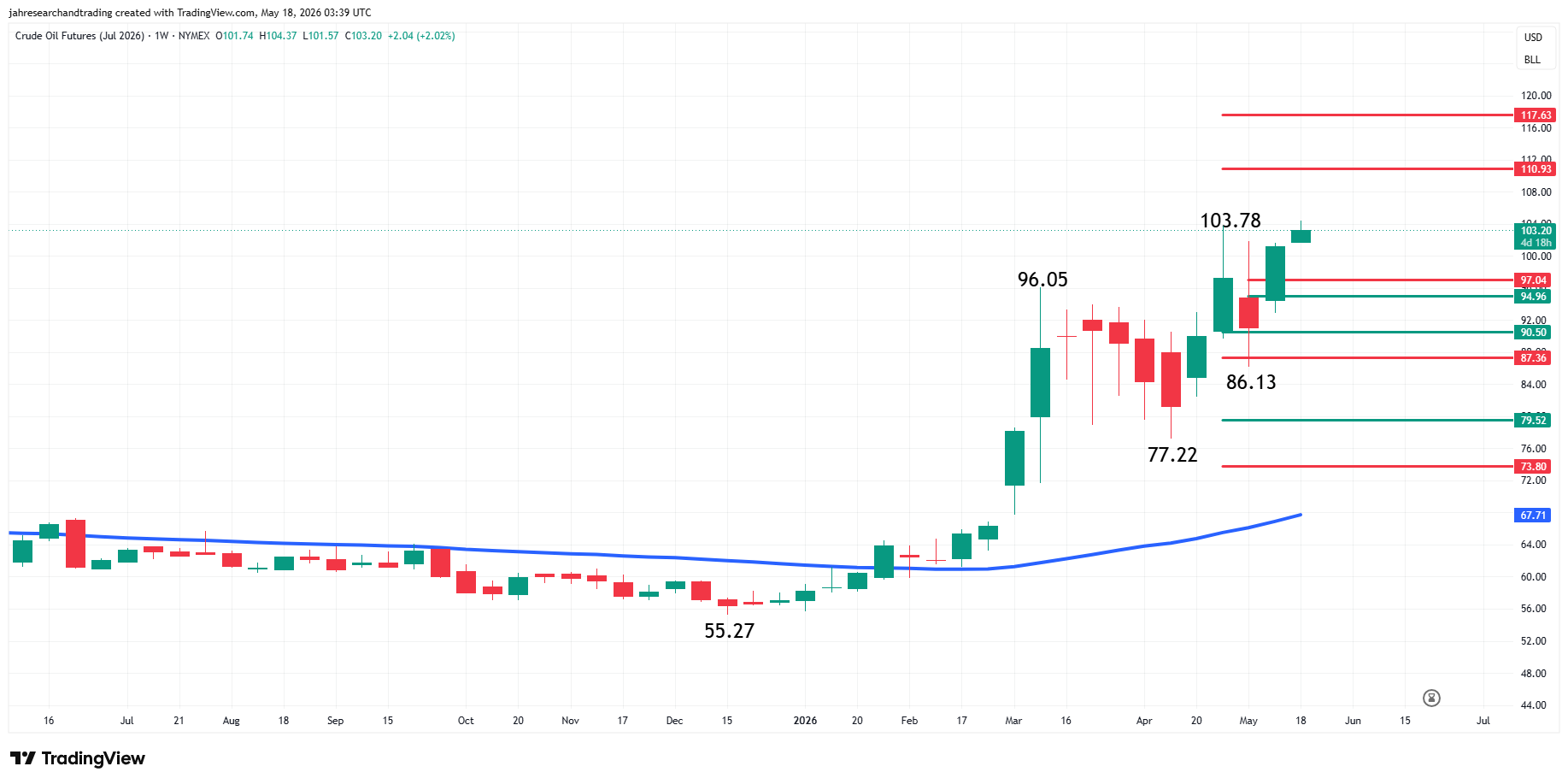
July WTI crude oil futures closed last week in a position to challenge the main swing top at $103.78. This is a potential trigger point for an acceleration to the upside with near-term objectives at $110.93 and $117.63.
On the downside, near-term support is a pair of retracement zones at $97.04 to $94.96 and $90.50 to $87.36.
The minor trend changes to down on a trade through $86.13. This will also shift momentum to the downside. The nearest main bottom is $77.22. A trade through this level changes the main trend to down.
The series of higher bottoms is a strong sign that buyers keep coming in on the hard breaks. This strategy is being supported by the uptrend on the swing chart and the strength and direction of the 52-week moving average.
The early price action on Sunday indicates that traders have shifted from being passive buyers to being aggressive active buying. This means willing to take out offers. This is a bullish sign. If new buyers come in over $103.78 then look for a surge to the upside. New buyers rather than buy stops can launch a strong rally.
Brent Oil Price Forecast
Every new Brent Oil analysis as it publishes, today's technical signal and key levels, live price — on one page.
See all Brent Oil forecastsJuly Brent Crude Oil Futures Technical Analysis
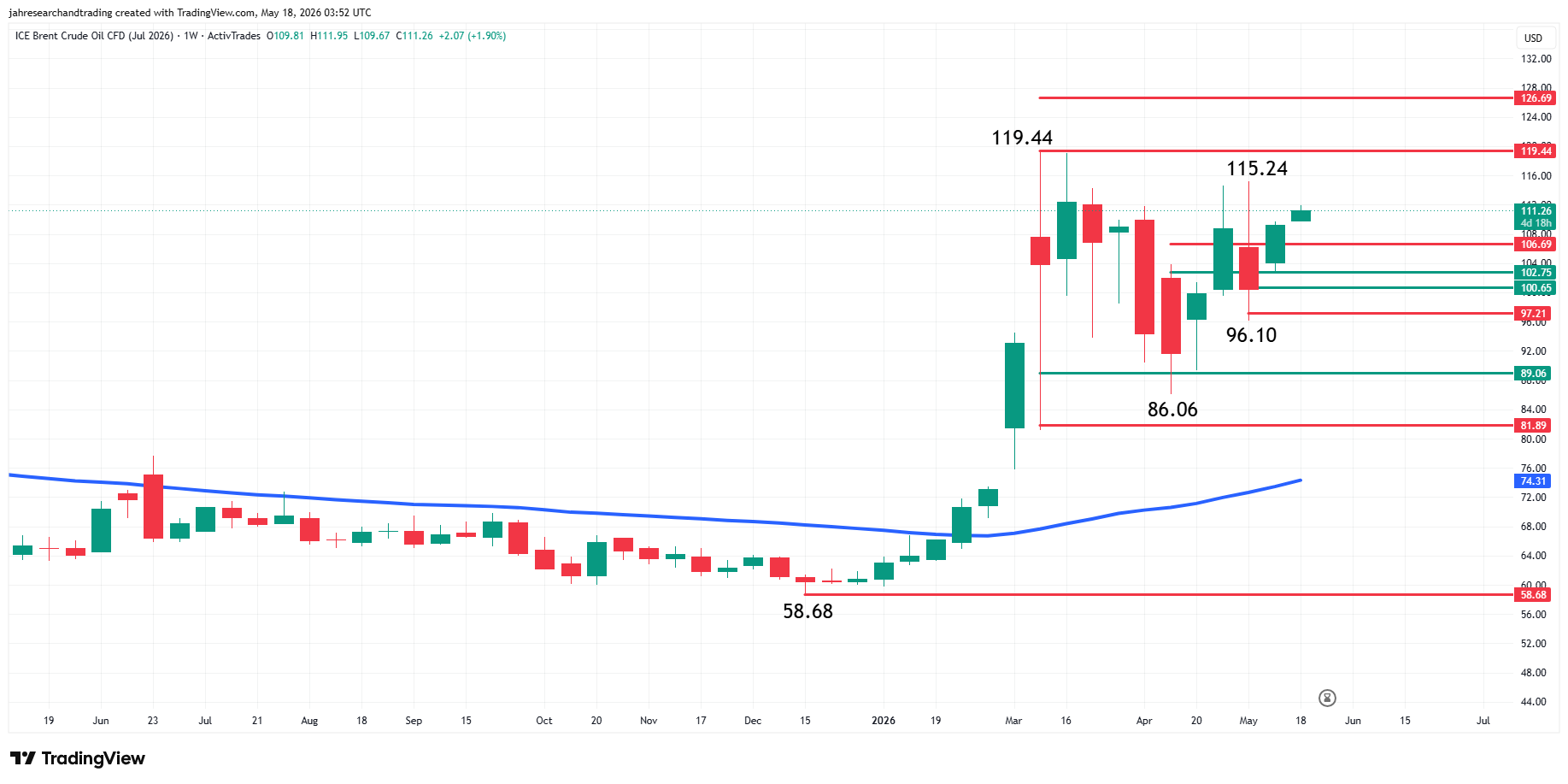
July Brent crude oil futures also closed in a bullish position last Friday, putting it in a position to challenge the two war-driven tops at $115.24 and $119.44 early this week. An extended rally over $119.44 could launch a further move into $126.69.
On the downside, solid support is layered at $106.69, $102.75, $100.65 and $97.21.
A trade through the minor bottom at $96.10 will shift momentum to the downside. The major support zone is $89.06 to $81.89. Inside this zone is the main bottom at $86.06. With the long-term trend fully supported by the 52-week moving average at $74.31, buy the dip traders are likely to keep coming in on any breaks into the major support levels.
The Strait of Hormuz Is the Whole Story
Shipping through the Strait of Hormuz is still running far below normal and every session it stays that way is another session the market has to price in tighter supply. The waterway moves close to one-fifth of the world’s oil on a normal day. Last week was not a normal day and neither was the week before it. Traders who had been waiting for a quick diplomatic resolution stopped waiting. The bids came in hard and they did not stop.
Military escorts have kept some tankers moving but the flow is a fraction of what it was before the conflict started. That is not a short-term disruption anymore. It is a structural supply problem and the market is treating it that way.
Stalled Talks and Fresh Military Exchanges
Every negative headline out of the U.S.-Iran negotiation track added pressure last week. Stalled talks, fresh military exchanges, and Trump’s repeated warnings that the clock is ticking on Iran kept traders from getting comfortable on the short side. The possibility of another round of strikes targeting infrastructure on a larger scale is sitting in the background of every session right now. That threat alone is a bid under this market and it stays there until Washington and Tehran reach something durable.
EIA Report Confirmed the Squeeze
The Energy Information Administration reported a 4.3 million barrel draw in U.S. crude inventories for the week ending May 8. That was well above what analysts had penciled in. Inventories at the Cushing, Oklahoma delivery hub also moved lower. Refiners were running hard ahead of summer driving season and export demand stayed strong as U.S. producers tried to fill some of the gap left by missing Middle East barrels. The draw confirmed what traders already suspected. Supply is tighter than the headline numbers had been suggesting and the market adjusted accordingly.
Middle East Production Losses
Saudi Arabia, Iraq, and the United Arab Emirates did not cut production by choice last week. Export routes stayed disrupted and some producers had to shut in output entirely because they could not move crude safely through the region. The supply that was already missing got smaller. Diesel and jet fuel demand held through all of it. Demand is not the problem. Supply is and it keeps getting worse.
What to Watch
The U.S.-Iran negotiation track is the only thing that changes this market’s direction in a meaningful way. Progress toward reopening the Strait of Hormuz sends oil lower fast. Another breakdown in talks or fresh military action sends it higher.
The next Energy Information Administration inventory report will show whether the draw from last week was a one-week event or the beginning of an accelerating trend. Summer demand, refinery runs, and any comments from major producers are secondary but worth tracking.
The level I am watching is $103.78 on July WTI crude oil futures. That is the main swing top and the trigger point for an acceleration higher toward $110.93 and then $117.63.
On July Spot Brent crude, the war-driven tops at $115.24 and $119.44 are the next tests. Clear those and $126.69 opens up. Support on WTI sits at $97.04 to $94.96 first, then $90.50 to $87.36. Those levels are where the buy the dip traders have been coming in on every hard break and nothing last week suggested that changes.
If you’d like to know more about how to trade crude oil, please visit our educational area.