
July WTI Surges 3.7% as Trump Says Patience With Tehran Is Running Out
July WTI crude oil futures are trading at $100.54, up $3.62 or 3.74% Friday. July Brent crude oil futures climbed to $108.68, up $2.10 or 1.97%. WTI is on pace for a nearly 10% weekly gain. Brent is up almost 8%.
Trump said his patience with Iran is running out and the market heard it immediately. The ceasefire that traders were cautiously pricing as progress is back under threat and oil is repricing that risk in real time. The charts and the supply data are pointing the same direction. Here is what is driving this market.
Technical Outlook
July WTI Crude Oil Futures
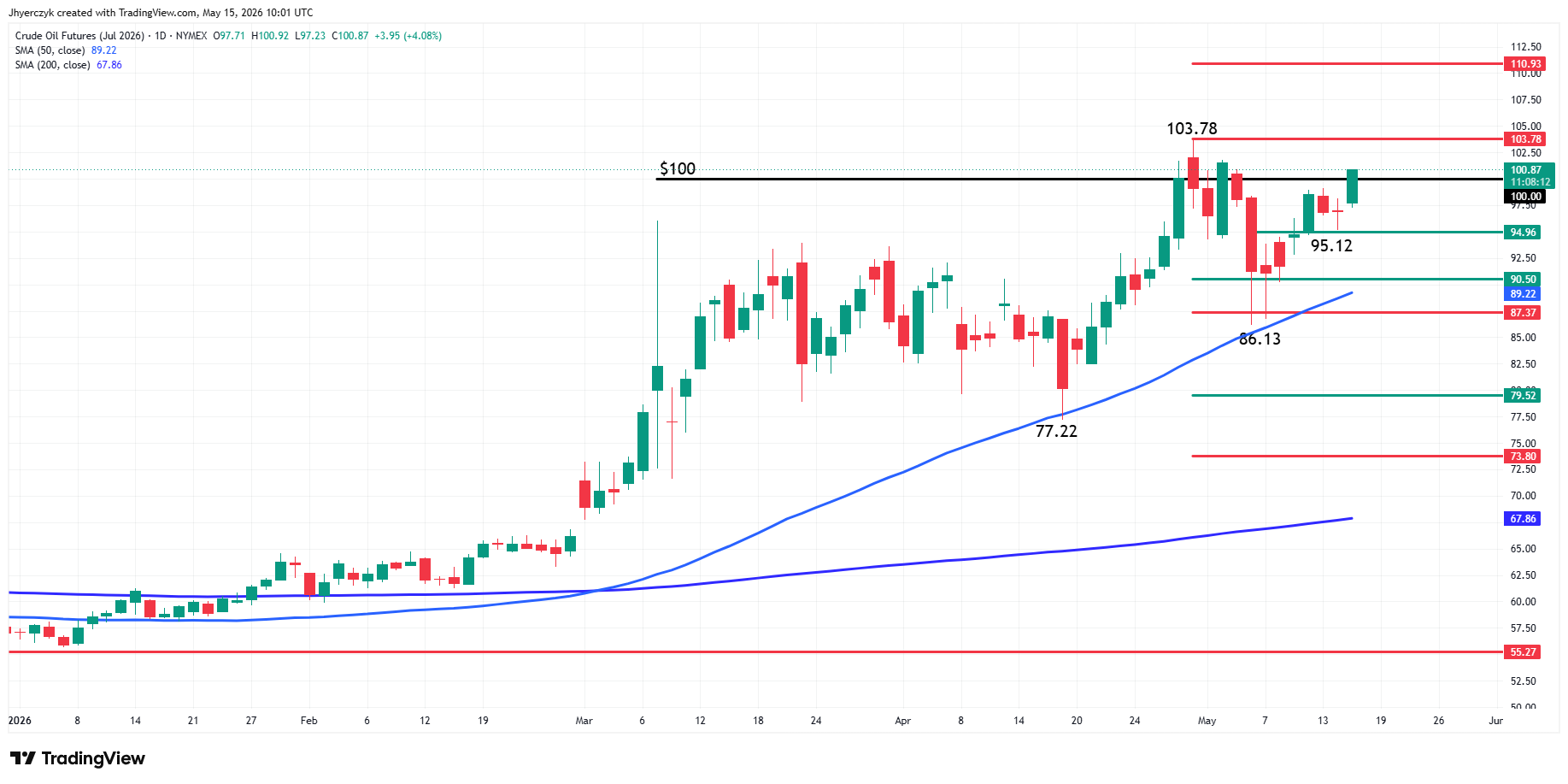
July WTI crude oil futures are sharply higher on Friday as traders attempt to overcome the psychological $100.00 level.
Overtaking the $100.00 level with conviction could trigger an acceleration to the upside with $103.78 the next potential upside target. This price is both resistance and a potential breakout level with $110.93 a potential objective. This is the June contract high.
A failure to overcome $100.00 will signal the presence of sellers. If this generates enough downside momentum, we could see a retest of the 50% level at $94.96, which launched the latest rally.
The major support zone is $90.50 to $87.37. Inside this zone is the 50-day moving average at $89.22. As long as the 50-day MA holds as support, traders will remain in buy the dip mode.
Brent Oil Price Forecast
Every new Brent Oil analysis as it publishes, today's technical signal and key levels, live price — on one page.
See all Brent Oil forecastsJuly Brent Crude Oil Futures
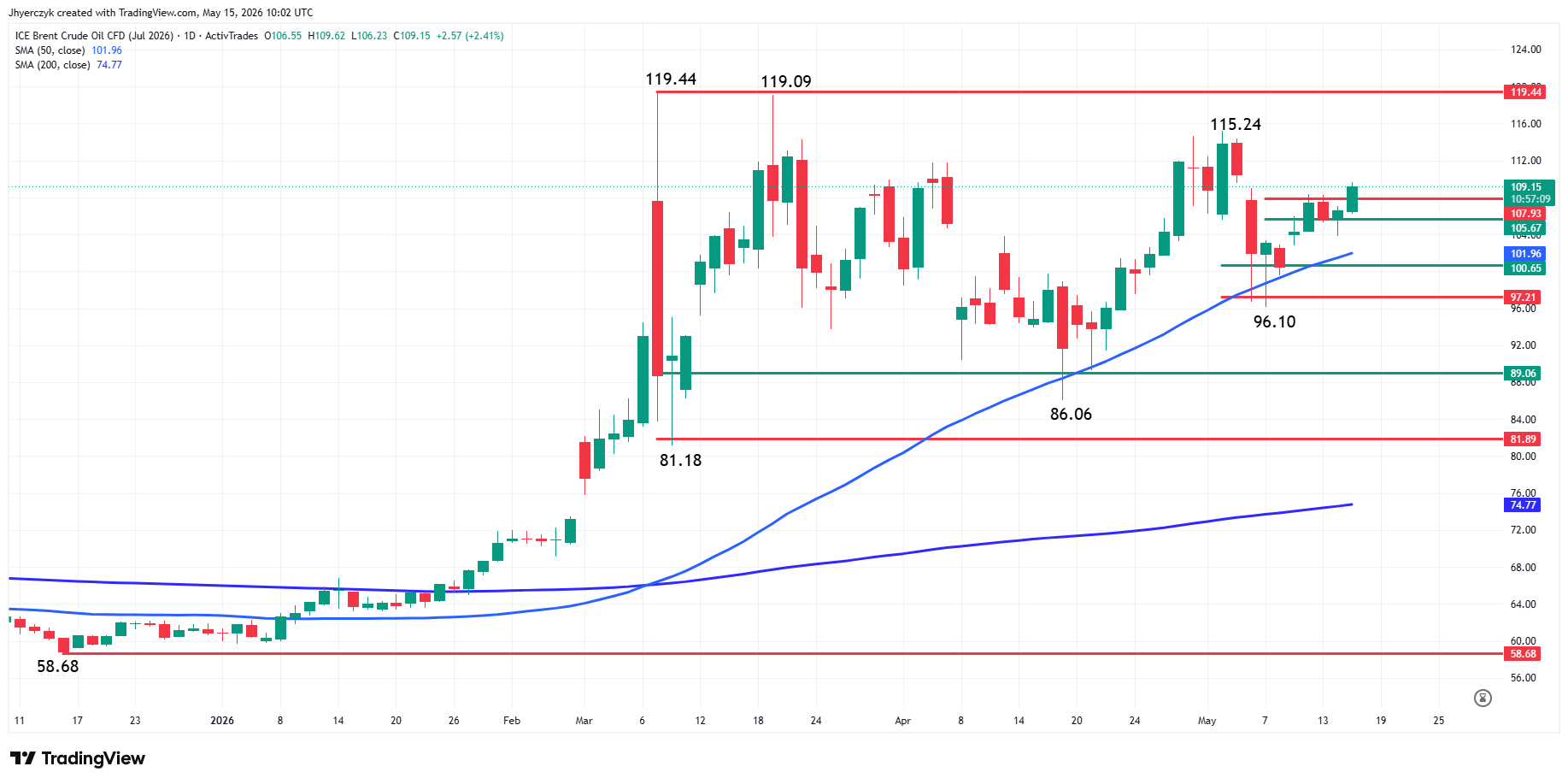
July Brent crude oil futures are also edging higher. They are attempting to breakout over a minor retracement zone at $105.67 to $107.93. If the move creates enough upside momentum, we could see a surge into the May 4 top at $115.24, followed by a pair of tops at $119.09 to $119.44.
A failure at $105.67 will be a sign of weakness. This could trigger a sharp break into the 50-day moving average at $101.96, followed by the intermediate retracement zone at $100.65 to $97.21.
For July WTI crude oil futures, look for a bullish tone today on a sustained move over $100.00 and a bearish tone under $94.96.
For July Brent crude oil futures, a sustained move over $107.93 will indicate the presence of buyers and a sustained move under $105.67 will signal the presence of sellers.
Trump Changed the Tone in One Statement
Trump and Xi agreed on two things after their Beijing meetings. Iran cannot have nuclear weapons and the Strait of Hormuz has to fully reopen. Then Trump added the line that moved oil. His patience with Tehran is running out. That is not diplomatic language. That is a warning and the crude oil market priced it as one immediately. Two days of cautious optimism about Strait traffic resuming unwound in a single press appearance. I’ve watched this market flip on a headline before but Thursday’s move from relative calm to a 3.7% surge tells you how thin the peace trade was underneath.
The Strait Numbers Tell the Real Story
Thirty vessel crossings in a roughly 24-hour window according to Iranian state media. Ten ships in the last 24 hours according to shipping analytics. Before the conflict started 140 ships moved through daily. The math is not complicated. Ten is not 140. Traders who briefly treated the partial resumption as a sign of normalization are now reading it differently. Tehran is deciding who gets through and who does not. That is not a reopened shipping lane. That is leverage and the oil market is pricing the difference between those two things right now.
The Inventory Picture Has No Cushion Left
The Energy Information Administration reported a larger than expected crude draw this week. Cushing hub stocks dropped sharply. Gasoline inventories fell as buyers moved away from Gulf supply routes. Strong U.S. exports kept domestic stockpiles from recovering even with production running healthy. Refiners stayed at elevated utilization rates to meet summer fuel demand. I keep coming back to the same conclusion every time I look at these numbers. The global oil market has almost no spare capacity left and every session the Strait stays restricted takes another layer off what little buffer remains.
Two Agencies Reading the Same Crisis
The IEA put a number on it. Supply deficits are coming if the Gulf stays disrupted and inventories that have been falling for months have no room left to absorb more losses as summer demand peaks. OPEC came at it from the other direction. Demand growth got trimmed because $100 oil is starting to hurt consumers and businesses. Production increases from member countries are not coming fast enough to fill the gap the Strait has created. One agency is worried about running out of supply. The other is worried about killing demand. Both of those problems exist at the same time right now and July WTI crude oil is sitting in the middle of them.
What I’m Watching
The $100.00 level on July WTI crude oil is the trade. Push through it with conviction and $103.78 opens up as the next target with $110.93 behind it. Stall at $100.00 and the 50% level at $94.96 becomes the downside test.
On July Brent crude oil the equivalent test is $107.93. Get through that and the May 4 top at $115.24 comes back into view. Trump’s patience comment is the fundamental catalyst that launched Friday’s move.
Whether Tehran responds with conciliation or escalation over the weekend is the event that sets Monday’s opening direction. The supply data argues for higher prices. The diplomatic track is the only thing that argues against it.
If you’d like to know more about how to trade crude oil, please visit our educational area.