



June WTI Posts Its Best Week of the Conflict as the Strait Stays Shut
June WTI crude oil and Spot Brent crude oil posted their strongest weekly gains since the conflict began, driven by a Strait of Hormuz that stayed effectively closed all five sessions and Iran talks that produced nothing until Friday. The moves were not clean. Spot Brent hit $120.54 Thursday and reversed hard. June WTI spiked to $110.93 and came back. Both looked like breakdowns. Neither one was. The supply math is not getting better and this market is reflecting it.

Monday Set the Tone
Iran talks collapsed over the weekend and Monday’s market wasted no time responding. June WTI crude oil futures jumped 1.90%. Trump’s comments suggesting Iran needed to make the first move killed whatever optimism was left in the room. The Strait of Hormuz entered the week operating at minimal capacity with estimates putting the shortfall between 10 and 13 million barrels per day not reaching global markets. That is not a rounding error and the market stopped treating it like one.
$100 Breaks, Holds, Then the Blockade Extends
Tuesday, June WTI punched through $100 a barrel for the first time since early April. The Islamabad talks stalled on the same demand blocking every round from the start. Iran wants the U.S. naval blockade lifted before it reopens the Strait. The U.S. is not moving on that. Large Iranian crude carriers were sitting idle near ports, floating storage was filling up and Iran was cutting production because there was nowhere for the oil to go.
The American Petroleum Institute confirmed what the physical market was already showing. Crude stockpiles drew 1.79 million barrels when the market expected a build. Gasoline inventories dropped more than 8 million barrels. A draw that size on gasoline is not a blip. Combined with a crude draw and an active supply disruption, the bulls had everything they needed on both sides of the ledger.
Wednesday, Washington extended the blockade of Iranian ports and both markets moved roughly 3% on the session. Abu Dhabi National Oil Company told some customers they may need to load crude from outside the Gulf. When a producer that size is rerouting shipments, the disruption is real and it is not going away on its own.
Brent Oil Price Forecast
Every new Brent Oil analysis as it publishes, today's technical signal and key levels, live price — on one page.
See all Brent Oil forecastsThursday’s Spike Was Positioning, Not Fundamentals
Spot Brent crude oil hit $120.54 a barrel Thursday. June WTI spiked to $110.93 overnight. Both reversed hard into the close with Spot Brent settling near $114 and June WTI coming back to $105. Contract expiry, thin liquidity and elevated volatility drove the move. Traders do not chase highs in that environment. They reduce exposure and wait. The underlying supply picture did not improve by a single barrel between Thursday morning and Thursday’s close. The price moved. The fundamentals did not.
Friday’s Dip Was Diplomacy, Not a Trend Change
Iran put a new proposal on the table Friday and June WTI sold off. That is the pattern and it never changes. Diplomacy shows a pulse and traders trim exposure. It does not mean anything structurally shifted. Both contracts finished the week with strong gains. A ceasefire is technically in place and nobody trusts it. Threats are still live on both sides. I’ve watched this long enough to know that a proposal is not a deal. Until someone actually reopens the Strait, every dip on a diplomatic headline is noise. The market is stuck in a stalemate and traders are pricing it in one session at a time.
Technical Outlook
Weekly June WTI Technical Analysis
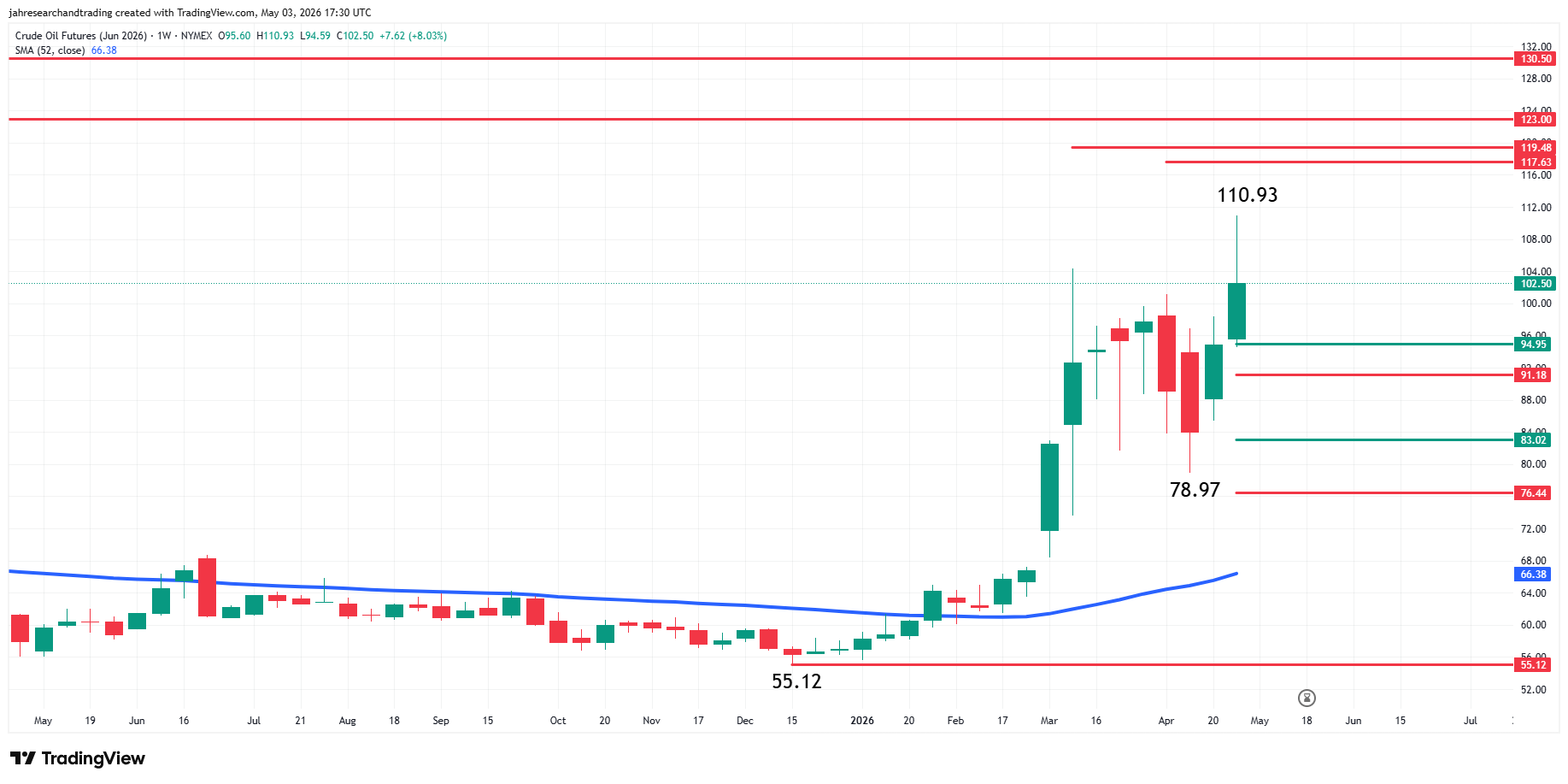
June WTI crude oil futures settled sharply higher last week after reaching its highest level since 2022 at $110.93. Despite the strong spike to the upside, the rally still fell short of the previous nearby tops at $117.63 and $119.48. Nonetheless, they remain targets as well as the start of the Russia-Ukraine war at $123.00 to $130.50.
On the downside, we’re dealing with two major ranges. The long-term range is $55.12 to $110.93. Its retracement zone support is $83.02 to $76.44. The short-term range is $78.97 to $110.93. Its retracement zone at $94.95 to $91.18.
The market is in an uptrend according to the weekly swing chart. A trade through $110.93 will signal a resumption of the uptrend. A trade through the main bottom at $78.87 will change the trend to down. However, this is where it gets tricky. Just because the trend changes to down, it doesn’t mean you just start shorting at will, especially if you’re a weekly chart trader. Once the trend changes, you’ll have better control of the risk if you look to short rallies.
Another factor to consider before shorting weakness is the position of the 52-week moving average. It is providing support and trend guidance at $66.38. At some point in the future, it’s going to be the key level to watch. It may be under $70 now, but it’s going to start sloping higher the longer WTI spends at elevated levels.
I tend to talk about the risks first because that’s my nature. I’ve been trained to find my exit before I put on a trade. Otherwise, the market will tell you when and where to get out and it’s usually not your best price.
As far as near-term buy area. Consider this, the trend is up according to the swing chart and the 52-week moving average so the market is still in buy the dip mode in my opinion. The first zone for potential buying activity is $94.95 to $91.18. The second zone is $83.02 to $76.44.
Given last week’s wide range, I believe the key level to watch this week is $102.76. Hold above it and bullish traders will build a case for extending the rally. A sustained move under it means we’re likely headed lower into the two support zones.
June WTI settled at $102.50, up $7.62 or +8.03%.
Weekly Spot Brent Technical Analysis
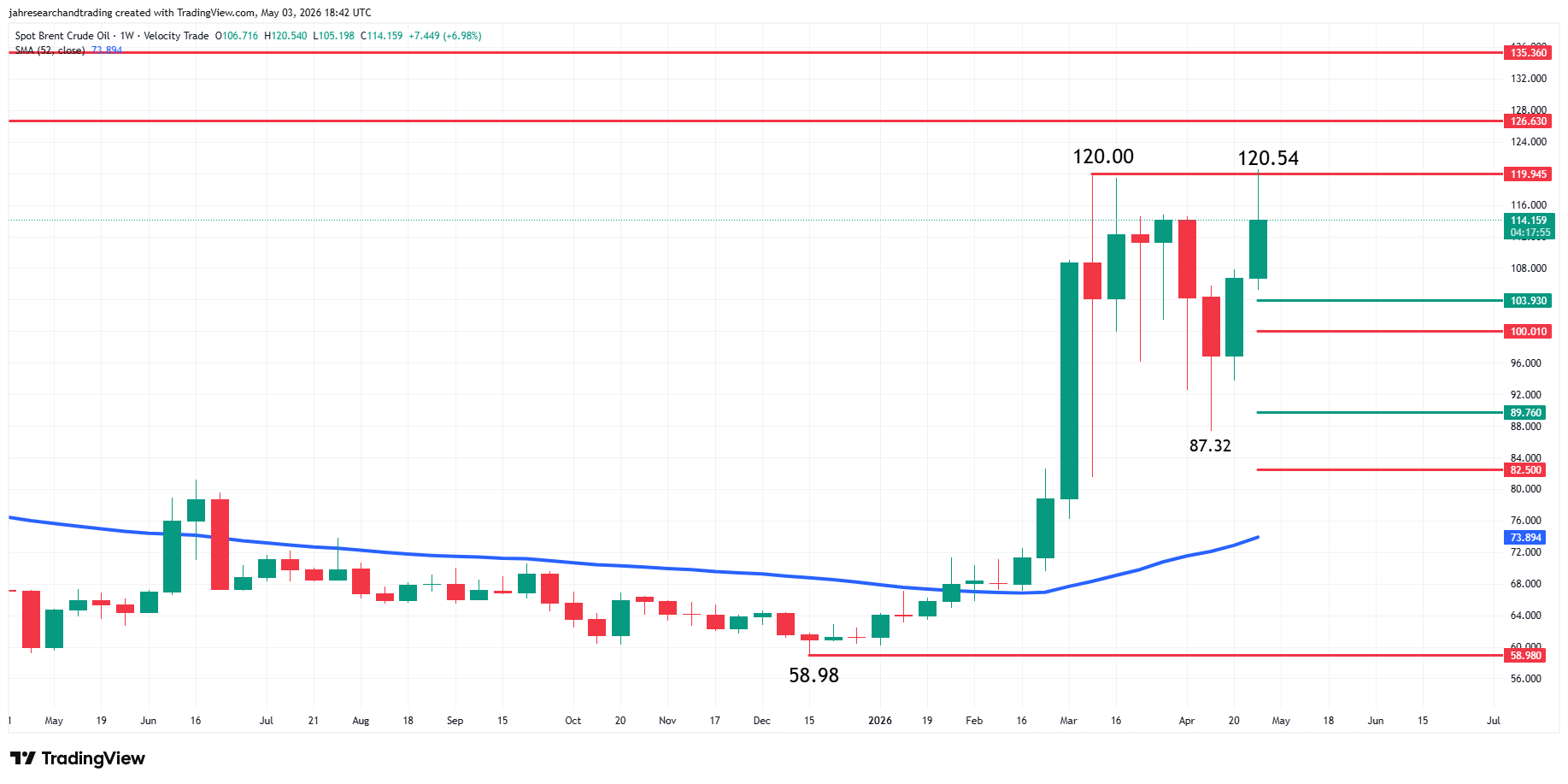
Spot Brent crude oil is in an uptrend according to the weekly swing chart and the 52-week moving average.
According to the weekly swing chart, a trade through $120.54 will signal a resumption of the uptrend. This could create the upside momentum needed to challenge the 2022 tops at $126.63 and $135.36. The trend will change to down on a trade through $87.32.
The 52-week moving average at $73.89 is also providing support and trend help.
The first support zone is $103.93 to $100.01. The second support zone is $89.76 to $82.50. With the main trend up, corrections into these zones could attract buyers.
The key level controlling the direction this week is likely to be $112.87. A sustained move over this level will set a potentially bullish tone. A sustained move under this price could cast a bearish tone.
For the week, Spot Brent settled at $114.16, up $7.45 or +6.98%.
What I’m Watching
The forecast comes down to two things. The Strait and the talks. Iran is demanding control over the Strait and compensation for losses sustained since the conflict began. The U.S. is focused on nuclear concessions and is not moving on the naval blockade. That gap has not narrowed in weeks and a fresh proposal from Tehran does not close it.
OPEC+ agreed to raise output again in June but it is mostly symbolic. The Strait of Hormuz closure is still choking off actual supply and those extra barrels are not hitting the market in any meaningful way. Production is technically higher on paper. Exports remain limited. Until the Strait reopens, an OPEC+ output increase is a number on a spreadsheet, not a market driver.
Analysts tracking the situation expect normalization of flows to take several months minimum once a resolution is reached. The supply deficit does not go away the moment someone shakes hands in Islamabad or Rome or wherever the next round of talks happens to be scheduled. Short-term pullbacks are going to happen. Contract mechanics, positioning resets and ceasefire headlines will create dips. In my opinion those dips do not change the structural story. The Strait is closed. The talks are stalled. The inventory draws are real. Until a verified reopening of the Strait happens or a credible diplomatic breakthrough emerges, downside in June WTI crude oil and Spot Brent crude oil looks limited and the risk stays skewed toward further upside.
If you’d like to know more about how to trade crude oil, please visit our educational area.


