
Oil Prices Steady as U.S.-Iran Talks Keep Markets on Edge
Oil prices are holding steady on Friday as traders wait to see what comes out of the high-stakes talks between the United States and Iran happening in Oman right now. The big fear? Another supply-disrupting conflict in the Middle East.
At 12:51 GMT, March WTI Crude Oil is trading $63.08, down $0.21 or -0.33%.

Technicals Signal Potential Downside Break
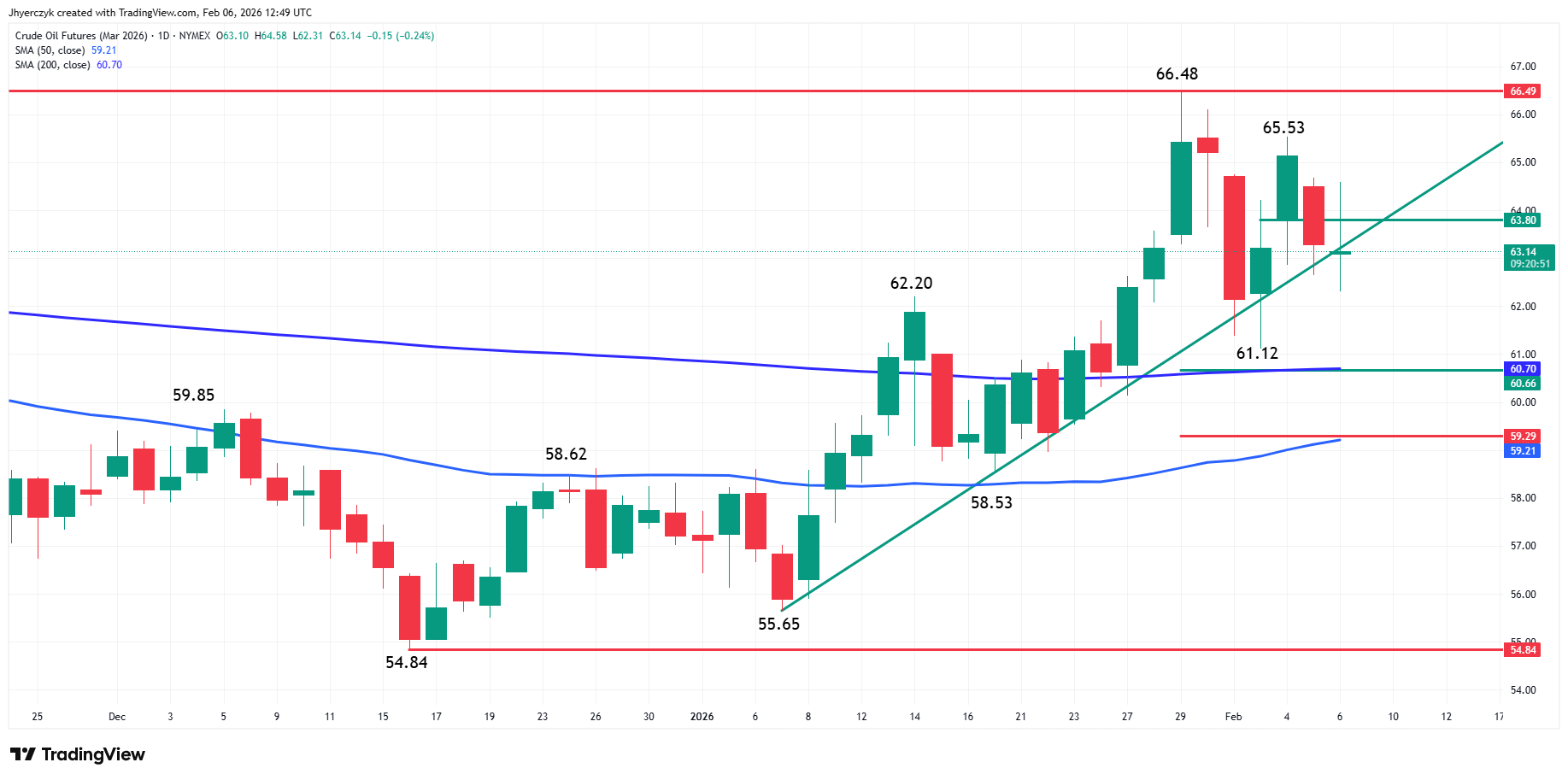
Technically, the main trend is still up, but momentum looks like it’s getting ready to flip. We’ve got a secondary lower top at $65.53, and more importantly, the market is trading on the weak side of the uptrend line at $63.21. Resistance sits at $65.53 and $66.49.
If we break under that trend line with any conviction, we could see a sharp move into the support cluster at the 200-day moving average around $60.70 and the 50% level at $60.66. WTI is already on track to close the week down 3.2%.
Geopolitical Risk vs. Weak Fundamentals
“Investors are watching the U.S.-Iran talks, and their sentiment is shaped by the outcome,” said Tamas Varga, an oil analyst at PVM. The problem is there’s no consensus on what they’re even talking about. Iran wants to stick to nuclear issues, while the U.S. wants to throw in ballistic missiles and Iran’s support for armed groups in the region.
Here’s why this matters: any escalation between these two could disrupt oil flows through the Strait of Hormuz, where about a fifth of the world’s oil passes through. Saudi Arabia, the UAE, Kuwait, Iraq, and Iran all export most of their crude through this chokepoint.
Brent Oil Price Forecast
Every new Brent Oil analysis as it publishes, today's technical signal and key levels, live price — on one page.
See all Brent Oil forecastsIf the talks go well and ease tensions, oil could drop even further. Capital Economics thinks geopolitical fears will give way to weak fundamentals, and they’re calling for prices to drift toward $50 a barrel by the end of 2026, helped by Kazakhstan ramping up production.
Oversupply Concerns Weigh on Prices
The weekly decline isn’t just about geopolitics. Prices got hit by the broader market selloff and ongoing expectations of an oversupplied market. Saudi Arabia just cut its official selling price for Arab Light crude to Asia to a five-year low—the fourth straight month of cuts.
“The underlying fundamental backdrop is not really encouraging, it implies an oversupplied market,” said Varga.
Bottom line: momentum is shifting to the downside. All we need is enough selling pressure to break away from that uptrend line at $63.21, and we’ve got plenty of room to fall toward $60.70 to $60.66.
Flip side? If we cross back above the trend line, we could challenge resistance at $65.53 to $66.49. We’re in a headline-driven market right now, so expect some volatility.
More Information in our Economic Calendar.