
Weekend Strikes Reversed Friday’s Selloff Before Monday’s Open
August WTI crude oil is trading near $70.31 early Monday, up about $1.08 on the session. September Brent is around $73.56, up roughly $0.96. Both contracts are climbing into the 50-day moving averages that capped last week’s selling and the buying started before most traders were at their desks. Friday’s 3.74% drop on WTI and 3.84% decline on Brent priced in tankers moving through the Strait of Hormuz and the war premium coming out. The weekend put it right back in.
The U.S. struck Iranian military targets over the weekend in retaliation for Iran’s attacks on shipping in the Strait. Iran responded with missile and drone strikes on targets in Kuwait and Bahrain. President Trump warned the U.S. might no longer be able to stay reasonable and could be forced to “militarily complete the job,” adding that Iran could face annihilation. The ceasefire and memorandum of understanding from mid-June looked like progress two weeks ago. It does not look like much this morning.

Daily August WTI Crude Oil Futures Technical Analysis
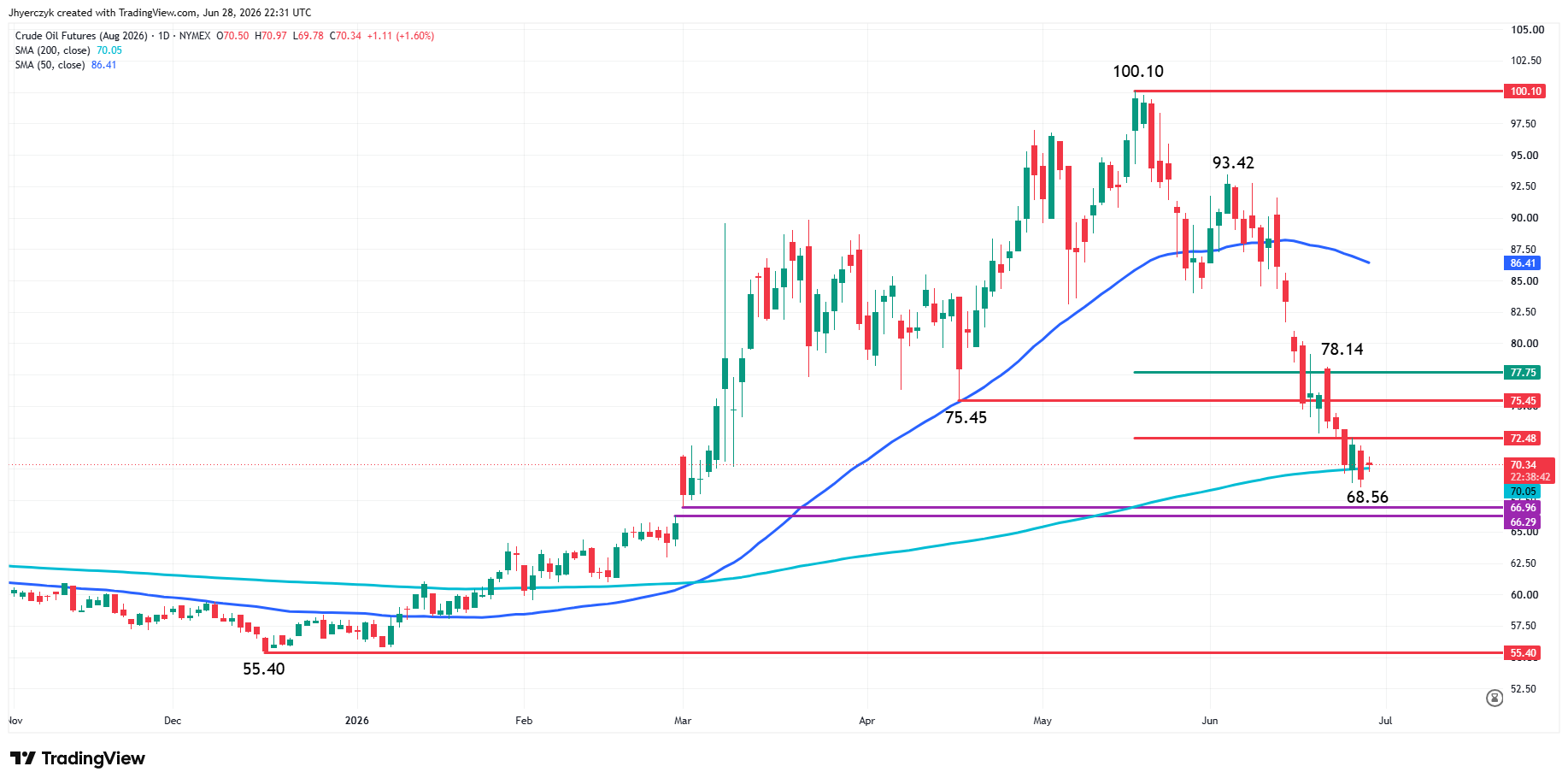
Looking at Friday’s close and the early opening on Sunday, the tone in the August crude oil futures market is likely to be determined by trader reaction to the 50-day moving average at $70.05.
A sustained move over $70.05 will indicate the presence of buyers. If this triggers a short-covering rally then look for an acceleration into $72.48. Momentum will climb if buyers can overcome this barrier. Any rally is likely to be fueled by short-covering. Real buying is likely to come in on a sustained move over the 50-day MA and the successful creation of a support base.
On the downside, a sustained move under the 50-day MA will first target last week’s low at $68.56 and the price gap at $66.96 to $66.20.
Daily September Brent Crude Oil Futures Technical Analysis
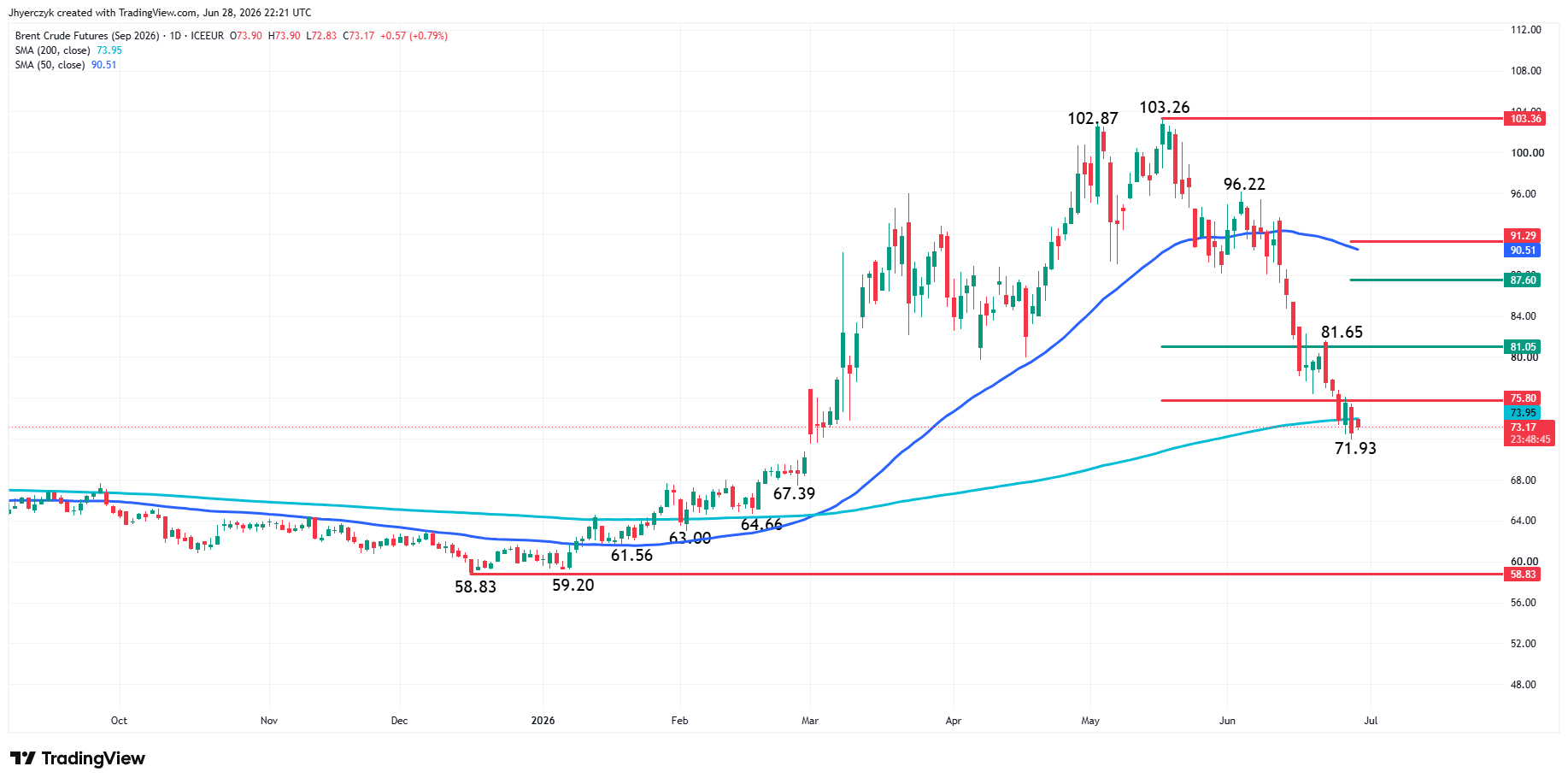
August crude oil futures opened slightly better early Monday but traders are still having trouble overcoming the 50-day moving average at $73.96.
Brent Oil Price Forecast
Every new Brent Oil analysis as it publishes, today's technical signal and key levels, live price — on one page.
See all Brent Oil forecastsA clean move over the 50-day MA will signal short-covering. Overcoming the Fibonacci level at $75.80 will indicate the short-covering is getting stronger. If this creates enough upside momentum then $81.05 to $81.65 will hit the radar.
On the downside, if last week’s low at $71.93 fails as support then brace for another steep break with $67.39 to $64.66 a potential target area.
Friday Sold the Peace and Monday Is Buying the War Back
Friday’s selloff had a real catalyst behind it. Maritime data showed tanker traffic through the Strait of Hormuz picking up after weeks of disruptions. Traders saw ships moving and started pulling the risk premium out of both contracts. WTI settled at $69.23, below $70 for the first time since late February. The worst-case supply cutoff that had been holding the bid under crude stopped looking like the base case.
Michigan consumer sentiment improved slightly that morning and inflation expectations ticked down. The dollar eased. None of that mattered as much as the ships. The Strait reopening was the trade.
Forty-eight hours later the improvement is in question. U.S. strikes on Iranian military targets and Iran’s retaliatory attacks on Kuwait and Bahrain put the shipping lanes right back into the risk calculation. The talks that produced the mid-June memorandum of understanding are on hold. Technical negotiations are reportedly still on track but the distinction between paused talks and active strikes is not one the oil market cares about. Ships were moving Friday. The question Monday morning is whether they keep moving.
The Market Priced Peace on Friday and Got War on Sunday
The contrast between Friday and the weekend is the kind of swing that defines crude during an active conflict. Oil does not wait for signed agreements. It prices the tankers and the missiles in real time. Friday said the tankers are sailing. Sunday said the missiles are flying. Both were true on the day they happened and the price reflected it within hours.
Goldman Sachs, J.P. Morgan and Citi are all calling crude the most sensitive commodity to Middle East headlines right now. They see a wide trading range as long as the conflict stays active. Friday proved the downside of that range when tankers moved. Sunday proved the upside when missiles flew. The banks are right about one thing. This market is not going to settle until the Strait question gets a permanent answer.
The Friday-to-Monday reversal is a compressed version of what this market has been doing for months. Rally on conflict. Sell on peace signals. Rally again when the peace signals break down. The cycle does not stop until either the conflict ends or the supply disruptions become permanent enough that the market stops trying to price in a resolution.
Trump’s Language Changed the Escalation Risk
The U.S. has been conducting strikes throughout the conflict but Trump’s language over the weekend was different. “Militarily complete the job” and the warning that Iran could face annihilation are not the same as targeted retaliatory strikes. That is escalation language and the oil market treats escalation language as a signal that the next round of disruptions could be larger than the last.
If the U.S. moves from retaliatory strikes to a broader military campaign, the Strait of Hormuz risk goes from partial disruption to potential closure. The difference between tankers sailing with increased risk and tankers not sailing at all is the difference between crude trading in the $60s to $70s and crude trading significantly higher. The market is not pricing in closure Monday morning. It is pricing in the increased probability that Friday’s progress was temporary.
What to Watch
The 50-day moving averages on both contracts are the decision point. WTI at $70.05 and Brent at $73.96. Both benchmarks are pressing into those levels Monday morning on the weekend escalation and the question is whether the buying is short-covering or something more durable. A sustained move above the 50-day on WTI opens $72.48 and momentum builds from there. Brent needs to clear $73.96 and then $75.80 before the short-covering can accelerate.
The headlines out of the Strait of Hormuz Monday and Tuesday will determine whether Friday’s tanker traffic increase holds or reverses. If ships start rerouting again after the weekend strikes, the supply risk that came out of the market Friday goes right back in. Tankers still sailing despite the weekend strikes would put crude in a range between the 50-day and last week’s lows. That is the neutral outcome. Trump’s language is the variable nobody can price. “Militarily complete the job” is not the same as another round of targeted strikes. If that language becomes policy, the risk premium this market spent three weeks removing was removed too early.
If you’d like to know more about how to trade crude oil, please visit our educational area.