


On February 19, President Trump put Iran on a 10-15 day ultimatum with the Geneva negotiations on Thursday marking the likely deadline after which military action could take place if no agreement is reached. The White House has stated that it is “very wise” for Iran to reach an agreement, while Vice President Vance has already accused Iran of not addressing the core issues raised by the U.S., indicating that there are still major differences between the two countries as they enter Thursday’s meeting – leaving oil markets likely to move in either of two vastly different directions depending on the outcome of Thursday’s talks.
Jaime Martinez Medina, Global Market Strategist at PU Prime commented:
Oil markets are entering a decisive phase following President Trump’s 10-15 day ultimatum to Iran, with the upcoming Geneva negotiations representing a clear inflection point. The outcome could send crude prices sharply in either direction, as traders reassess geopolitical risk premiums currently embedded in the market.
Over the past two months, WTI has climbed from near $60 to around $67 per barrel, while Brent trades above $71. Analysts estimate that roughly $8-$10 per barrel of “Iran risk premium” is already reflected in prices. This means markets are partially pricing in the possibility of disruption, particularly related to the Strait of Hormuz, through which roughly one-third of global seaborne crude passes.
If a diplomatic framework is reached, even a preliminary one, that risk premium would likely unwind quickly. Iranian barrels could gradually return to an already well-supplied market, reinforcing projections of a surplus into late 2026. In such a scenario, Brent could move back toward the $60 range in line with several institutional base forecasts. OPEC+ would then face renewed pressure to deepen production cuts in order to stabilize prices, while U.S. shale producers would contend with tighter margins.
Conversely, a breakdown in negotiations followed by military escalation would dramatically alter the supply outlook. Initial price reactions could see crude spike $5-$8 in a single session. The critical variable would be any disruption, even temporary, to traffic through the Strait of Hormuz. A partial interruption could quickly push prices toward $85-$90, with volatility intensifying as markets monitor shipping flows and regional responses.
Importantly, this is no longer a purely bilateral issue. Iran’s recent joint naval exercises with Russia underscore the broader geopolitical dimensions.
In short, oil is now trading less on fundamentals and more on event risk. Geneva is the pivot point. The market is positioned for two very different outcomes, and volatility is likely regardless of the result.
A Deal Sends Prices Lower — Fast
A successful agreement will flood the already oversupplied global market with additional Iranian oil, driving prices lower and forcing OPEC+ to defend their price levels with larger cuts. U.S. shale producers will feel the effects almost immediately. Goldman’s expects that the global oil market will remain in surplus until 2026 without Iranian production added back into it; thus, a successful agreement will likely send Brent oil prices to levels below what they are currently at based on Goldman’s base case Brent forecast of approximately $60 by Q4 if there is no further conflict.
No Deal — and the Strait of Hormuz Becomes the Story
In the case of a breakdown of negotiations that leads to the commencement of armed conflict, the oil market dynamics will change drastically. Already we see oil prices rising on the threats alone, as the markets are likely pricing in worst-case scenarios related to disruption of the Strait of Hormuz, through which the IEA estimates about 31% of all crude oil transported by sea. Having already conducted military exercises in the strait, Iran recently announced that they are about to carry out a series of joint naval operations with Russia in the Gulf of Oman, adding to the geopolitical implications of this situation — it is not simply a bilateral impasse, it has become something much bigger.
Brent Oil Price Forecast
Every new Brent Oil analysis as it publishes, today's technical signal and key levels, live price — on one page.
See all Brent Oil forecastsThe Risk Is Already in the Price
Furthermore, should Iran retaliate against the infrastructure of the Gulf, we could see an increase in price volatility and possible reduction in available supply, and while a release from the U.S. Strategic Petroleum Reserve would alleviate some of the initial price spike caused by an Iranian conflict, a prolonged conflict could have serious economic repercussions for economies that are oil importers.
Within the last week, WTI has increased approximately 6% per barrel, and analysts state that there is approximately $10 of “Iran risk” presently factored into current price levels. Barclays believes that with the midterm elections approaching and the administration focused on the affordability of energy to the consumer, the U.S. government may not be willing to sustain armed conflict with Iran because it would keep oil prices elevated for an extended period of time, and therefore any military action will likely be swift and targeted rather than a sustained campaign. Nevertheless, Thursday’s outcome will undoubtedly impact price volatility over the short-term.
Two Months, Two Very Different Markets
To clarify this. Two months ago, crude oil was almost $60 a barrel. Now, it has increased almost 20% based on a very bullish EIA report and the Iran war premium included in every trade. We are currently seeing WTI trading around $67 a barrel and Brent trading over $71 a barrel. So, we have already seen a large move in the market. The question is now what happens next and we believe that we will know on Thursday.
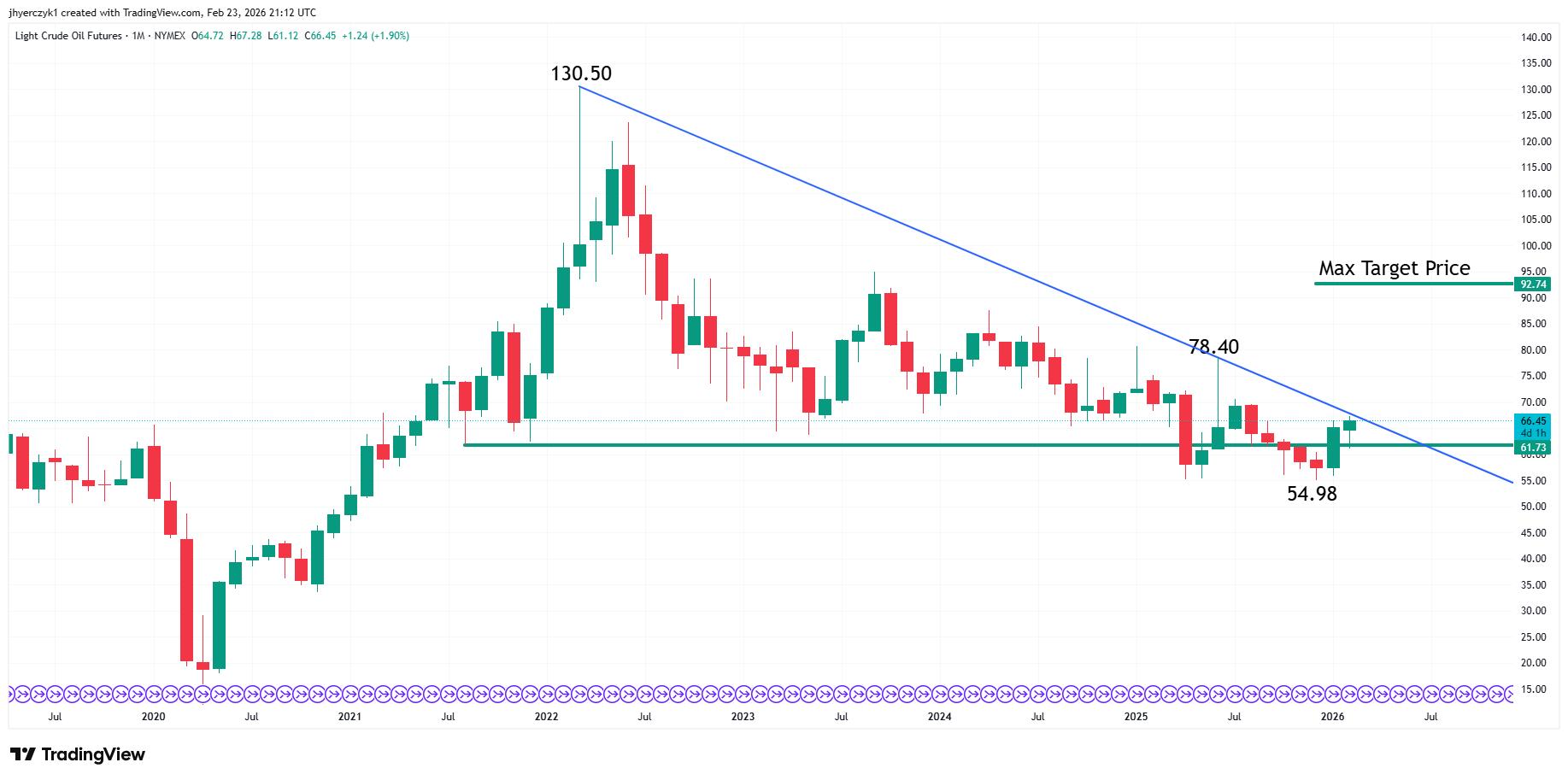
Monthly Nearby Crude Oil (1M chart) – Source: TradingView
If There Is a Deal
If everything goes well with the talks in Geneva and there is an agreement to produce a framework, even a preliminary agreement, then we would expect a very swift and severe market reaction. The risk premium for Iran alone is estimated around $10/barrel and that will come out quickly. You would then also be bringing Iranian barrels back into the marketplace, where the IEA already predicts significant supply surplus. Goldman Sachs’ base forecast for Brent is $60/barrel by Q4 without any supply disruptions. A potential agreement could bring you to that level extremely quickly. OPEC+ will then find themselves with the very tough choice of either increasing their current cuts to protect prices in the market or allowing the markets to do what over-supplied markets do. U.S. shale producers who are already working with low margins will immediately feel the effects.
If There Is a Strike
If negotiations fail and a strike occurs, look for oil prices to jump sharply. Initially, there will be a fear price surge of $5 to $8 per barrel in one day. The real issue will be whether Iran retaliates against the shipping lane through the Strait of Hormuz. Approximately one-third of the world’s seaborne crude oil will transit this chokepoint daily, and a partial closure, even temporarily, will drive up the market to between $85 and $90 before anyone has time to react. If the Strait of Hormuz were closed for a week, it would constitute a global economic catastrophe. Each of these events would prompt tapping of the Strategic Petroleum Reserve and emergency OPEC+ meetings. Traders would pay close attention to satellite images and shipping reports from the Persian Gulf.
This Is Bigger Than a Bilateral Standoff
Iran conducted joint naval exercises with Russia in the Gulf of Oman, so this is not merely coincidence or a stunt for domestic audiences; it is intended to warn the United States that any military action against Iran will have consequences beyond Iran’s borders. We have not observed geopolitical risk this layered in several years.
A Binary Trade With Two Completely Different Destinations
The supply is good and there hasn’t been any significant change to that supply situation; however, when aircraft carriers are at the ready and the countdown clock is measured in hours, supply fundamentals mean little to nothing. This is now a binary trade for this market with two completely different outcomes. If there is a deal, you may see $58-$62 per barrel for crude oil within the next 60 days; if there is a strike in the Strait of Hormuz, then $90 will merely be the low end of your price range. Thursday is likely to be the event day that ultimately determines what happens this weekend.