
In my view, the base scenario continues to be of apparent calm. The price, which today opened at 65.45, favors a phase of consolidation. The current breakout, not being supported yet by productive or macroeconomic shocks, is more given by a market that is pricing uncertainty and anticipation of risk than by real and concrete fundamental realities.
Below, we go to see what the levels of the news catalysts are, the context of the supply, and the most relevant technical levels in this phase.

News
Crude has started to show a phase of weakness despite the geopolitical context remains noisy. This is the aspect that really counts.
When a market stops reacting with force to risk, it often signals that the positioning and the underlying balance are weighing more than the news and the rumors.
The new sanctions linked to the logistics connected to Iran and the jamming in the Strait of Hormuz have added a “risk premium” to the price of crude (also without a physical block of the routes), but the reaction of the market has been measured, not explosive.
At the same time the Russian exports still robust, the Iranian flows that continue through shadow fleet and a US production near the historical highs is making more difficult for oil to sustain the bullish follow-through.
The union of these two opposite forces generates this phase of uncertainty and compression of prices. The waiting for the new nuclear talks between the US and Iran favors this phase and, if they should lead to a reduction of tensions, we could see the price slipping lower. On the contrary, we would assist to the release of that compressed energy of which we were speaking before.
The price action on the Renko chart reflects perfectly the situation. The market has tried several times in the past days, failing, to maintain the price in zone 67 and then turned to the downside going to test supports already known such as 63.90.
This behavior is a classic when passing from a trend regime to the range. Looking at the charts it seems to see the sellers liquidating the rallies and the buyers hunting the better supports.
Brent Oil Price Forecast
Every new Brent Oil analysis as it publishes, today's technical signal and key levels, live price — on one page.
See all Brent Oil forecastsContext
Adopting a wider vision, we note that while remaining sensitive to shocks, the oil now struggles to sustain a narrative of scarcity. The times of a perception of structurally insufficient supply we could have left them behind.
At least in this period the real market movers are geopolitics, sanctions, shipping disruption.
And it is exactly for this reason that, for example, a Russian or Iranian shadow fleet attenuates these impulses. Surely it is early to speak of change of regime and scenario, but certainly it is what we are seeing happening in this period/phase of market.
The US production remains a key anchor. Output and productivity have remained quite solid to limit the upside when the prices approach important resistance zones.
Also without a dramatic increase of supply, the simple persistence changes the behavior of the market, because oil, as we have seen, often reacts to the change of the balance more than to the absolute level.
In this context, the technical levels become even more important because it is there that the positioning concentrates.
Financial Analysis
Technical Picture: The Renko Shows Breakout After a Retest of the Support
The Renko structure is the most clear part of the story at this moment.
The area 67.20 emerges as the evident roof. The chart shows repeated attempts toward that zone, followed by failure and rollover. This sequence usually indicates that the buyers are present, but not enough strong to absorb the supply and maintain the bullish movement.
After the failure, the price has rotated toward the first support at 65.70 and then headed without stops to the now famous 63.90.
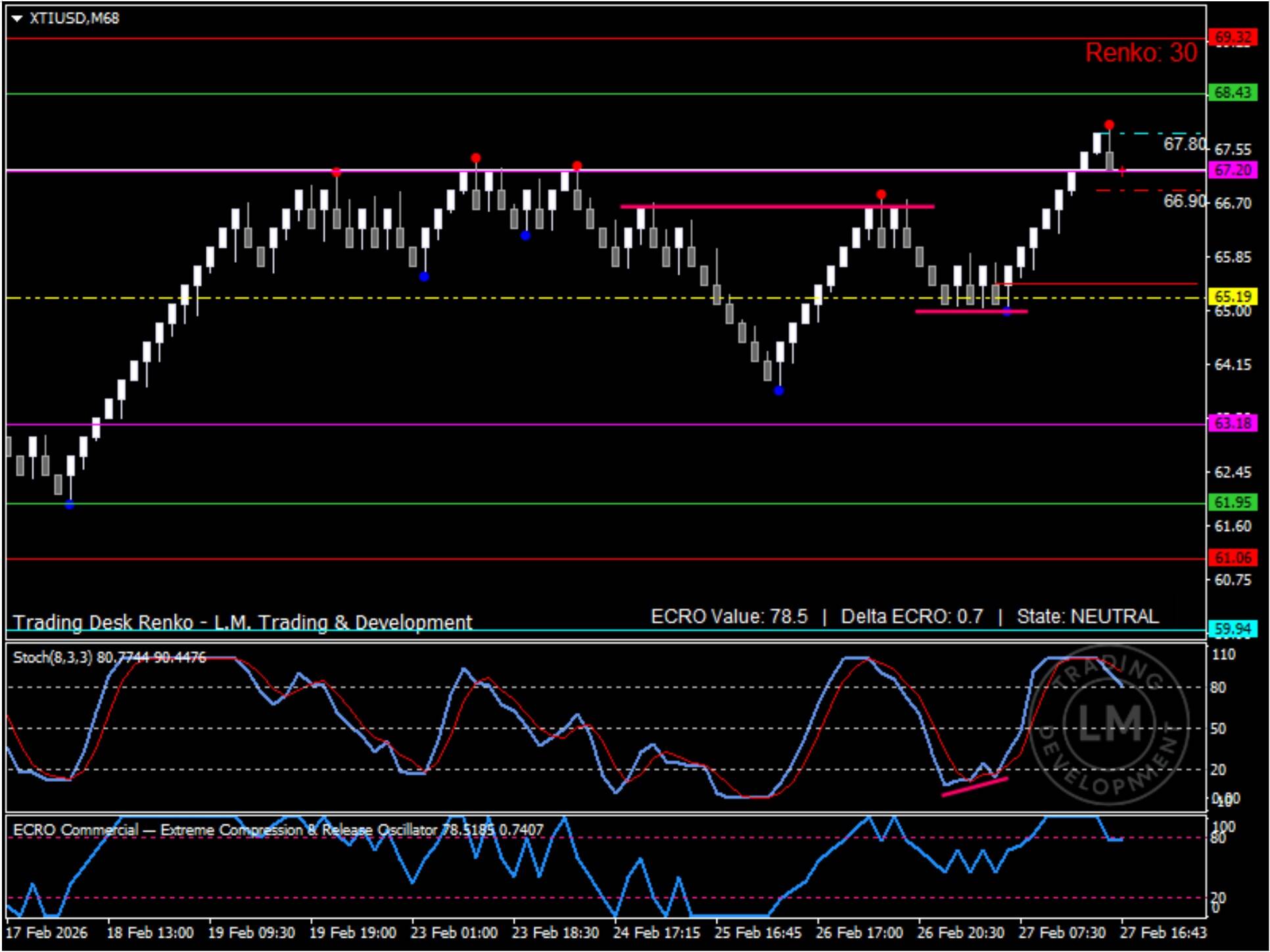
As anticipated in the opening, we can consider a bullish bias only after a clear pullback and continuation of zone 67. In this case we will see 68.40 first and 69.30 then.
Momentum and Positioning: Neutral Readings, Bullish Fuel in Decline
The momentum does not signal a takeoff. It is more subtle. On the indicators panel, the ECRO is in phase of release after having passed all the Asian session and part of the European one dancing between the opening price and the Weekly Pivot at 65.19. The Stochastic tells us of a nice bullish divergence that has anticipated the movement of the break of the latest highs.
Let us not forget that the rallies could struggle to become persistent without a net change in the geopolitical news.
Positioning and Risk
In my view, the short setup is neutral until the price does not confirm the break of 67.20.
Bullish Scenario
To take back control, the buyers must conquer 67.20 with clear follow-through. In that case, the path toward the upper resistance band and potentially the area 70 reopens. The most probable catalyst would be a real shock as we were saying before, the only true “fuel” (it is the case to say it) to support a movement of this kind.
Bearish Scenario
A net break below 63.90 without rapid recovery would suggest a transition into corrective phase, with 63.00 / 63.20 as next key area.
The main driver would be a further easing of the international tensions.
The key risk of this reading remains a possible geopolitical escalation, which can change the picture rapidly.
Conclusion
Oil, after repeated failures near 67.20, has lifted the head. Whether it is a false movement or not will be told by the technical analysis and above all by the geopolitics of these days.
The context of the supply does not signal a real scarcity, which helps to explain why the market struggles to sustain the bullish momentum despite the background noise.
The base scenario remains range, except the long/short breakouts of which we have spoken.
Until a real shock will emerge it is probable that oil will remain trapped in this regime guided by the range.