



Shares of the China-founded, Singapore-headquartered retailer fell as much as 10% during their first session on the Hong Kong Stock Exchange and extended losses on the third day of trading, closing almost 9% lower at around HK$42, compared with the HK$48.56 IPO price. The decline has left Shein valued at roughly $22.7 billion, a fraction of the approximately $100 billion valuation investors attached to the company at the height of the pandemic-driven e-commerce boom.
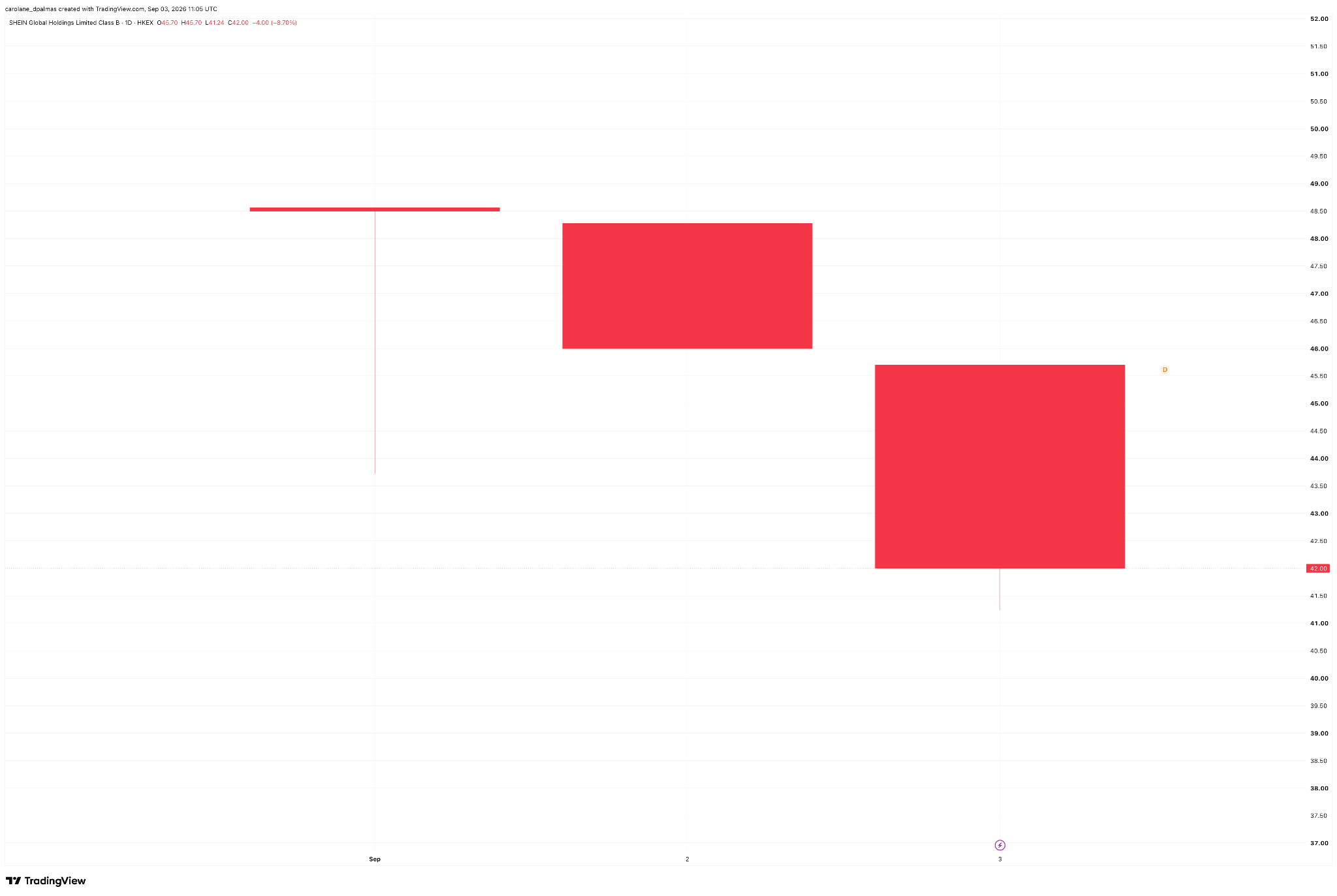
The disappointing performance does not necessarily mean that Shein’s growth story is over. The company still has enormous scale, a global customer base and a supply-chain model that has disrupted the traditional fashion industry. But the investment case has become considerably more complicated.
For investors, the central question is whether Shein can continue growing fast enough to offset rising regulatory, logistics and compliance costs without sacrificing the low prices and high product turnover that made its business so successful.
From $100 Billion Darling to $23 Billion Public Company
Shein’s valuation illustrates just how dramatically market expectations have changed. Pandemic lockdowns accelerated online shopping, while social-media trends such as “Shein hauls” turned the company into a global phenomenon among younger consumers. A 2022 fundraising round valued the business at close to $100 billion.
That enthusiasm subsequently faded. A later private fundraising round valued Shein at approximately $66 billion, while efforts to list in New York and London encountered political and regulatory resistance, particularly over its Chinese supply chain. Chinese regulators eventually approved its Hong Kong listing in July.
The IPO was priced at HK$48.56, raising around $1.7 billion and valuing Shein at approximately $26 billion. The subsequent share-price decline therefore suggests that public-market investors remain unconvinced that the company’s earlier growth trajectory can be replicated.
There is also a broader market consideration. Consumer companies have generally struggled to attract the same enthusiasm as technology and artificial-intelligence stocks, leaving investors more demanding about margins, cash generation and sustainable growth. And Shein is particularly exposed to that scrutiny because its model depends on enormous sales volumes and very low prices.
Hong Kong Hang Seng Price Forecast
Every new Hong Kong Hang Seng analysis as it publishes, today's technical signal and key levels, live price — on one page.
See all Hong Kong Hang Seng forecastsThe Biggest Problem: the Economics of Cheap Fashion Are Changing
Shein’s competitive advantage has historically been built around a highly responsive Chinese manufacturing network, data-driven product selection and direct-to-consumer delivery.
Its scale remains impressive. The company’s prospectus indicates around 273 million active customers across approximately 160 markets in 2025. Its catalogue contained more than 2 million apparel styles at the end of March 2026, while roughly 4,700 new designs were made available each day during the first quarter.
That ability to test products rapidly and reorder successful items has helped Shein minimise inventory risk while responding almost immediately to changing consumer preferences. But the regulatory environment is attacking one of the foundations of that model: inexpensive cross-border shipping.
The United States has removed the de minimis exemption that previously allowed qualifying packages worth less than $800 to enter without duties. The change has already hurt Shein’s US business. Its US revenue fell 14.3% year on year in the first quarter of 2026, while group revenue growth slowed sharply. Shein subsequently reported a $99 million net loss for the quarter, compared with a $395 million profit a year earlier.
That is an important warning for investors. Shein can raise prices, localise inventory and develop regional fulfilment centres, but each of those solutions potentially makes its business more expensive and less differentiated.
Europe Is Becoming Another Regulatory Headache
Europe presents a similar challenge. The European Union has introduced a €3 charge on low-value e-commerce parcels, while France has gone further with a new levy specifically targeting ultra-fast fashion. The French charge, introduced on September 1, currently ranges from relatively small amounts for some products to €12 for a jacket and could rise to as much as €19.50 per item by 2030, subject to a 50% cap relative to the product’s pre-tax price.
The measures are designed to address environmental concerns surrounding high-volume, low-cost clothing and to encourage greater durability and repairability. For Shein, this is more than an ESG issue. It is a potential margin problem.
The company’s competitive proposition depends heavily on consumers perceiving its products as inexpensive enough to justify frequent purchases. Additional duties and environmental charges could force Shein either to absorb higher costs or pass them on to consumers.
Neither option is ideal.
Absorbing the costs puts pressure on margins. Passing them to customers risks weakening demand and potentially making traditional retailers such as Zara or H&M more competitive. The scale of the problem is already visible in European cross-border commerce, with French authorities saying imports of small parcels from China fell by around 30% to 40% following the introduction of the separate EU €3 levy in July.
Geopolitical and Reputational Risks Remain
Shein must also contend with an increasingly complicated political environment.
Its supply chain and Chinese origins have attracted scrutiny in Western markets, contributing to the failure of its previous US and UK listing plans. Regulatory attention has also extended to its marketplace operations and compliance with European digital-platform rules. This creates an additional risk for shareholders because regulatory action can increase costs even when it does not directly prevent Shein from operating.
There is also a reputational challenge. The company has faced criticism concerning sustainability, labour practices and the environmental consequences of ultra-fast fashion. As governments increasingly attempt to reduce overconsumption and textile waste, Shein’s core model is likely to remain under scrutiny.
For investors, that means the company carries risks that go beyond conventional consumer-sector metrics.
Where Could the Next Phase of Growth Come from?
The investment case is not entirely negative.
Shein has several potential avenues for expansion that could make the company less dependent on selling its own ultra-cheap clothing directly from Chinese factories to Western consumers.
One of the most promising is its marketplace business. Instead of relying exclusively on Shein-branded products, the company can use its enormous customer base, technology, fulfilment infrastructure and data capabilities to connect third-party brands with consumers.
Its Shein Xcelerator programme is designed to provide brands with services ranging from on-demand production to fulfilment and access to Shein’s global sales platform. By the end of 2025, 20 brands had joined the programme, with combined revenues across sales channels exceeding $580 million. This could be strategically important because marketplace revenue can potentially generate higher-margin income without requiring Shein to manufacture every product itself.
The company is also trying to broaden its brand portfolio through acquisitions, including Missguided and US retailer Everlane. Expanding its exposure to established local brands could help Shein reduce some of the consumer resistance associated with its Chinese manufacturing base while providing access to different customer segments.
International diversification is another opportunity. The US and Europe remain crucial markets, but expansion into emerging economies could provide additional volume as growth in mature Western markets becomes more difficult. The challenge is that lower consumer purchasing power and higher delivery costs in developing markets could limit the profitability of this strategy.
Why Investors May Want to Remain Cautious
Shein, therefore, enters public markets with a paradoxical profile.
Operationally, it remains one of the world’s most sophisticated fashion retailers. Its ability to analyse consumer demand, introduce products rapidly and manage inventory at enormous scale remains a formidable competitive advantage.
Financially, however, the company is facing a more difficult environment. The end of favourable low-value import rules, higher logistics expenses, new European fees, regulatory scrutiny and weaker US growth are all attacking the economics of the model at the same time. The first-quarter loss is particularly significant because it suggests these pressures are already affecting profitability rather than simply representing distant risks.
The share-price decline may therefore be less about investors rejecting Shein outright and more about a reassessment of how much growth and profitability the company can realistically deliver.
For traders, the Hong Kong listing also creates a new price-discovery mechanism around a company whose valuation has historically been determined in private markets. The addition of Shein to the Hang Seng Composite Index on September 14 and the availability of options and short selling should increase liquidity and potentially amplify volatility.
Ultimately, Shein’s investment case rests on whether management can transform the company from a highly efficient low-cost fashion exporter into a broader global commerce platform. If it succeeds, the current valuation could eventually look attractive relative to its enormous customer base and technological capabilities. If regulatory costs continue rising while US and European growth slows, however, the stock could remain under pressure.
For investors, the key metric to watch is therefore not simply revenue growth, but whether Shein can restore sustainable earnings growth while adapting its business model to a world in which ultra-cheap cross-border commerce is becoming increasingly expensive.
Sources used: Financial Times, Reuters, Associated Press, The Guardian, Euronews, Shein Group, Hong Kong Exchange, The Information, Fidelity, Yahoo Finance, CNBC