The shares are now down more than 30% since the start of the year and have lost more than half their value from the post-listing peak reached only days after the debut.
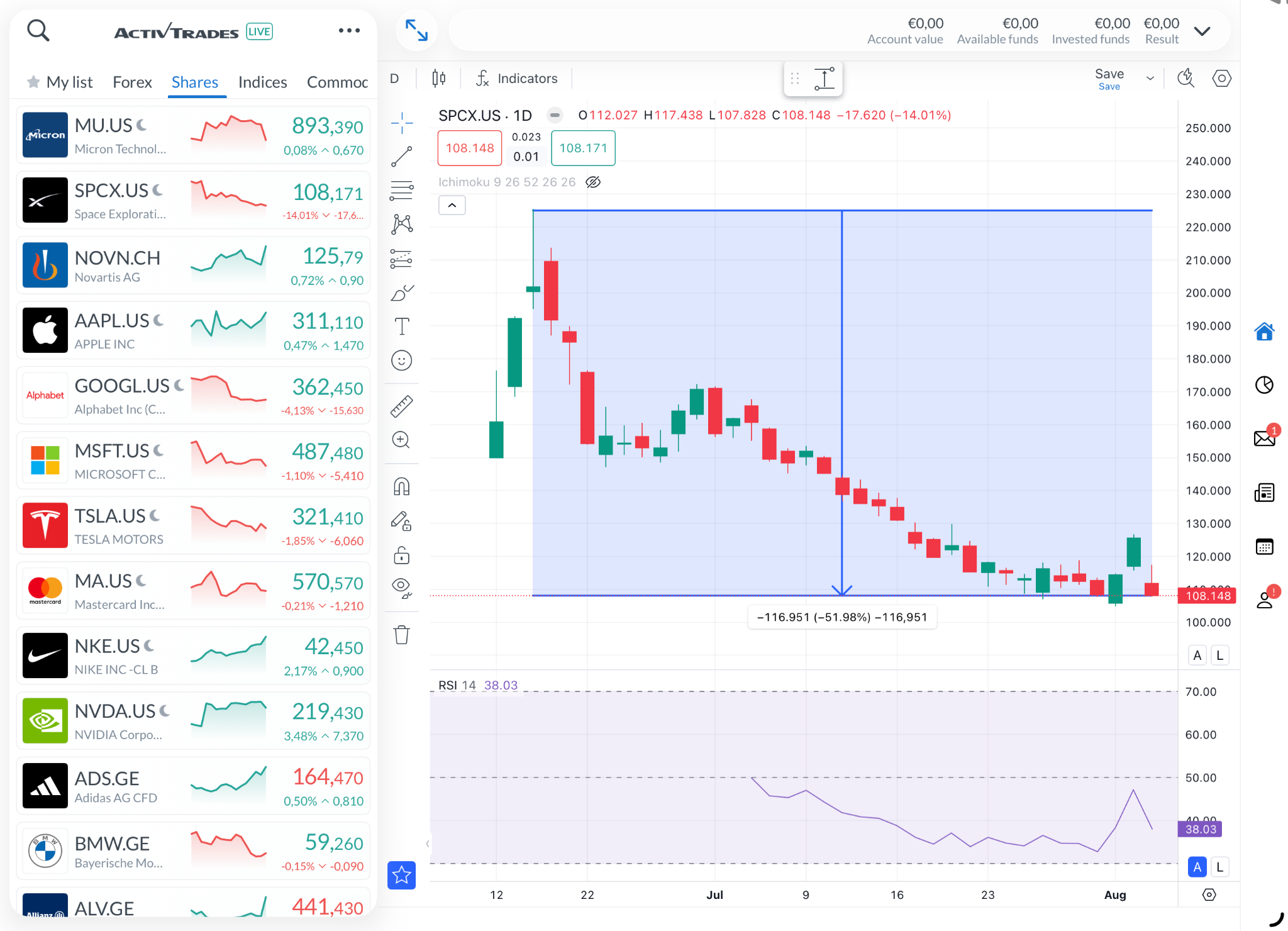
The comparison investors have increasingly drawn is Meta’s 2012 IPO. The social-media company struggled after its market debut and continued falling for months before eventually losing more than half its IPO value. But the scale of the two situations is very different. Meta’s market capitalization after its first trading day was around $100 billion, roughly a fifth of the value SpaceX has now seen erased from its own post-IPO peak.
That difference highlights the stakes surrounding SpaceX. With the company still valued at roughly $1.5 trillion, even relatively modest changes in investor expectations can translate into hundreds of billions of dollars in market value.

A Mixed Quarter With One Clear Profit Engine
SpaceX’s second-quarter results, released last Tuesday, highlighted the contrast between its rapidly expanding businesses and the enormous cost of funding its longer-term ambitions.
Revenue reached $7.81 billion, well above the $6.93 billion analysts had expected and 92% higher than a year earlier. The net loss narrowed to $541 million from roughly $1 billion, while the operating loss fell to $143 million from $970 million. Yet the headline earnings improvement masks an important distinction: Starlink remains SpaceX’s only operating-profit-generating business.
Starlink’s operating profit increased 79% during the quarter, while the company’s other major activities—including its AI operations, rocket business and Starship program—continue to consume substantial amounts of capital.
The AI division is moving in the right direction, with revenue reportedly rising by roughly 250% while operating losses narrowed. Space-related revenue, including commercial launches, government missions and Starship development, increased 29% year over year. But these businesses remain expensive to develop.
A central question remains: Can Starlink generate enough cash to finance SpaceX’s increasingly ambitious expansion into artificial intelligence, data centers and next-generation space infrastructure?
Starlink Is Growing Rapidly, but Revenue per Customer Is Falling
Starlink remains the strongest part of the SpaceX investment story. The satellite-internet service doubled its customer base to 12 million by the end of the quarter, expanding across consumer, enterprise, aviation, maritime and government markets in more than 150 countries. Revenue increased 66% to $4.3 billion, meaning Starlink now generates more than half of SpaceX’s total revenue.
However, average revenue per subscriber declined 22% year over year as SpaceX expanded into international markets and introduced cheaper pricing tiers to accelerate adoption. The company is therefore adding customers faster than it is increasing revenue per customer.
That is not necessarily a problem at this stage of Starlink’s expansion. Lower prices can accelerate market penetration and create economies of scale. But investors will need to determine whether the resulting subscriber growth can ultimately translate into higher absolute profits without materially compressing margins.
That question becomes increasingly important as Starlink is expected to finance more of SpaceX’s broader investment program. Elon Musk has also set an ambitious long-term target for the business. He has said Starlink could eventually carry the majority of global internet traffic, potentially within less than a decade. For investors, however, the distinction between that potential and the cash flows currently being generated by the business remains crucial.
Starlink Wants to Move Beyond Satellite Broadband
The next stage of the Starlink strategy could bring SpaceX into much more direct competition with America’s established wireless carriers. SpaceX President Gwynne Shotwell said the company plans to build the infrastructure required to turn Starlink into a broader mobile service and aims to attract customers from Verizon, AT&T and T-Mobile.
This would represent a significant expansion beyond Starlink’s existing direct-to-device service, which primarily extends connectivity to areas where traditional cellular coverage is unavailable. SpaceX has already made a major financial commitment to this strategy. Last year, it spent a combined $19.6 billion acquiring 65 megahertz of wireless spectrum from EchoStar through two separate transactions.
The objective is clear: combine satellite connectivity, spectrum and ground infrastructure to compete more directly with traditional wireless operators. The challenge is the capital required to make that ambition commercially viable.
Verizon, AT&T and T-Mobile have spent decades and hundreds of billions of dollars developing their networks and acquiring spectrum. Starlink’s satellite infrastructure could give SpaceX a technological advantage in coverage and deployment speed, particularly in underserved areas. But turning that advantage into a large-scale wireless business will require substantial additional investment.
This creates another major question: Will Starlink’s expansion increase its ability to generate cash, or will it become another capital-intensive project competing for funding with Starship and AI?
Capital Spending Is Becoming the Bigger Concern
For investors, the most difficult number in SpaceX’s latest results may not be revenue or earnings but capital expenditure. Quarterly expenditure surged 550% to $18.3 billion. That increase comes as SpaceX continues investing heavily in Starship, next-generation Starlink infrastructure and AI-related data centers.
Starlink generated approximately $1.6 billion in profit during the quarter, but that contribution must be viewed against SpaceX’s broader capital requirements. The company lost close to $5 billion in 2025 and more than $4.8 billion so far in 2026, while free cash flow remains under pressure.
Management has also indicated that capital spending will remain elevated through the rest of the year. SpaceX needs to invest aggressively to develop the businesses that underpin its long-term valuation, but those investments are simultaneously reducing the amount of cash available today.
The key issue is therefore not simply whether SpaceX can grow rapidly. It is whether the company can convert that growth into sufficient free cash flow before its investment requirements become too large for Starlink to support.
SpaceX Valuation Leaves Little Room for Error & Lock-up Expiration Adds Fresh Pressure
At close to 49 times revenue, SpaceX’s valuation already reflects an extraordinary amount of future growth. There is a credible bull case. Starlink is rapidly expanding its subscriber base, its profitability is improving and SpaceX has multiple potential growth engines in AI, satellite connectivity, space infrastructure and next-generation communications.
Musk has also outlined a target of $1 trillion in annual revenue by 2030, alongside plans to develop space-based data centers. If even part of these ambitions materializes, today’s valuation could ultimately look less demanding. But these remain long-term targets rather than delivered earnings or cash flows. That distinction is becoming increasingly important as investors reassess the stock following its dramatic post-IPO decline.
The company’s fundamentals are not the only issue facing the stock. Around 900 million shares are expected to become eligible for trading as the first lock-up period expires today, potentially more than doubling the number of shares currently available to the public. A further 12.9 billion shares could become eligible by mid-2027.
The potential increase in supply is significant given the stock’s already sharp decline. However, the expiration of a lock-up does not automatically mean that all newly eligible shares will be sold. The actual market impact will depend on how aggressively early investors, employees and other shareholders choose to monetize their holdings.
That distinction matters. Many existing holders have substantial gains following SpaceX’s IPO, creating a powerful incentive for some investors to sell. At the same time, others may be reluctant to sell after the stock’s recent decline, particularly if they remain convinced about SpaceX’s long-term growth prospects. The market will therefore be watching actual selling volumes and changes in the public float, rather than simply the number of shares becoming eligible for sale.
Sources: SpaceX, Yahoo Finance, CNBC, The Guardian, BBC, The Financial Times, The Wall Street Journal, Reuters
The information provided does not constitute investment research. The material has not been prepared in accordance with the legal requirements designed to promote the independence of investment research and as such is to be considered to be a marketing communication.
All information has been prepared by ActivTrades (“AT”). The information does not contain a record of AT’s prices, or an offer of or solicitation for a transaction in any financial instrument. No representation or warranty is given as to the accuracy or completeness of this information.
Any material provided does not have regard to the specific investment objective and financial situation of any person who may receive it. Past performance is not a reliable indicator of future performance. AT provides an execution-only service. Consequently, any person acting on the information provided does so at their own risk. Forecasts are not guarantees. Rates may change. Political risk is unpredictable. Central bank actions may vary. Platforms’ tools do not guarantee success.