
Supertanker rates have surged more than 40-fold. Commodity trading giants are generating billions in profits. And G7 governments are accelerating emergency Oil releases. The world is waking up to scarcity – but are investors positioned for what comes next?
What if 2026 is not the peak of the Commodity boom?
What if it marks the beginning of one of the greatest Hard Asset Wealth Creation opportunities of our lifetime?
That is the conviction behind The Gold & Silver Club’s Hard Asset Decade thesis.
For decades, the global economy operated on one reassuring assumption: there would always be more.
More Oil. More Metals. More Agriculture. More production. More supply.
That assumption is fracturing.
And the implications for traders and investors could be profound.
Crude Oil: The Opportunity Hiding in Plain Sight
Gold has dominated headlines this year. Yet Crude Oil has quietly delivered some of 2026’s most explosive trading opportunities.
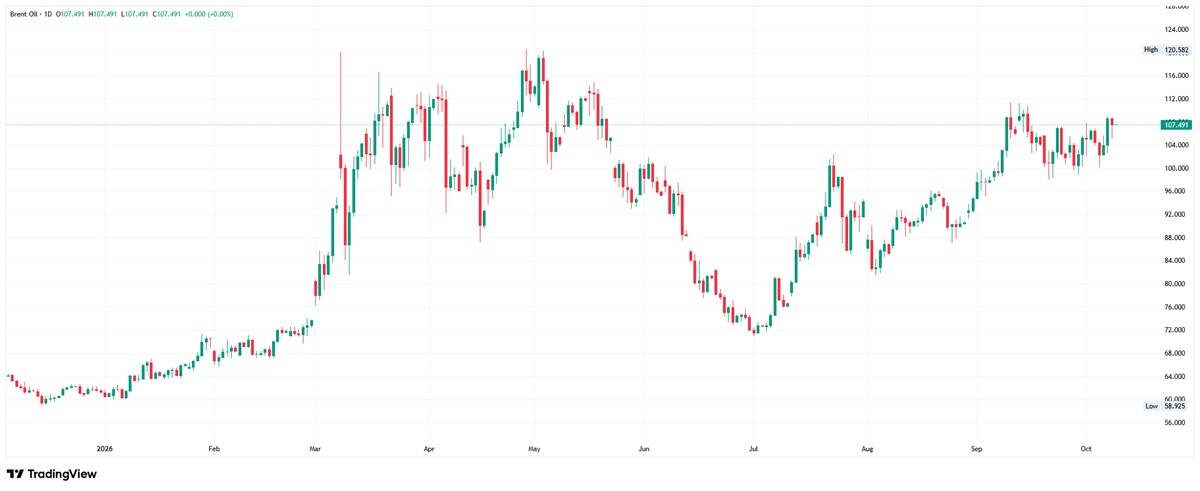
According to The Gold & Silver Club’s supplied tally – Brent has traded above $100 a barrel on fourteen distinct occasions, so far in 2026.
GSC Commodity Intelligence’s analysis also identifies twelve double-digit rebounds of 12%–19% following single-digit pullbacks, occurring within just three to five trading sessions alone.
The pace at which Crude Oil is moving in today’s macro environment is unprecedented. History is being writing in real-time.
“While much of the investment community remains captivated by Gold, Crude Oil is presenting some of the most compelling trading opportunities we have witnessed,” says Lars Hansen, Head of Research at The Gold & Silver Club. “For traders who understand the underlying catalysts, Crude Oil deserves serious attention.”
The biggest mistake may not be missing the last Oil rally. It could be failing to prepare for the next one.
Brent Oil Price Forecast
Every new Brent Oil analysis as it publishes, today's technical signal and key levels, live price — on one page.
See all Brent Oil forecastsThe Hidden Energy Shock: Supertanker Costs Explode 47-Fold
Global Oil logistics have been transformed. Rates for VLCCs transporting Crude Oil from the Middle East to Asia have reached $1.4 million per day, compared with roughly $30,000 in January.
That represents a staggering 47-fold increase.
Freight costs on the benchmark route have climbed from $1.73 to almost $33 per barrel – equivalent to roughly 27% of the benchmark Crude price used in its comparison, versus around 3% in January.
That logistics squeeze is also being reflected in financial markets.
The Breakwave Tanker Shipping ETF (BWET) has surged an astonishing 7,051% over the past 12 months to October 9, 2026, according to data tracked by GSC Commodity Intelligence. For comparison, the S&P 500 has recorded a gain of 14.4%, over the same period.
To put that into perspective, a $100,000 investment in BWET made a year ago would have grown to approximately $7.15 million.
With the fund providing exposure to Crude Oil tanker freight futures, the scale of that move highlights a crucial dimension of the Scarcity Trade: the market is repricing not just Oil, but the capacity to deliver it.
The world may have Oil. But getting it where it is needed, in the form it is needed, has become considerably more expensive.
“Scarcity is no longer simply about what exists underground,” Hansen says. “It is about what can actually reach the consumer, in the right form, at the right time.”
The Scarcity Shock Is Spreading Across the Economy
The consequences extend far beyond Crude Oil.
Diesel powers agriculture, freight, mining, construction and manufacturing. Rising fuel and transportation costs can increase the expense of producing and delivering food, Metals and everyday goods.
Energy scarcity can therefore become an inflation problem, affecting corporate margins, consumer spending and borrowing costs.
The pressure has become sufficiently serious that G7 governments agreed on October 2 to accelerate the release of 100 million barrels of previously committed emergency Oil stocks over four months, prioritising Diesel deliveries.
These measures may provide immediate relief, but cannot instantly replace damaged refineries or restore disrupted shipping routes.
“This is the defining characteristic of the Scarcity Trade,” Hansen says. “When the cost of obtaining essential resources rises, the consequences can spread throughout the global economy. That is why Hard Assets deserve far greater attention.”
Follow the Smart Money: Commodity Giants Are Cashing In
Some of the world’s most influential Commodity trading businesses are already demonstrating the scale of the opportunity.
Glencore has raised its 2026 Commodity profit outlook beyond $5 billion, following a first half in which adjusted operating earnings surged 142% to $3.3 billion. Its revised long-term earnings framework extends into 2027 and beyond.
Meanwhile, hedge funds including Citadel, Millennium, Point72 and Balyasny continue to aggressively compete for exceptional Commodity trading expertise.
“These institutions are not simply observing the Commodity opportunity. They are investing substantial capital and resources to compete in it,” Hansen says. “The important question is not simply what institutions are earning today. It is what opportunities they believe justify continued investment in expertise, infrastructure and capital.”
For The Gold & Silver Club, that distinction is central.
The Year of Hard Assets demonstrated the potential. The Hard Asset Decade could transform how investors think about essential resources.
The $10 Million Talent War Reveals the Stakes
Competition for exceptional hedge-fund analysts and traders has intensified, with reports suggesting compensation packages for some leading professionals exceeding $10 million annually.
While many investors remain focused on yesterday’s strongest-performing assets, professional firms are investing heavily in the capabilities needed to identify tomorrow’s opportunities.
“The opportunity is not simply recognizing what Commodities have already achieved,” Hansen says. “It is understanding where the next major supply imbalance could emerge before the wider market catches on.”
The Hard Asset Decade Is Here
The Gold & Silver Club famously coined 2026 as “The Year of Hard Assets.”
But the bigger story is only beginning to emerge.
Energy powers industry. Agriculture depends on fuel and fertilizers. Electrification requires Copper, Silver and Aluminium. AI infrastructure demands electricity and critical materials.
The world does not merely consume Hard Assets. It uses Hard Assets to produce almost everything else.
Governments can create liquidity. Central banks can adjust interest rates.
But neither can instantly create another barrel of Oil, tonne of Copper, cargo of Wheat or functioning refinery.
“The greatest opportunity may lie in recognizing that the world is moving from an era of abundant resources towards one where security of supply commands an increasingly valuable premium,” Hansen says. “That is the foundation of The Hard Asset Decade.”
The world spent decades pricing abundance. It may now be entering a decade forced to price scarcity.
And that leaves one increasingly uncomfortable conclusion at the heart of The Gold & Silver Club’s thesis: “None of Us Own Enough Hard Assets”.
The Year of Hard Assets was the beginning. The Hard Asset Decade is here.
The only question now is: whether you are positioned to capitalize on what could become the greatest wealth creation opportunity of our lifetime.
Where are prices heading next? Watch The Commodity Report now, for my latest price forecasts and predictions: