



The move represents a sharp reversal from the yen’s weakness earlier in the summer, when the USD/JPY approached 165 and forced Japanese authorities to intervene in the foreign-exchange market.
The latest appreciation is increasingly being driven by expectations that the Bank of Japan (BoJ) is preparing to raise interest rates at its September meeting, while investors are also reassessing the outlook for US monetary policy. The BoJ is scheduled to meet next Thursday and Friday, with markets now pricing in a high probability of a 25-basis-point increase. More importantly, investors will be looking for guidance on whether the central bank could accelerate the pace of subsequent tightening.
U.S. consumer-price data due on Friday will provide an important signal ahead of the Federal Reserve’s September 15-16 meeting. The inflation figures have become particularly significant because the Fed’s policy outlook remains unusually divided. Governor Christopher Waller has indicated that he could support keeping rates unchanged if inflation continues to moderate, while Fed Chair Kevin Warsh has stressed that insufficient progress on inflation could warrant tighter policy.
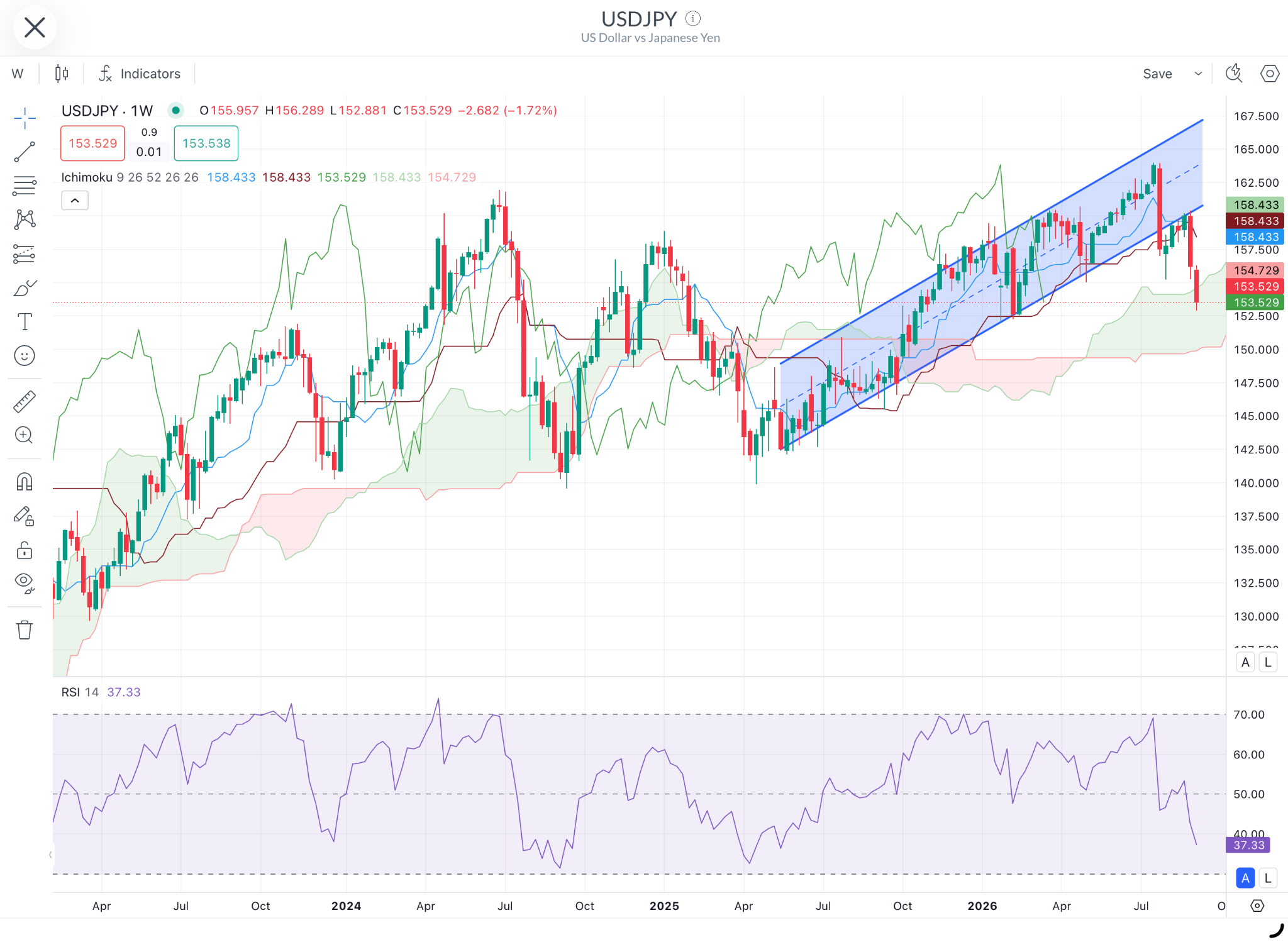
From a technical perspective, the weekly chart points to a clear deterioration in the USD/JPY trend. The pair has broken below its ascending trend structure and is trading beneath both the Tenkan-sen and Kijun-sen lines of the Ichimoku Cloud index. This suggests that the medium-term bullish structure has weakened. The weekly RSI has also fallen below the neutral 50 threshold and is moving lower, indicating that bearish momentum is becoming more established.
A Hawkish BoJ Could Accelerate the Yen’s Recovery
The fundamental backdrop is becoming increasingly challenging for the USD/JPY bulls because the interest-rate differential that supported the yen carry trade for years is gradually narrowing.
The carry trade involves borrowing yen at relatively low interest rates and using the proceeds to purchase higher-yielding currencies and assets, including US dollars. The strategy became particularly attractive during 2022 and 2023 as the Federal Reserve aggressively tightened monetary policy while the BoJ maintained exceptionally accommodative conditions. But that relationship is now changing.
Markets increasingly expect the BoJ to raise its policy rate next week, but investors are paying even greater attention to what comes afterwards. Recent comments from BoJ officials have encouraged expectations that Japanese monetary policy could become more restrictive than previously anticipated. Board member Hajime Takata recently argued that Japan was approaching the central bank’s 2% inflation objective and warned that the risk of prices overheating was increasing.
That message matters because a faster BoJ tightening cycle would reduce the relative attractiveness of yen-funded carry trades. The incentive to borrow in yen and invest abroad becomes smaller as Japanese rates rise, particularly if US rates are simultaneously expected to decline.
This dynamic has already begun to encourage investors to reduce yen-short positions. The latest yen appreciation has also triggered stop-loss orders and algorithmic buying, potentially amplifying the move. Reuters notes that the current rally remains orderly and differs from the violent carry-trade unwind seen in 2024, but the changing policy expectations are nevertheless forcing investors to reassess the economics of holding large yen-funded positions.
The size of the underlying carry trade also explains why the USD/JPY could remain highly sensitive to further changes in interest-rate expectations. Cross-border yen borrowing reached around ¥360 trillion, or approximately $2.34 trillion, in March, according to a Jefferies analysis of Bank for International Settlements data cited by Reuters. At the same time, speculative short positions in the yen have already declined from their July peak.
This does not necessarily mean that a 2024-style global carry-trade unwind is imminent. The BoJ has spent considerable time preparing markets for the possibility of higher rates, making a move next week considerably less surprising than the July 2024 rate increase. Nevertheless, the risk would increase if the central bank combines a rate hike with guidance suggesting that additional increases could follow relatively quickly.
USD/JPY Price Forecast
Every new USD/JPY analysis as it publishes, today's technical signal and key levels, live price — on one page.
See all USD/JPY forecastsIntervention and Domestic Repatriation Add Another Layer of Support for the Yen
Monetary policy is not the only factor supporting the Japanese currency. The possibility of renewed government intervention remains an important consideration for traders, particularly after the scale of Tokyo’s recent operations. Japan spent approximately ¥15.4 trillion, or nearly $99 billion, on yen-buying intervention between July 30 and August 26, according to Japanese Finance Ministry data.
The operation helped push the yen away from levels near 164 per dollar, while part of the intervention was coordinated with the United States. Japanese Finance Minister Satsuki Katayama has subsequently stressed that Tokyo and Washington remain aligned on the objective of maintaining orderly foreign-exchange markets.
That means traders cannot simply assume that a renewed yen depreciation would be tolerated indefinitely. If the USD/JPY were to reverse sharply higher and return towards the levels that previously prompted official action, the perceived intervention risk could itself become a deterrent to aggressive yen-selling.
There is also a potentially more structural source of yen demand: Japanese institutional investors.
Japan’s enormous pension and financial sector has historically allocated substantial amounts of capital overseas, partly because extremely low domestic yields encouraged investors to search for returns abroad. That equation is changing as Japanese government bond yields rise. The 10-year JGB yield recently reached 3%, its highest level since 1996, making domestic fixed-income assets considerably more attractive than they were during the ultra-low-rate era.
Fitch Ratings expects Japanese policy rates to rise faster than current market consensus in 2026 and 2027, arguing that higher domestic yields could reduce the incentive for Japanese institutions to pursue lower-yielding foreign assets. The ratings agency said domestic banks and life insurers are already reassessing opportunities at home, even though there is not yet clear evidence of a major portfolio shift by the Government Pension Investment Fund (GPIF).
The potential scale of such a shift is significant. Japan’s pension system manages assets measured in trillions of dollars, meaning even a modest change in the allocation between overseas and domestic investments could generate substantial currency flows.
For the USD/JPY, this introduces a potentially important structural headwind. If Japanese yields continue to rise while the BoJ signals further tightening, domestic institutions may have less reason to hedge or maintain large overseas allocations. Repatriation flows could then provide an additional source of yen demand independently of speculative positioning.
Sources: The Wall Street Journal, Fitch Ratings, Bank for International Settlements (BIS), Jefferies, Bank of Japan (BoJ), U.S. Federal Reserve, Reuters Japanese Ministry of Finance