


Gold and Silver delivered that lesson brutally over the past 12 months. The trades were there – early, clean and asymmetric – but most traders arrived only once the headlines did. Now, with attention still fixed on what has already moved, a far more consequential shift is taking place elsewhere in the Commodities market – one that few are positioned for.
According to analysts at The Gold & Silver Club, the early stages of a powerful repricing are already underway and one metal stands apart as the most underappreciated opportunity of 2026.
That metal is Copper.
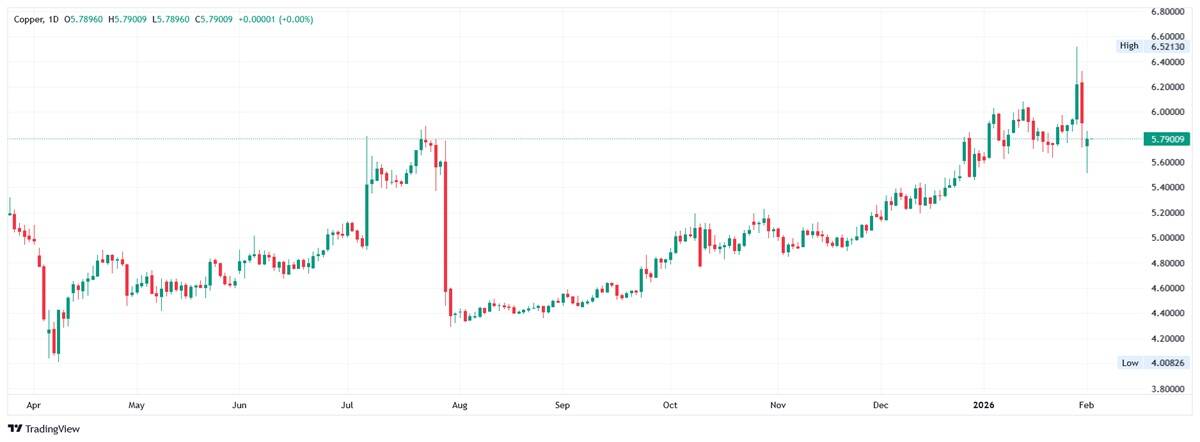
Long regarded as cyclical, unfashionable and too closely tied to old-economy growth, Copper is suddenly behaving very differently. Prices have surged to record highs, breaking above $14,500 per metric ton for the first time ever, including an extraordinary double-digit gain in a single session. Since December, Copper has risen approximately 24%, catching even seasoned traders off guard.
This is not a speculative spike. It is a structural repricing.
The Industrial Metal at the Centre of the New Economy
Copper sits at the heart of the modern world. Power Grids, Electric Vehicles, Renewable Energy, Data Centres, Batteries – none function at scale without it. As electrification accelerates globally, Copper intensity across the economy rises with it.
According to Lars Hansen, Head of Research at The Gold & Silver Club, the market is only beginning to grapple with the implications.
“Copper remains materially under-owned relative to its role in the global system,” Hansen notes. “If traders apply even a modest re-rating based on structural demand and constrained supply, today’s prices will look remarkably cheap in hindsight.”
That assessment is rooted not in sentiment, but in hard numbers.
Copper Price Forecast
Every new Copper analysis as it publishes, today's technical signal and key levels, live price — on one page.
See all Copper forecastsDemand Is Structural. Supply Is Not.
Global Copper demand currently sits near 25 million tonnes per year. Meeting decarbonisation targets and electrification goals implies a near doubling of that figure over the coming decades.
Electric vehicles alone require several times more Copper than internal combustion cars. AI compounds the problem: data centres, grid reinforcement and high-density power infrastructure are Copper-intensive at a scale few anticipated five years ago.
Supply, meanwhile, is failing to keep pace. Years of underinvestment, declining ore grades, delayed projects and mounting political risk have hollowed out future capacity. New Copper mines are expensive, slow to develop and increasingly difficult to permit. Inventories are thin. Spare capacity is minimal.
This is not a short-term imbalance. It is a long-duration collision between accelerating demand and structural scarcity.
When Governments Start Hoarding, Markets React
Geopolitics is now adding fuel to the fire. The United States is preparing to launch a $12 billion strategic critical-minerals initiative designed to reduce reliance on China and shield domestic manufacturers from supply shocks. Copper is expected to be a cornerstone of the programme, alongside other essential industrial metals.
History offers a clear lesson: when governments, corporations and households begin to stockpile hard assets, scarcity intensifies. Prices rise, volatility increases and cycles become more extreme. Hoarding is not irrational – it is human – and Commodity markets amplify that behaviour.
China has already moved. Much of Copper’s recent breakout occurred during Asian trading hours, when Chinese flows dominate global metals markets. Traders there have been aggressively accumulating industrial metals linked to future growth, pushing prices sharply higher in a matter of hours.
The Rotation Few Are Watching
For now, trader focus remains firmly on Gold and Silver. But beneath the surface, capital is rotating. Institutions are quietly building exposure to Copper and related metals, aware that liquidity can evaporate quickly once positioning crowds.
Copper is not alone – Aluminium, Uranium and other industrial metals have already posted historic moves on tightening balances. But Copper remains the backbone of the system and arguably the least fully priced.
As Hansen puts it: “If Gold and Silver was the signal, Copper is the confirmation.”
“We are in a world that is short Energy, short Metals and short Infrastructure,” Hansen says. “That is where the opportunity lies. This is the revenge of the old economy.”
Markets reward foresight, not hindsight. For traders who missed the Precious Metals surge, Copper represents a rare second chance. One that is rapidly closing as the old economy reasserts its importance in a very new world.


