XRP (XRP) failed to hold its gains after Ondo Finance, Ripple, Kinexys by JP Morgan, and Mastercard completed what Ondo called the first near-real-time, cross-border, cross-bank redemption of tokenized US Treasurys.
XRP Dips 4.8% After XRPL Pilot
Announced on May 6, the pilot used the XRP Ledger for the asset redemption leg, while the fiat side moved through Kinexys and Mastercard-linked banking infrastructure.
Ondo said the blockchain leg settled in under five seconds, making the announcement one of the more credible institutional blockchain headlines tied to XRPL this year.
On paper, the setup looked bullish for XRP. That is usually the kind of headline XRP traders cite as evidence that Ripple’s enterprise push is finally converging with real-world blockchain adoption.
The market reaction told a different story.
XRP opened May 6 near $1.41, rallied intraday to about $1.456, then quickly gave back the move. By May 8, XRP was trading around $1.387, leaving it down roughly 4.8% from the May 6 post-announcement high.
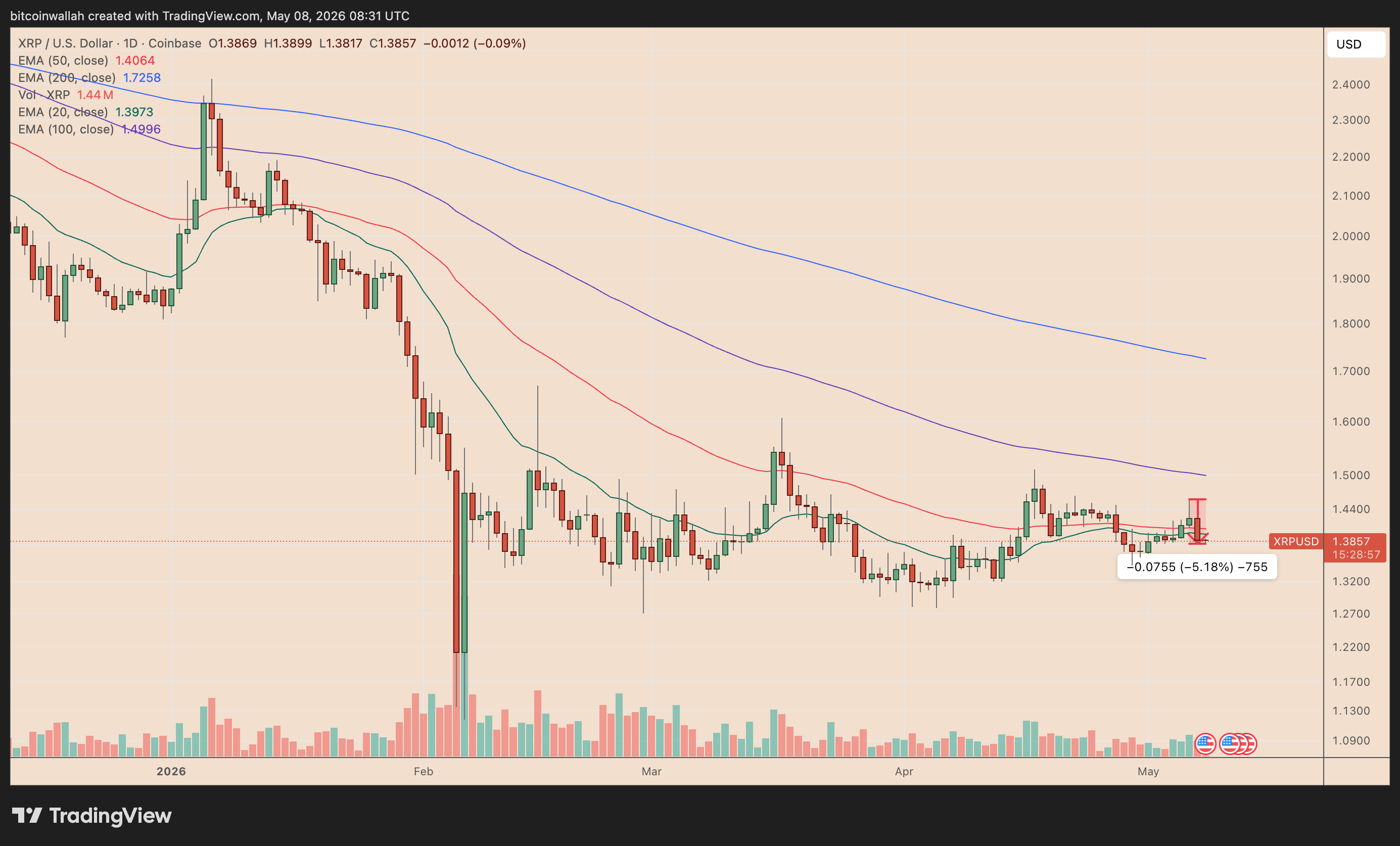
The pilot generated a short-lived pop, but not the kind of follow-through that would suggest investors were repricing XRP higher on the back of the news.
Ripple Price Forecast
Every new Ripple analysis as it publishes, today's technical signal and key levels, live price — on one page.
See all Ripple forecastsXRP Typically Gives Up Ripple Announcement Gains
Ripple partnership announcements may strengthen the company’s institutional credibility, but they have done far less for XRP’s market value than many bulls assume.
For instance, in April, Ripple announced a partnership with Kyobo Life Insurance to pilot Korea’s first tokenized government-bond settlement workflow using Ripple Custody.
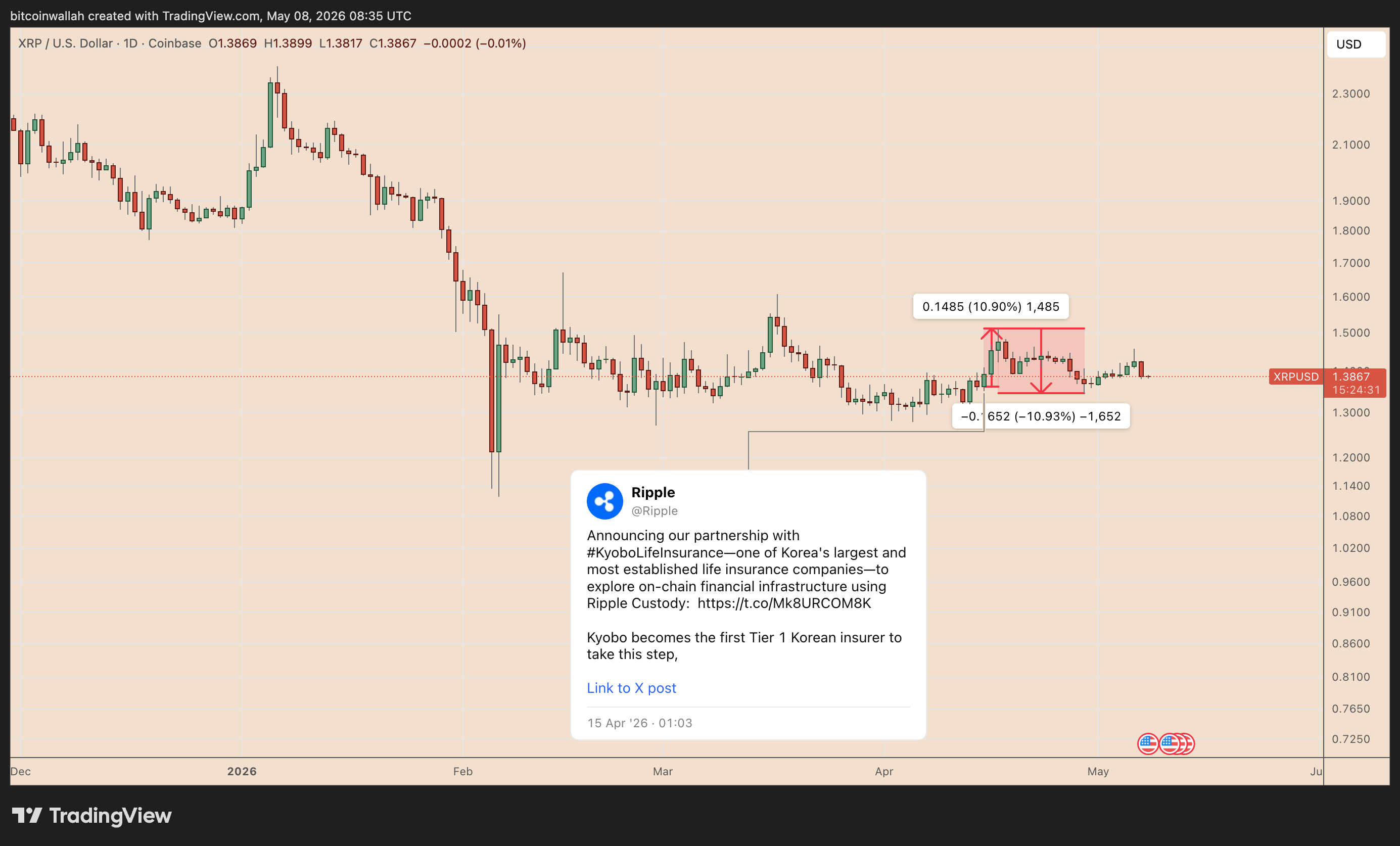
By April 29, XRP was around $1.381, meaning most of the early upside had already faded.
A month earlier, Ripple said it had joined the Monetary Authority of Singapore’s BLOOM initiative and partnered with Unloq to test programmable settlement infrastructure in trade finance.
XRP traded near $1.415 on March 25, fell to roughly $1.340 by April 1, then recovered to about $1.439 by April 24. So the initial seven-day reaction was negative, while the 30-day move was only marginally positive.
Again, the institutional headline reinforced XRPL’s utility story without producing an immediate or decisive XRP rerating. (The Asian Banker)
Older Data Reveals Larger Disconnect Between Ripple and XRP
Ripple’s Dec. 12, 2025 announcement that AMINA Bank had become the first European bank to adopt Ripple Payments was one of the company’s more prestigious banking partnerships.
Still, XRP was about $2.03 on the day, hovered around $2.09 roughly a month later, and then fell to around $1.38 by March 2026. Whatever strategic value the AMINA deal had for Ripple, it did not shield XRP from a much weaker three-month performance.
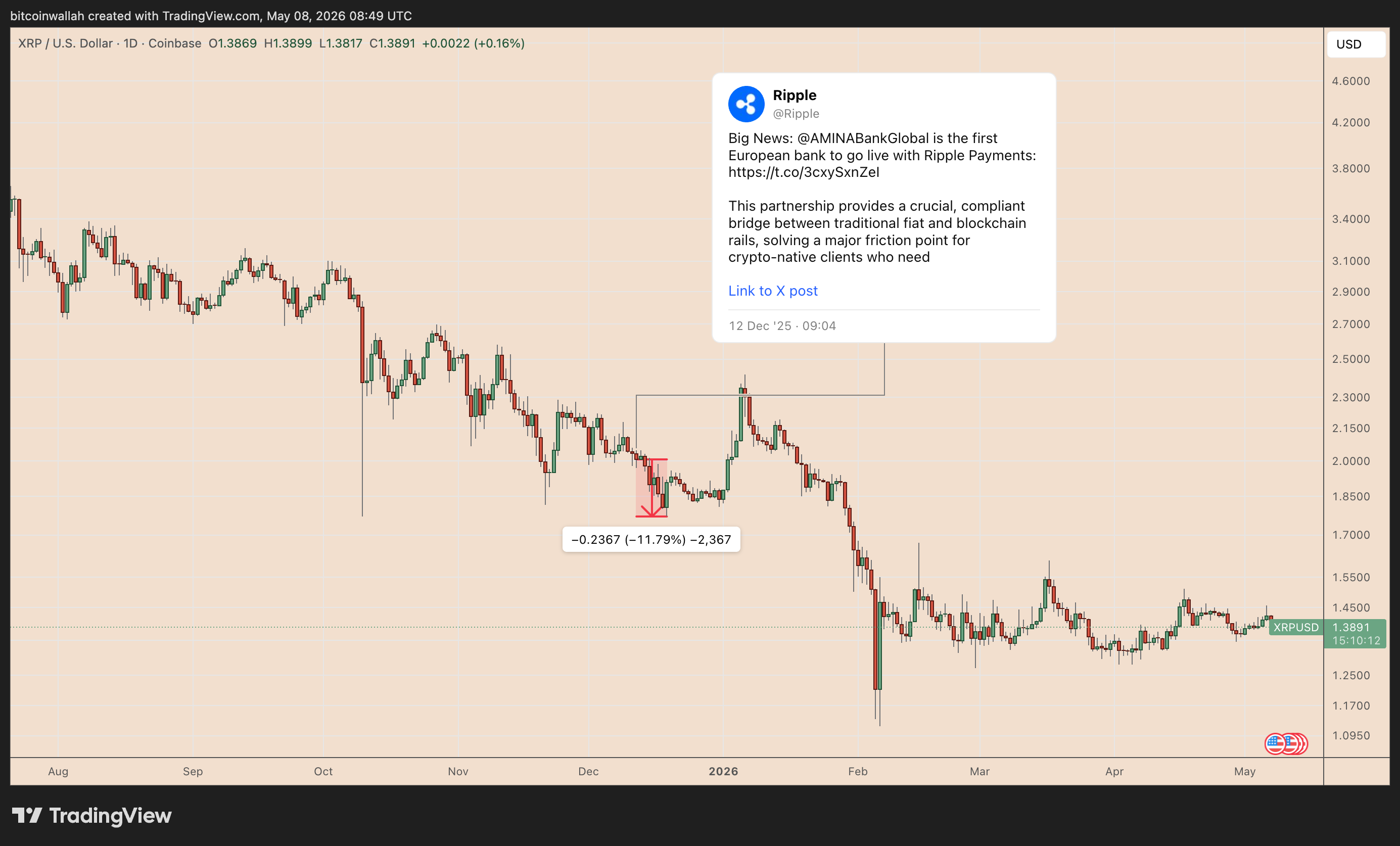
That is the main takeaway from the Ondo-Ripple-J.P. Morgan-Mastercard pilot as well. It was a real infrastructure milestone. But none of that automatically created a durable demand for XRP as a traded asset.
For now, the market appears to be separating Ripple-the-company from XRP-the-token. Until these partnerships produce measurable token demand, XRP may keep delivering the same downside results.
Will XRP Price Decline Further?
XRP’s daily chart is compressing inside a symmetrical triangle, a setup formed by lower highs and higher lows as volatility tightens.
On its own, the pattern is neutral. But in this case, it is appearing after a strong downtrend from the January highs, which makes a bearish resolution more likely.
The upper trendline has kept rebounds capped near the $1.40–$1.45 region, while the rising lower trendline has held the price above $1.25–$1.30. That squeeze shows the market is waiting for a breakout trigger.
Since XRP remains below both its 50-day EMA near $1.40 and 200-day EMA near $1.72, the broader trend still favors sellers.
A confirmed break below the triangle’s lower trendline could open the door to a drop toward $1.00–$1.02, which is the pattern’s projected downside target and also aligns with a key horizontal support zone on the chart.
In simple terms, traders measure the triangle’s maximum height and subtract it from the breakdown point to estimate the next move.
The RSI near 49 also shows weak momentum. It is not oversold enough to suggest panic selling is exhausted, but it is also not strong enough to support a bullish breakout yet.