


Bitcoin (BTC) underwent a sharp rebound on Thursday after dipping briefly below its $60,000 support level. This is the second time in June and the third since February that bulls have protected the psychological price floor.
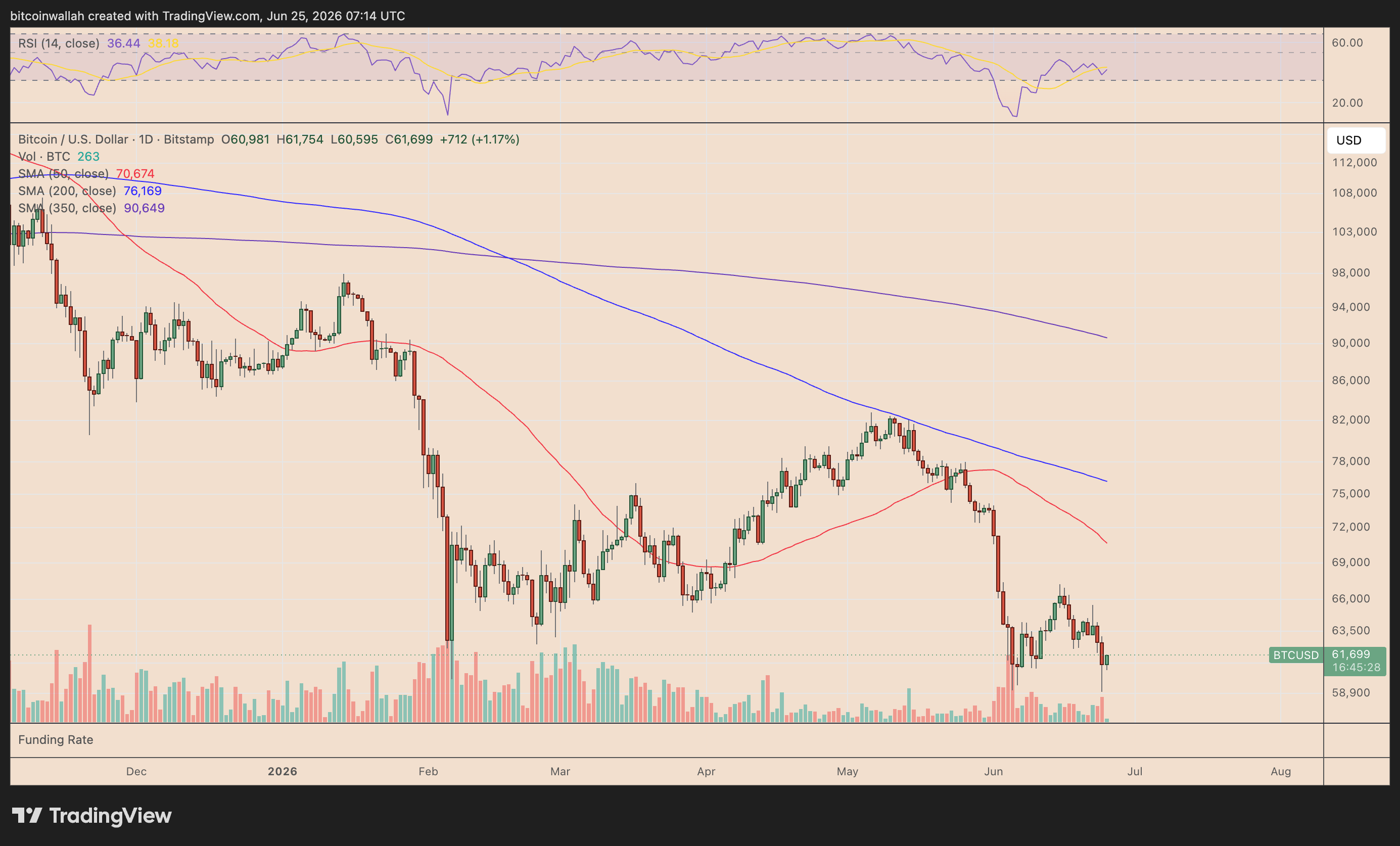
However, BTC’s odds of eventually breaking below $60,000 are high, according to market analyst Qmo, who projected a high probability that Bitcoin will cascade toward a $47,000 target by October.
The Historical Playbook Behind Qmo’s Bearish Thesis
At the core of Qmo’s bearish thesis is Bitcoin’s historical price behavior during previous bear markets.
Specifically, the analyst points to a repeating macro fractal involving the 350-week moving average (MA).
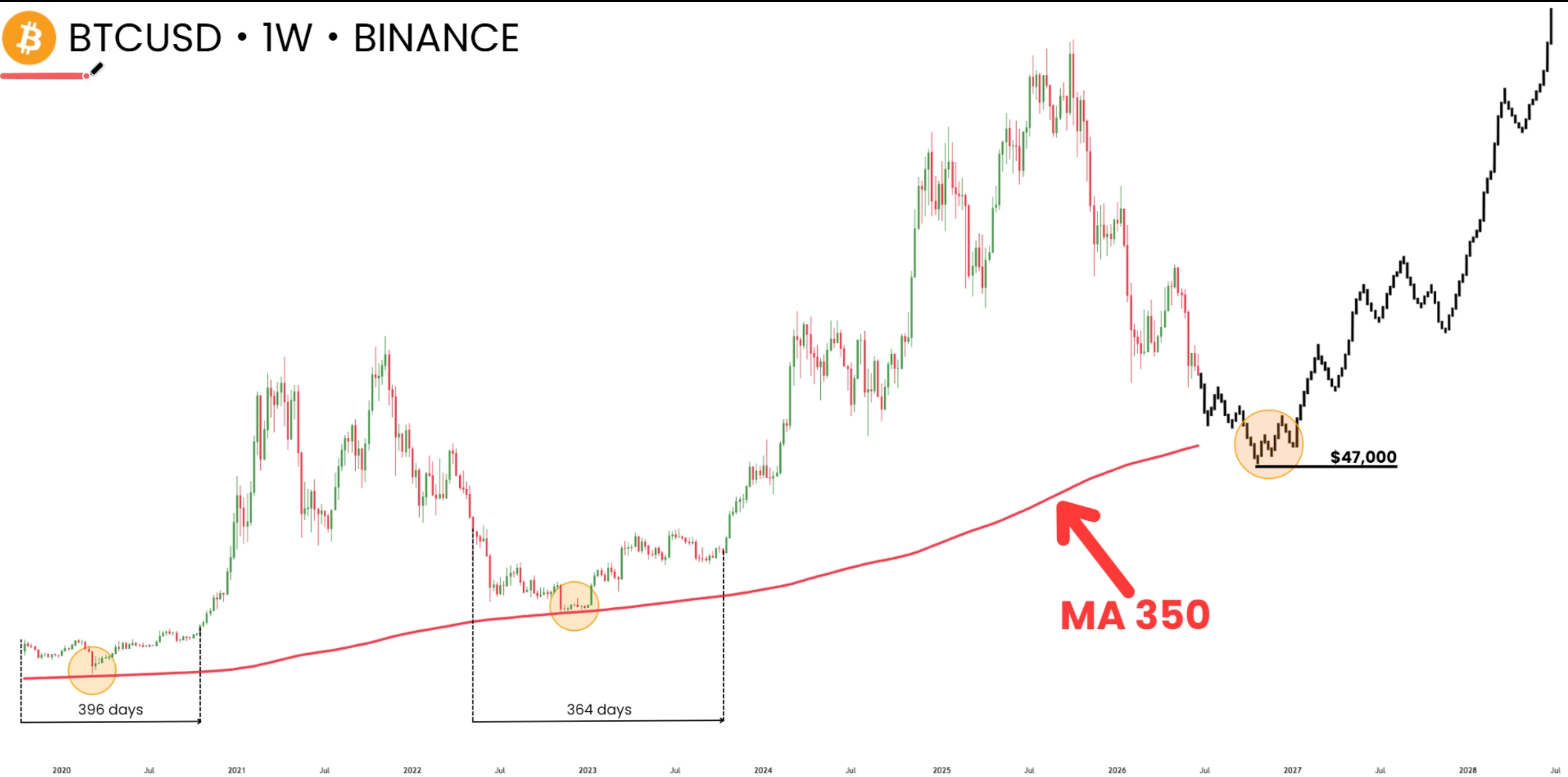
Historically, Bitcoin has never established a durable macro floor without first testing this exact long-term support line.
The 350-week MA currently sits near $47,900, down roughly 22% from the current price of around $61,600. This structural gap suggests the market has not yet experienced its final capitulation phase.
Bitcoin’s bear market calendar also favors a deeper correction:
-
The 2018 Crypto Winter: Bitcoin endured a 396-day downtrend, ultimately crashing 83% from its peak, bottoming out precisely at its 350-week SMA.
The 2022 Cycle: A similarly brutal setup unfolded when a 364-day bear market erased 77% of BTC’s value, ending only after price action tagged the same multi-year moving average.
If this historical fractal continues to play out, a capitulation event toward the $47,000–$48,000 zone may be required to reset market momentum, which would align perfectly with the analyst’s October bottom target.
Bitcoin Price Forecast
Every new Bitcoin analysis as it publishes, today's technical signal and key levels, live price — on one page.
See all Bitcoin forecastsBitcoin On-Chain Data Backs BTC Capitulation Thesis
Complementing the technical moving average framework is Bitcoin’s on-chain Market Value to Realized Value (MVRV) Pricing Bands, which track the asset’s spot price against its aggregate investor cost basis.
Historically, Bitcoin bear markets reach absolute exhaustion only when the spot price declines to test the key valuation bands determined by the Realized Price (RP).
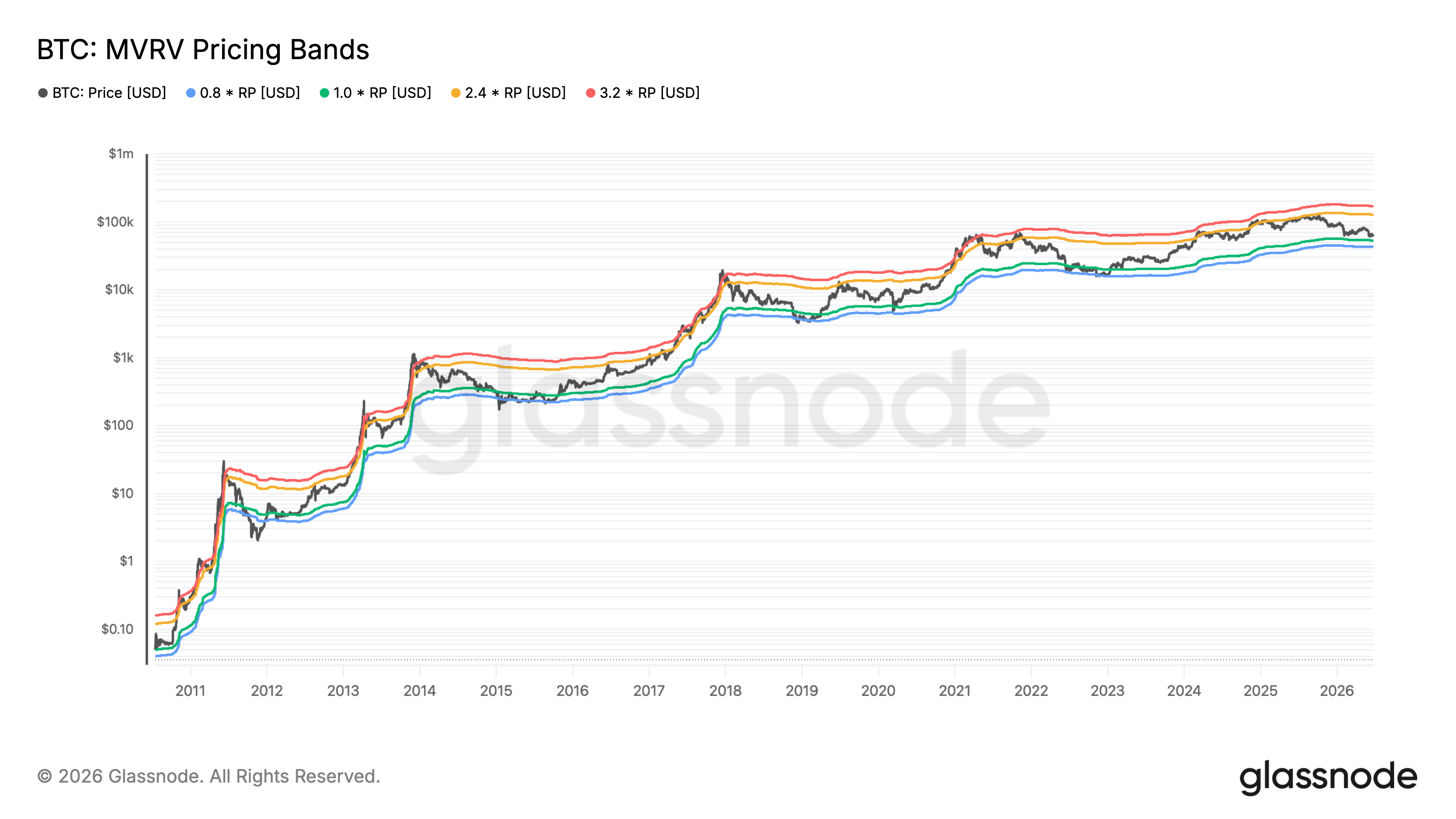
During the ongoing 2026 correction, Bitcoin’s price has pulled back from its upper valuation extensions but remains visibly decoupled from these historical green and blue baselines, aligning with the $53,390 and the $42,710 levels, respectively,
Should the spot price follow historical precedents and gravitate toward these lower on-chain boundaries, it would provide strong confluence for the technical downside targets sitting near the $47,000 region.
Short-Term Head-and-Shoulders Pattern Validates Downside Momentum
Adding weight to the macro bearish outlook is a classical technical reversal pattern developing on shorter-term timeframes. On the 4-hour chart, Bitcoin has carved out a distinct Head and Shoulders (H&S) structure, signaling local trend exhaustion.
As illustrated below, the cryptocurrency established a left shoulder near the $64,000 region in early June, followed by a peak “head” formation near $67,000, and a lower right shoulder matching the initial shoulder height.
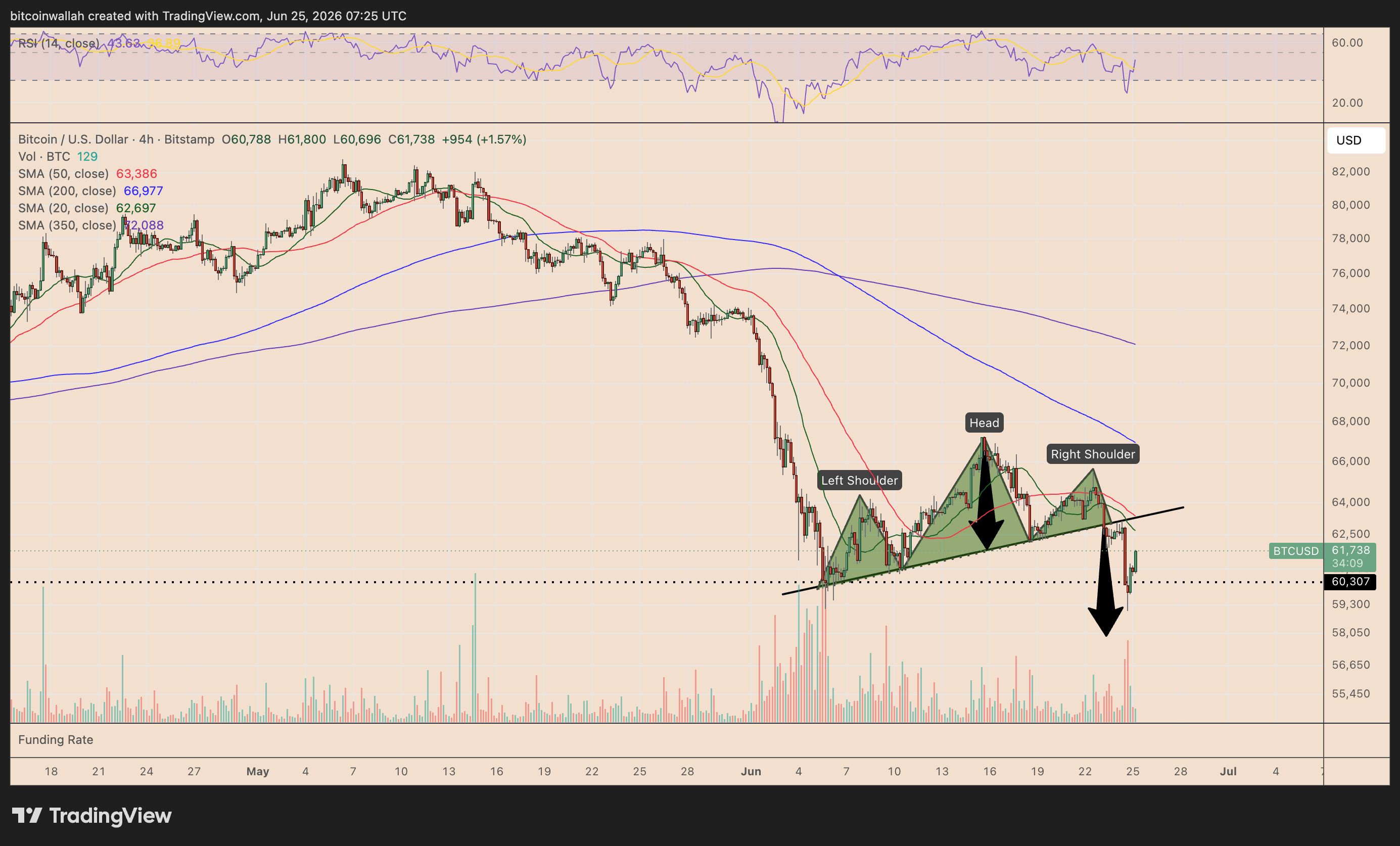
Crucially, the recent price action shows a definitive break below the ascending neckline support, with the measured downside target sitting at around $57,890.
Understanding the Post-Breakdown Retest
The intraday rebound, pushing back toward the ascending neckline and crossing above the $63,000 level, is typical pullback behavior common in major structural breakdowns.
- Sellers Catching Their Breath: Following a major support break below $60,300, aggressive short-sellers often take profits, causing temporary buying pressure that drives the price upward.
- Support Turning into Resistance: The upward move allows the market to test the validity of the breakout. A level that previously acted as a rigid demand floor typically flips into a psychological supply ceiling as trapped buyers look to exit close to break-even.
Consequently, if the current rebound stalls at or near the $63,000 threshold, it will confirm the neckline has officially flipped into structural overhead resistance.
Under this classical technical blueprint, such a rejection would provide the necessary confirmation for bears to re-enter, setting the stage for a resumed downtrend toward the measured macro downside targets under $50,000.