
Bitcoin (BTC) has dipped from around $96,000 in mid-January to a key support at $60,000 just yesterday. The sell-off kicked off after President Donald Trump named Kevin Harsh as a potential replacement for Jerome Powell at the Federal Reserve.
However, it intensified as a result of cascade liquidations. Data from CoinGlass shows that over $1 billion worth of long positions in BTC were wiped out of the futures market in the past 24 hours alone.
Overall, more than $8 billion worth of long positions were taken out of circulation as the token dipped to its lowest level since October 2024.

BTC Still On Track to Hit Our Prediction for 2026
As we shared in our 2026 prediction for Bitcoin (BTC), a break below the 50-week exponential moving average (EMA) opened up the floodgates for massive selling that could end up pushing the top crypto to $36,000.
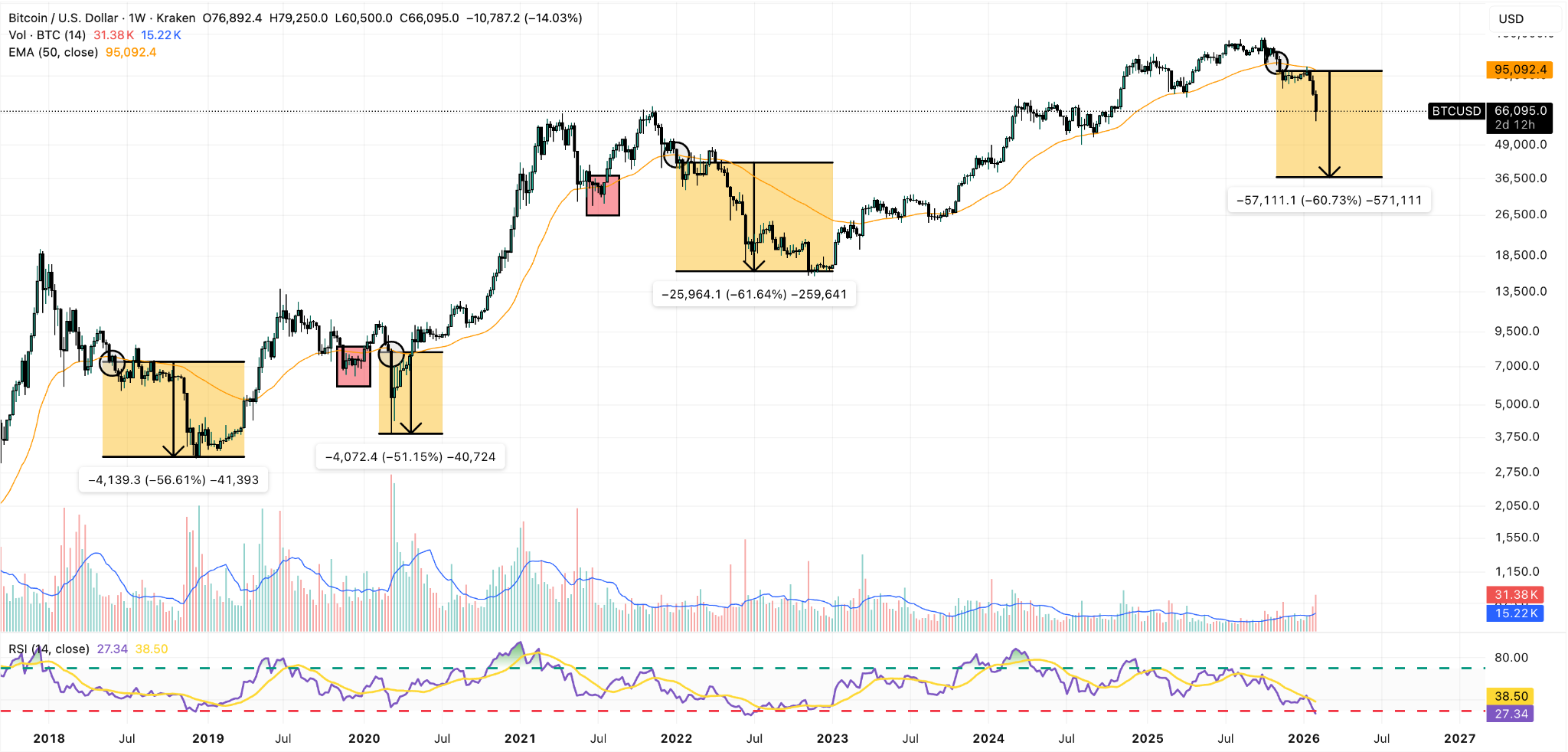
BTC/USD Weekly Chart (Kraken) – Source: TradingView
BTC has already broken below this key line three times in the past, in 2018, 2020, and 2022. Every time this has happened, it has retreated by 50% or higher.
The extent of the sell-off and heavily depressed market sentiment points to a massive risk-off move already unfolding.
This confirms a potential drop to $36,000 if historical patterns repeat, meaning a 60% drop since the 50-week EMA was broken and a 45% downside risk from current levels.
Bitcoin Price Forecast
Every new Bitcoin analysis as it publishes, today's technical signal and key levels, live price — on one page.
See all Bitcoin forecastsExtremely “Oversold” RSI Favors a More Conservative Bearish Target of $48K
The Relative Strength Index (RSI) has dipped to its lowest level in the weekly chart since June 2022.
Back then, the RSI hovered near oversold territory for a while, but the price did not recover immediately. It actually kept dropping from around $19,000 to $16,000 (a 16% loss) in a few months before hitting a bottom.
With the RSI already reaching these lows so rapidly, the odds that we will hit $36,000 have lowered. However, we could still see BTC dropping by another 10% to 20%, meaning a bearish target of at least $48,000 for the next few months.
BTC Long-Term Holders Are Starting to Accumulate
Long-term holders seem to be buying the latest dip. Although still not frantically, there are signs of early-stage accumulation.
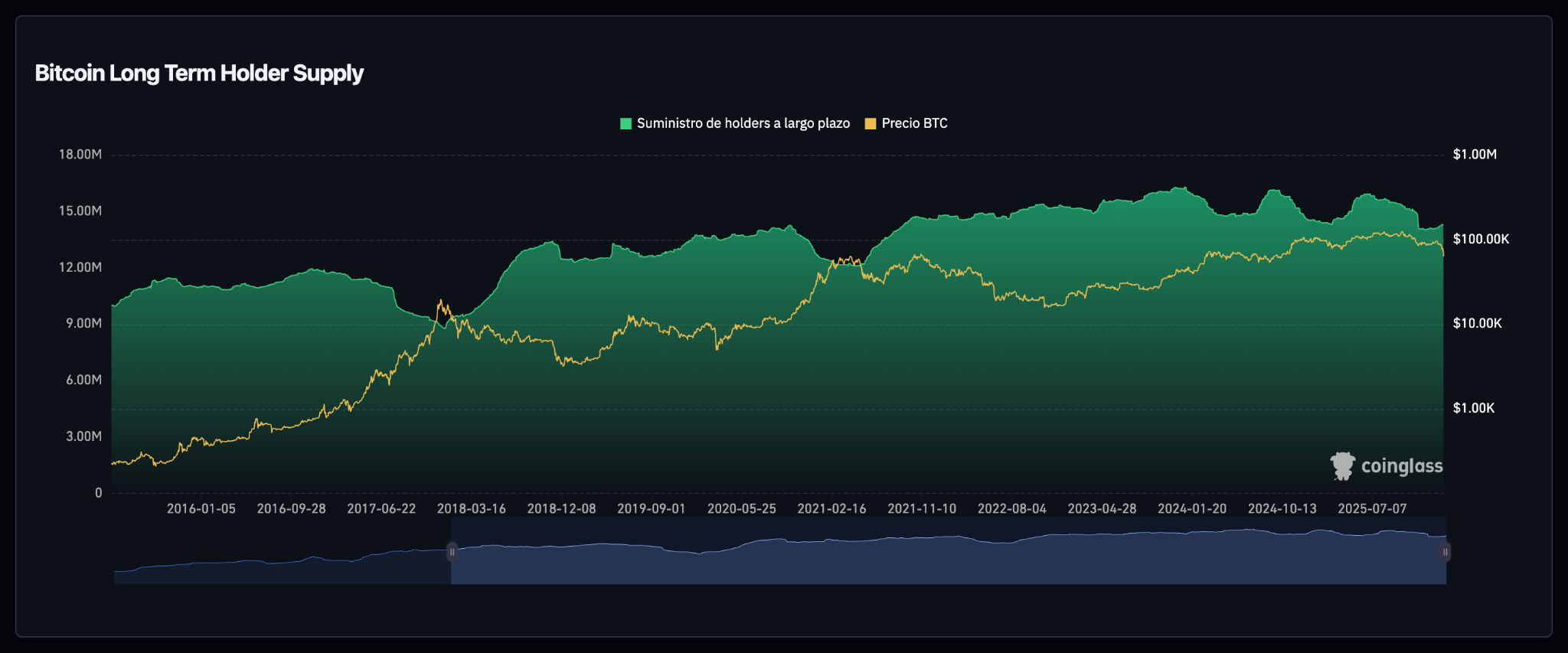
BTC Long-Term Holder Supply – Source: CoinGlass
Data from CoinGlass shows that the amount of BTC in the hands of long-term holders has been steadily increasing since late November, after BTC dipped from $110,000 to $90,000.
The total holdings in these wallets have increased by 200,000 BTC since then, meaning a $15 billion expansion at an average price of $75,000.
Comparing this to the January 2022 – January 2023 crypto winter, we notice a similar pattern. Back then, long-term holders progressively increased their BTC stash from 14.6 million tokens to 15.25 million tokens.
They kept buying while everybody was selling, and that’s what they are doing now again. As BTC starts to rotate from weak hands to strong hands, this begins to create a floor.
To sum up, in the near term, we could still see BTC dropping to $48,000 or even to $36,000 if bearish momentum gets bad.
Throughout this period, if LTH holders continue to accumulate, that would replicate previous “boom and bust” cycles that have ended up yielding big returns to buyers with a long-term horizon.