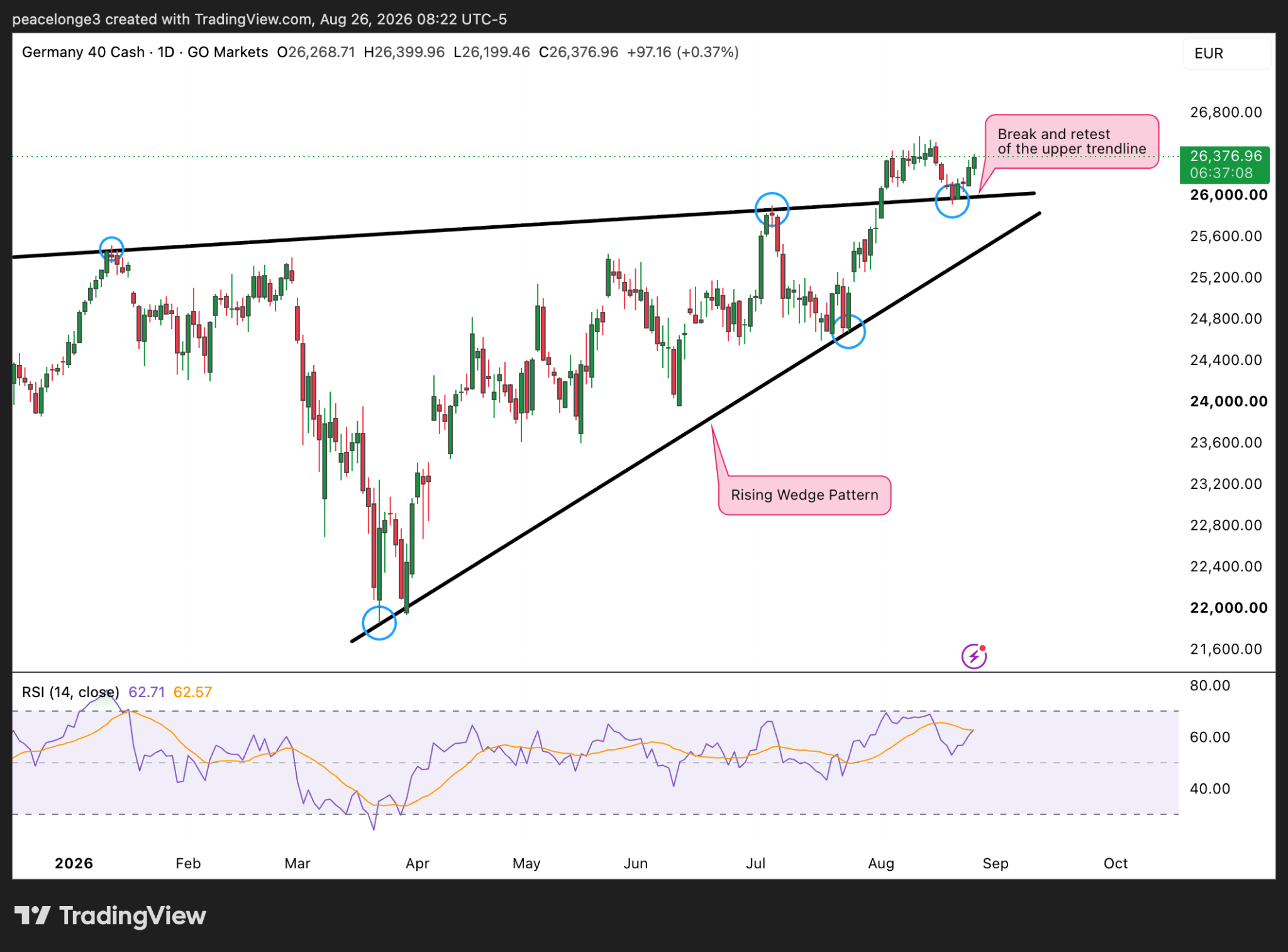
The DAX spent about 200 days trading inside a rising wedge pattern, from as far back as January 2026. Rising wedges typically resolve to the downside; however, on August 4, price did the opposite and broke to the upside, liquidating short bets.
About two weeks later, price pulled back towards the upper trendline of the wedge for a retest. The trendline, which is now resistance-turned-support, held the retest and pushed price back up. As of today, August 26, the daily candle has broken above the previous day’s high, and the path to the psychological 27,000 is open.
The RSI currently reads 63.04, which is significantly above the average level and much closer to the overbought zone. This is a strong indication of bullish momentum with enough room to keep pushing to the upside.

DAX Bulls Eye 27,000 as Wedge Retest Holds
It is worth noting that the last high that was created by price around 26,500 is the next major resistance for the bulls. If bullish momentum holds and a daily close above that level is printed, the path to 27,000 and price discovery becomes easier. However, if the 26,500 resistance holds, price can be forced lower, and possibly into a consolidation with slowed momentum.
The hope for bears lies in the invalidation of the 26,000 retest level. If price manages to fall back down and close below 26,000 on the daily timeframe, the bullish thesis breaks and the path to the wedge’s lower trendline near 25,500 reopens.
What Is Driving the Bid Under German Equities?
The fundamentals of DAX 40 support the ongoing bullish trend. Strong economic data like the German Ifo Business Climate Index rising to 88.8 in August 2026, up 2.54% from the last month, justify the bulls winning over the bears. The Expectations Index also increased to 89.1, cementing the optimism of investors in German equities.
When analyzing the performance of the DAX, one cannot leave business sentiment aside, as it is a major indication of how firms read Germany’s investment conditions. If these conditions favor sustained industrial demand and solid earnings opportunities across the industrial and finance sectors tracked by the index, more investments are likely to come pouring into the economy. Another detail that deserves a mention is that Germany’s Ifo Business Climate Index has improved for a fourth consecutive month, culminating in the 88.8 August reading.
DAX Price Forecast
Every new DAX analysis as it publishes, today's technical signal and key levels, live price — on one page.
See all DAX forecastsYear-to-Date Gains and Heavyweight Constituents Anchor the Trend
Looking beyond the DAX’s performance in the past month to the year-to-date picture reveals a more than 7% move to the upside. This shows that the year has been bullish overall, with more momentum building now. It is worth noting that this is one of the stronger outlooks among other European instruments over the same time stretch. A significant portion of the bullish performance is owed to some big names like SAP and Infineon Technologies that have helped push the DAX higher through their own individual performances.
Another interesting insight into the DAX’s bullish strength lies in the index’s constituents. It is made up of large multinational companies that operate outside the shores of Germany and rake in foreign earnings that are largely independent of whatever is happening with Germany’s economy. This means the DAX is able to continue setting record prices even if German economy headlines are soft.
Can the Breakout Survive the ECB and Tariff Risk?
The European Central Bank (ECB), which is responsible for setting interest rates for countries in the Eurozone, raised its rates by 25 basis points, 2.25%, in June 17. This hawkish posture is an attempt to control rising inflation due to the impact of the Middle East crisis on the energy sector, and higher rates for longer strengthen the DAX, as it possesses a unique structure that allows it to absorb and even leverage higher interest rates. The next decision is on September 10, and sustained ECB hawkishness will help propel the bullish climb.
The final fundamental factor to consider is the DAX’s exposure to trade policies. Seeing as the index consists heavily of multinational corporations, there’s a significant dependence on exports, and this means any unfavorable tariffs can pressure business activities. The United States government recently imposed a 15% baseline tariff on European car imports under a revised trade agreement in August 2026.
This tariff has strained Germany’s automotive sector and lowered car exports to the United States, and any increase in the existing tariff pressure can send the DAX’s price back down into the rising wedge.