The window for a resolution has narrowed substantially over the past week, and markets are beginning to price in that likelihood.
The Ceasefire That Isn’t
What was an agreed ceasefire in April has, frankly, ceased to mean very much at all. It is very hard to believe anything coming out of Washington or Tehran right now, which makes trading challenging to say the least.
The US confirmed a second day of Iranian strikes, which have been labelled as ‘self-defence’ following the downing of a US Apache helicopter earlier in the week. Iran has also announced that the Strait of Hormuz is fully closed to all vessels – I never knew it had reopened, even partially.
President Trump has said that Iran has asked the US to stop bombing. Defence Secretary Pete Hegseth was characteristically blunter in his phrasing, saying, ‘If we need to negotiate with bombs, we’ll negotiate with bombs’. Hegseth may have watched too many action movies as a child – it is a line that would not look out of place in a screenplay. However, markets remain sceptical of the diplomatic track until something concrete materialises.
Energy Driving the Inflation Bus
Despite a modest gap higher in Brent crude this morning, the benchmark is down 1.3% in early European trading, with WTI not far behind. The energy story feeds directly into the inflation picture, and yesterday’s May US CPI print showed the YY headline rose 4.2%. This was the fastest clip since April 2023 and more than double the Fed’s 2% target; energy alone accounted for most of the acceleration. The silver lining – if you could call it that – came from the core reading, which reached 2.9% YY. While still elevated, it is better than feared and certainly will not force the Fed’s hand at next week’s meeting.
Brent Oil Price Forecast
Every new Brent Oil analysis as it publishes, today's technical signal and key levels, live price — on one page.
See all Brent Oil forecastsNew Fed Chair Kevin Warsh also finds himself in an awkward position. His pre-appointment narrative centred on a disinflationary AI boom that would provide a credible path to lower rates. That story is not playing out as expected; AI is currently driving up costs for key technology components rather than reducing them.
Still, the consensus view is that the Fed will hold next week, and I agree with that assessment – the data supports patience rather than panic, for now. The more pressing question may be whether the hawks on the committee begin to gain traction as the summer progresses.
BoC Sitting on Its Hands
Alongside the inflation data, the BoC announced that it had kept the overnight policy rate unchanged at 2.25% for a fifth consecutive meeting. BoC Governor Tiff Macklem’s message was measured. Core inflation has eased, the Canadian economy has neither grown meaningfully nor tipped into recession over the past year, and risks to the outlook remain roughly where they were at the last decision.
This essentially says the central bank is sitting on its hands for now. Markets have priced in 35 bps of tightening by year-end, which still seems a little exaggerated to me, given the economic picture and the fact that there are only four meetings left this year.
Day Ahead: ECB Stepping Off the Sidelines & US PPI Inflation
Markets are fully pricing in a 25-bp rate hike from the ECB today at 12:15 pm GMT, which would mark its first hike since 2023. YY headline and core inflation have risen to 3.2% and 2.5%, respectively, suggesting the energy shock is beginning to broaden. You will likely recall that ECB President Christine Lagarde signalled at the April meeting that June would be the moment to reassess, and the data has since strengthened the case.
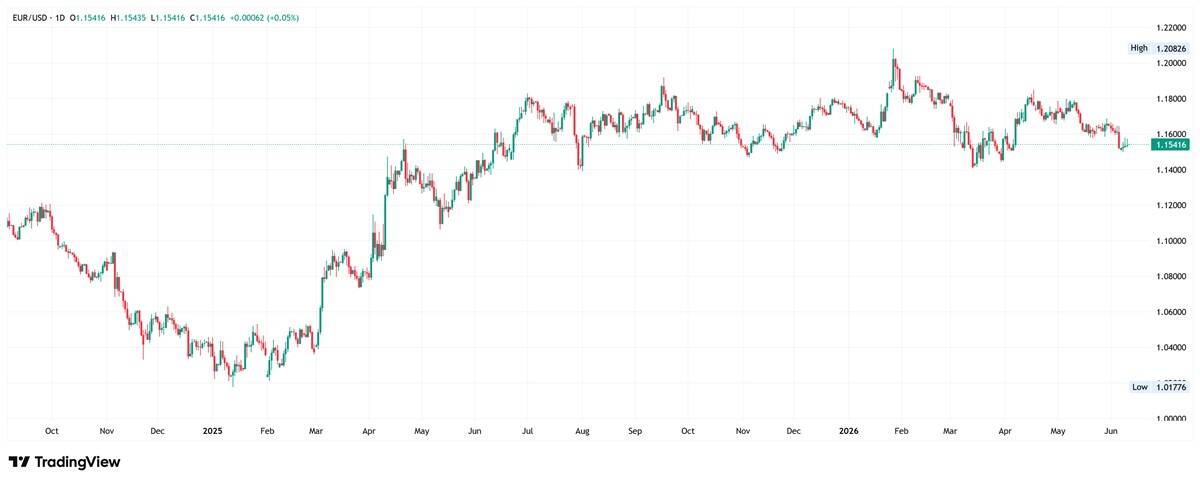
However, a rate hike is unlikely to jolt markets beyond a short-term EUR spike; what will matter to market participants is the forward guidance. If Lagarde frames the meeting as the start of a tightening cycle rather than a one-off ‘insurance hike’, this could underpin a strong bid in EUR/CHF and EUR/USD, particularly given current positioning.
The final piece of this week’s US inflation puzzle arrives at 12:30 pm with the US May PPI report. Headline PPI is expected to have risen 0.7% MM – a deceleration from April’s 1.4% – while the YY rate is forecast to climb to 6.4% (from 6%). A hot print here today would likely reinforce the case for those within the Fed who believe the easing bias should be abandoned entirely.
Written by FP Markets Chief Market Analyst, Aaron Hill