US-Iran Ceasefire in Limbo
As I am sure you are aware, the US and Iran have continued to trade blows, with the US recently striking Iranian command centres and missile sites – though there are also reports of bridges and ports being hit – in an effort to reduce its capacity to restrict vessels from transiting the Strait of Hormuz.
Kuwait has borne the brunt of Iranian retaliation this weekend, with an oil facility evacuated after sustaining serious damage and two power and desalination plants struck, causing fires and disruption to essential services. According to Iran’s Deputy Foreign Minister Kazem Gharibabadi, Tehran has also now suspended its commitment to the MoU. Iran’s navy says it has turned back vessels attempting to use what it calls unauthorised routes through the Strait.
Unsurprisingly, oil benchmarks opened higher this morning, with Brent crude reaching a high of US$91.42; This is a marked jump from US$70 at the beginning of July. Higher energy costs are naturally feeding into inflation concerns, which, of course, will have implications for how central banks will view the rate path.
AI Volatility Drags Chips Into a Bear Market
The other big story is the fallout from Chinese AI developments. Moonshot AI’s new Kimi K3 model rattled Wall Street and Silicon Valley, dragging chip stocks into their worst week since April last year and pulling the Philadelphia semiconductor index into a bear market. Alibaba quickly followed with a preview of its own flagship model.
Asian markets were choppy overnight. South Korea’s KOSPI opened sharply lower before attempting to pare losses, aided by Seoul tightening rules on leveraged ETFs. Japan is closed for a holiday, Australia was firmer on energy strength, and US and European futures point to a modestly higher open.
Day Ahead: CPI Inflation Eyed for Canada and New Zealand
Canada: CPI Will Be a Test for the CAD
The June Canadian CPI inflation report lands today, with the headline YY print expected to ease back under 3% to 2.9% (from 3.2% in May), reflecting the move lower in energy prices, with the max/min forecast between 3.2% and 2.7%. The BoC’s preferred core measures – CPI median and trim – are forecast to remain unchanged at 2.1% and 2%, respectively.
You will recall that the BoC held the line for a sixth consecutive meeting last week, leaving the overnight rate at 2.25% and underlining that it is at the right level – the lower end of its neutral range (a sweet spot where the rate is neither stimulating nor restricting growth). Given this, along with Governor Tiff Macklem’s comments this month regarding the neutral rate, inflation being ‘clearly above target’, and his warning that if the oil price spike feeds into broader inflation, consecutive rate hikes would likely be needed, I do not believe traders will pay much attention to a data miss; the stronger reaction could come from a beat.
Money market expectations point to 18 bps of tightening by year-end – about a 70% chance of a rate hike. Technically, the remaining 30% represents capital that has not yet committed to the hawkish thesis. So, with economists expecting headline inflation to soften, should we see this bump higher, and core measures also surprise higher, a CAD bid could emerge. The USD/CAD is a pair I will be watching closely for possible downside moves. This should be bolstered by last week’s easing in US CPI/PPI, which triggered a modest dovish repricing of Fed rate expectations. Additionally, CoT positioning shows the USD overstretched to the upside and the CAD modestly bearish, thereby supporting an unwind that could add extra impetus here.
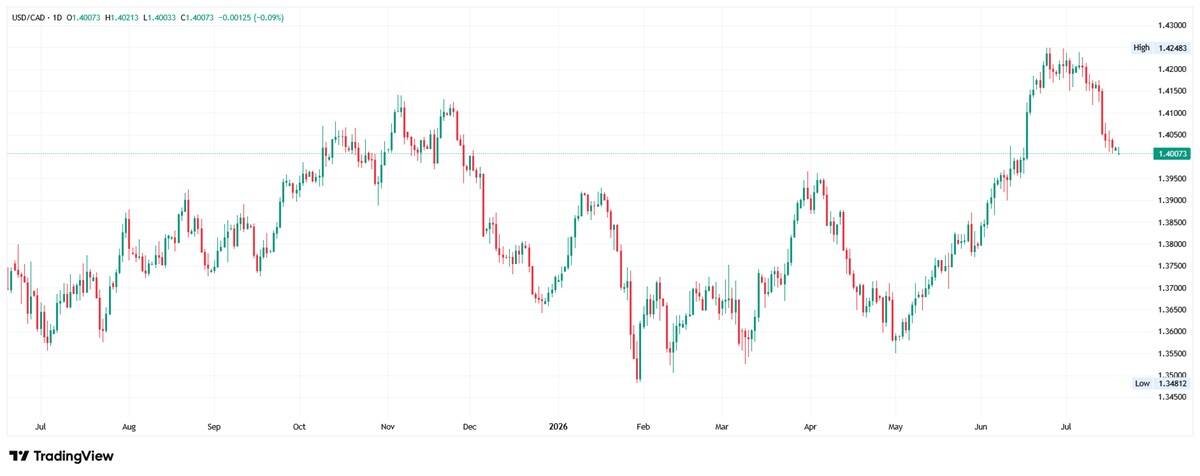
However, depending on the situation in the Middle East, trading the USD/CAD could be tricky, as if things heat up in the Gulf, the pair faces conflicting safe-haven and oil-driven bids. In this case, AUD/CAD could be a pair sellers look to, leveraging the CAD’s energy-driven strength against the risk-sensitive AUD.
New Zealand: Crowded Shorts
Late Monday (for me), we will also get our hands on the Q2 26 New Zealand CPI inflation numbers. Per forecasts, inflation is expected to reach 4% from 3.1% in Q1; the max/min estimate range is reasonably narrow between 4.1% and 3.8%, but do note that in the latest MPR, the bank noted that they expect YY inflation to peak at 3.9% in June, before softening to 3.3% in September. So, a 0.2% variance means a print of 3.9% is a ‘hit’ for the bank, but a ‘miss’ for the market. For the QQ print, analysts also anticipate inflation reaching 1.4% from 0.9% (estimate range between 1.6% and 1.3%).
Heading into the event, investors are pricing in about 52 bps of hikes by year-end – that is two more rate hikes on top of this month’s increase to 2.5%.
Per the forecast distribution, the YY above 4.1% would represent a clear beat and not only be north of the maximum estimate, but it would also be above the RBNZ’s forecast (3.9%), while at or below 3.8% would likely be viewed as a genuine miss. For QQ data, there is only one desk currently pencilling in 1.6%, so either at or above here might be enough of a surprise for a beat, while only two desks are looking at 1.3%, therefore either at or below here for a miss.
The NZD is crowded bearishly (large spec), with retail sentiment on NZD/USD also bearish right now. This opens the door for a short squeeze. Therefore, today’s Q2 CPI release will determine whether the 52 bps of priced-in rate hikes force an unwind or validate the capital flight to safe havens like the USD.
Written by FP Markets Chief Market Analyst, Aaron Hill