



A lot is going on this morning.
Oil Slides on Diplomatic Signals
Oil benchmarks were down on Tuesday, with WTI and Brent crude shedding nearly 5%. This follows comments from US Secretary of State Marco Rubio, who said the US will not initiate strikes on Iran, with the focus largely on economic sanctions – this is not really anything we did not already know. However, on top of that, Iran and Oman are closing in on a deal to facilitate flows through the Strait of Hormuz.
Gold at Three-month Highs
I would be remiss not to include spot gold. Against the USD, the yellow metal continues to trade near three-month highs, just shy of US$4,700. Although upside momentum paused briefly this week at daily resistance of US$4,660, MTD we are still up nearly 15%, aided by a fall in real US yields and the buck trading around three-month lows. I am closely watching technical support to emerge from around US$4,579, with overhead resistance calling for attention at US$4,764.
Equities Cautious Ahead of Nvidia’s Earnings
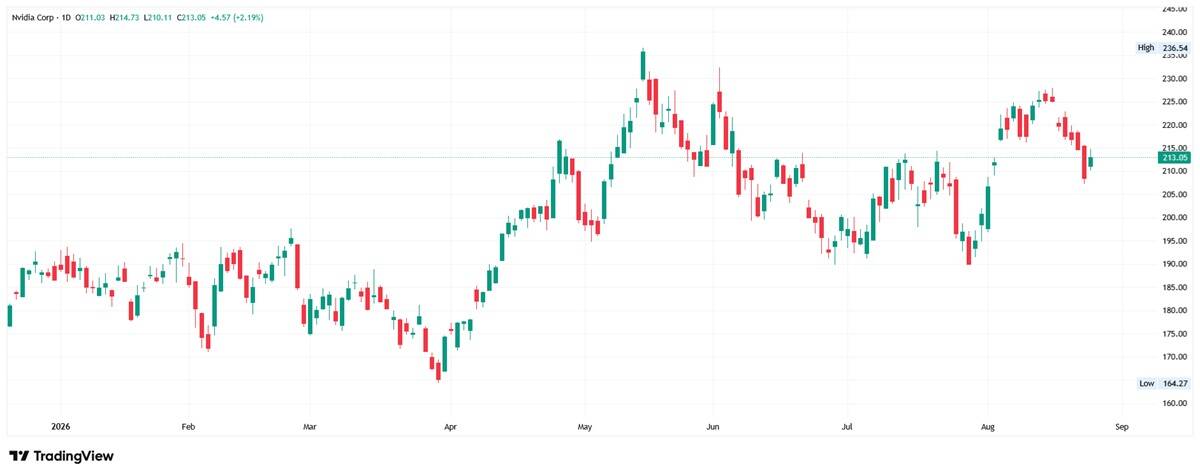
Sentiment is positive in the equity space; Asia-Pac shares caught a bid overnight on lower oil prices and easing bond yields, following a modestly positive close for US cash benchmarks yesterday. I expect cautious action in stocks ahead of Nvidia’s earnings report after today’s market close. I don’t think it is a question of whether Nvidia beats estimates anymore; it’s whether the company beats expectations by ‘enough’ to satisfy investors and keep the AI trade moving higher. Of interest, Tuesday saw the stock snap a seven-day losing streak – its longest since late 2022.
The company’s guidance points to about US$91 billion in revenue and 75% gross margins, implying 90-99% annual growth. Given the stock’s historical performance around earnings, revenue could come in higher – I am looking at around US$93.5 billion, or approximately 100% annual growth. Nvidia has topped its own targets by about 3% almost every quarter for years, a pattern that has repeatedly forced Wall Street to raise its long-term revenue and earnings assumptions.
FX & Bonds: CAD Lower, AUD Higher & Yields Lower Across the Curve
In the FX space, the CAD continues to trade on the back foot against the USD. The trade war between the US and Canada is clearly heating up, with Canada announcing dollar-for-dollar retaliation. What the US will do now is the question – will we see a retaliation-for-retaliation scenario? The AUD was also in the spotlight overnight, following better-than-expected Australian CPI inflation – both at the headline and trimmed-mean levels.
For bonds, US Treasury yields were lower across the curve amid the fall in oil and, of course, the implications of US Treasury Secretary Scott Bessent’s recent plans for bond intervention.
US PCE Inflation Numbers on Deck
12:30 pm GMT welcomes the July US PCE price index. Forecasts heading into the event suggest the YY headline number will ease to 3.6% from 3.7% in June (est. range between 3.7% and 3.5%), bringing PCE in line with the Fed’s latest projections by year-end. The YY core reading is expected to remain unchanged at 3.3% (est. range between 3.3% and 3.2%), which is also in line with the Fed’s end-of-year projection.
At the last Fed get-together, the Committee left the target rate on hold at 3.50-3.75% for a fifth consecutive meeting. What caught some off guard was that 3 of the 12 members voted for an immediate rate hike; the minutes (released earlier this month) also revealed that Fed Chair Kevin Warsh got his ‘old-fashioned family fight’, with inflation front and centre of the ‘squabble’.
Since then, Fed officials have remained divided. St. Louis Fed President Alberto Musalem recently hit the wires, striking a hawkish note, saying price pressures are too high and that raising the target rate could avoid more aggressive action down the line. San Francisco Fed President Mary Daly, on the other hand, described the Fed as being in a ‘good place’ and does not envisage the jobs market feeding into inflation.
Other data released ahead of this print includes CPI and PPI inflation easing in July – with the former cooling for two consecutive months – along with 23,000 jobs lost and retail sales falling. On the back of this, with year-end Fed rate pricing having climbed to 22 bps of tightening from 17 bps a week ago, I will be looking for a broad miss in the data to feed into recent soft prints and potentially trigger a further unwind in rate pricing, thereby weighing on the USD.
Adding to this, I like that the USD is overstretched to the upside in terms of positioning, which adds pressure to any unwind. This could add to the recent upswing in gold, which, as I mentioned above, recently clocked three-month highs.
Written by FP Markets Chief Market Analyst, Aaron Hill