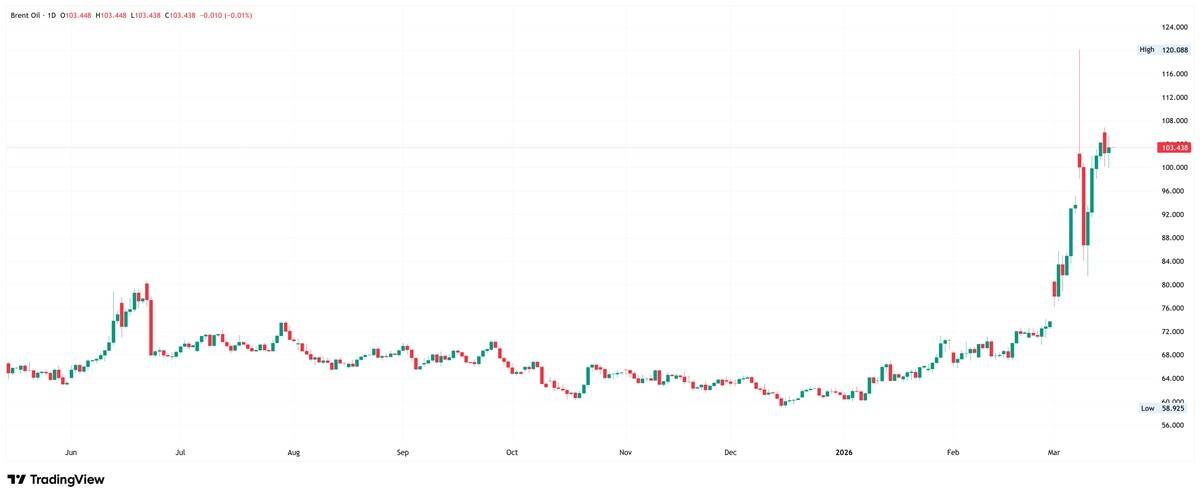
Nearly three weeks into the US-Israeli assault on Iran, the Strait of Hormuz – a significant waterway that carries approximately a fifth of the world’s global oil flows – remains effectively closed. US President Donald Trump’s recent call for allies to send warships to help secure passage through the Strait has largely fallen on deaf ears. US Treasury Secretary Scott Bessent was also on the wires recently, stating that some ships are making it through the Strait, which was the main cause of yesterday’s drop in oil prices. However, things are far from normal and oil prices are demonstrating this right now.
Spot gold and silver barely moved on Monday, with the former holding around US$5,000 and the latter modestly bid from US$80. I think as long as oil remains elevated, central banks will be unwilling to pull the trigger and lower rates, and, as we all know, higher rates are typically a headwind for non-yielding assets like gold.
In the FX space, with some respite in oil, USD buyers unwound some of their haven position – snapping a four-day losing streak and ended down 0.7% – and the EUR/USD found a floor and shook hands with US$1.15. With the Middle East conflict keeping the Strait all but closed, uncertainty remains high, which should eventually see USD dip buyers return. And with Europe’s dependence on oil, I ultimately expect the euro to continue exploring deeper waters versus the buck.
In fact, right now it seems to be all about winners versus losers in the energy markets, and investors are waiting for something more significant to happen before seeing more meaningful moves across asset classes. Energy-importing countries will struggle the longer the conflict continues, and the Strait remains closed, while energy exporters should benefit.
Across stocks, as you would expect, major US averages rebounded on Monday, with the S&P 500 rallying 67 points (1%) to 6,699, the Nasdaq 100 was up 274 points (1.1%) to 24,655, and the Dow Jones closed 387 points higher (0.8%) at 46,946. Nearly 400 names ended the day positively in the S&P 500, and it was green across the screen for all 11 sectors, led by technology and consumer discretionary.
Macro: Canadian CPI Eases on Base Effects, and the RBA Delivers, Just!
On the macro front, we had the February Canadian CPI inflation numbers land yesterday, and overnight the RBA announced it increased its cash rate by 25 bps to 4.1% from 3.85%.
In Canada, headline YY CPI inflation cooled to 1.8% from 2.3% in January; both CPI median and trim measures – the BoC’s preferred measures of inflation – also eased by more than expected to 2.3%, respectively. While this appears healthy on paper, it was largely due to base effects, as the temporary sales tax dropped out of the annual comparison, which should weigh on March’s print as well. However, higher energy prices will likely begin showing up, which may leave the BoC on hold for now. Money markets suggest that the central bank could look to hike rates at the tail end of this year, with 35 bps of hikes priced in for year-end.
The RBA hiking rates was unlikely to raise many eyebrows, but what caught many off guard was the narrow 5-4 vote split. With the economy facing a clear inflation issue, I was surprised to see it was down to a 1-vote margin on whether to hike or hold. The rate statement was largely hawkish, though it included dovish elements.
The Board did the bare minimum to tackle inflation, while using the remainder of the statement to avoid over-committing to further tightening. While the AUD is higher against the NZD this morning, it is largely flat against the rest of its G10 peers; of note, the AUD remains one of the most overstretched currencies to the upside in terms of CFTC positioning, suggesting vulnerability for a ‘squeeze’.
The day ahead is relatively thin on the macro front, with the focus shifting to tomorrow’s calendar: the BoC at 1:30 pm GMT and the Fed at 6:00 pm.
AUD/USD Price Forecast
Every new AUD/USD analysis as it publishes, today's technical signal and key levels, live price — on one page.
See all AUD/USD forecastsWritten by FP Markets Chief Market Analyst Aaron Hill