Big Tech Earnings: Alphabet & Tesla
South Korea’s KOSPI was the standout performer, gaining more than 4% and inching closer to daily channel resistance (extended from the all-time high of 9,385).
Alphabet kicked things off by announcing an eye-watering 2026 projected capex guidance of around US$200 billion for the year – higher than analysts had pencilled in – which sent the share price down by around 5%. The bright spot was the company’s Cloud revenue beat, though it was clearly not enough to offset concerns about increased AI spending.
Tesla also made headlines after the bell, showing that despite beating revenue expectations, the company reported a softer-than-expected bottom line, which immediately guided the TSLA stock lower by more than 3% in after-hours trading.
Yen at Four-decade Lows
The JPY continues to nurse losses around levels not seen since 1986, pulling USD/JPY to ¥163. Ultimately, with the USD continuing to show strength, rising US yields, and elevated oil prices, this is all providing a tailwind for the pair.
Verbal intervention from Japan’s finance minister has had limited impact, but the question is actually whether intervention would have any lasting effect. History suggests not. Technically, USD/JPY has scope to reach as far north as the daily resistance at ¥163.96.
Oil & the Red Sea
In the energy markets, oil benchmarks continued to rise on Wednesday after the Iranian-linked Houthis reported that they struck two Saudi oil tankers in the Red Sea. This escalates supply concerns and adds to the ongoing strikes between the US and Iran. US Secretary of State Marco Rubio says Washington is open to talks, but the prospects of getting back around the table are slim right now.
The front end of the US Treasury yield curve is bearing the brunt of the oil shock, amid renewed inflation concerns that could increase the odds of a Fed rate hike this year. The OIS market has seen a Fed hawkish repricing over the past week, with tightening expectations rising from 22 bps to 36 bps by year-end.
Macro: Aussie Jobs Beat & ECB Update in Focus
Overnight, we also saw the June Australian jobs report show employment jumped by nearly 80,000, considerably surpassing the 15,000 median estimate and up from 40,000 in May. Part-time roles did most of the heavy lifting, up by around 50,000, with full-time roles contributing a further 30,000 and notably less churn. The unemployment rate held at 4.4%, exactly as forecast, while participation edged up to a fresh high. The upshot is a labour market that’s still generating jobs at a healthy clip without any obvious loosening of slack.
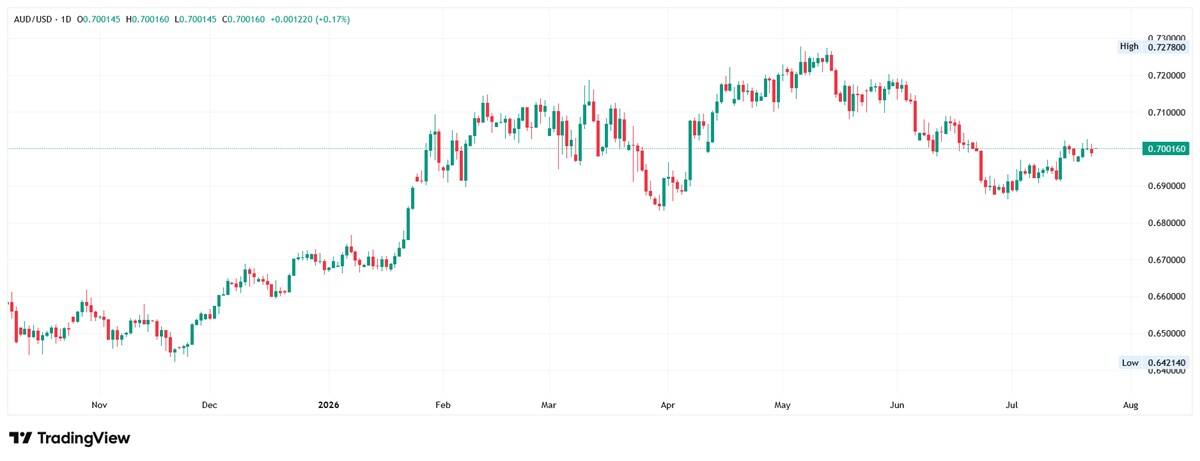
Notably, this triggered a solid bid in AUD versus G10 peers, though upside has gradually waned, most obviously against the NOK and CAD. Markets now fully price in an RBA rate hike by year-end, up from an implied 19 bps just a day ago.
ECB Decision Ahead: Words Matter More Than the Decision
The ECB meets today, but is likely to hold off on pulling the trigger and hiking for a second consecutive meeting, with a mere 4 bps of tightening implied (meaning there is about an 85% chance that the bank holds steady), 23 bps in September, 32 bps in October, and 47 bps by year-end – so, two rate hikes nearly fully priced in.
Only a few days after the June meeting, we saw the US and Iran sign the MoU – a 60-day ceasefire between the two sides and a timeline for structuring peace talks, which naturally weighed on oil and gas prices. Even though the US and Iran are still trading blows and energy prices have increased, albeit still considerably off their highs, I just do not see a reason for the ECB raising rates today. This is further supported by inflationary pressures easing – YY headline cooling to 2.8%, YY core to 2.4%, and YY services inflation pulled back to 3.2%.
With a rate hold largely baked in, it comes down to the ECB President Christine Lagarde’s approach. Given the market’s hawkish pricing, even if she adopts her usual stance – data-dependent and meeting-by-meeting – this could be enough for traders to pare back some of their hawkish bets, acting as a de facto dovish trigger because of overstretched market pricing, which is a downside risk for the EUR. Of note, though, CoT positioning shows the EUR is the most overstretched currency to the downside in the DM space right now, so moves lower could be short-lived and is a risk to factor in.
However, if Lagarde shelves her neutral stance and adopts more of a hawkish tone – perhaps even bring into line with ECB Board member Isabel Schnabel’s comments earlier this month about how the energy shocks could not be looked through – this could provide a tailwind for EUR longs, which could also aid a strong unwind in bearish positioning.
Written by FP Markets Chief Market Analyst, Aaron Hill