Why Did Bitcoin Rally
Bitcoin was trading at around $79,800 during the Asian trading session on 28 August 2026. It has rallied more than 20% since the 17 August low of $62,680 and is now flirting with a major $80,000 resistance level. The primary catalyst for the rally was rather unusual and a bit surprising. On 19 August, the U.S. Treasury Department announced plans to double its buybacks of long-duration bonds, ostensibly to cap the rising yields. The measure would inject extra liquidity into bond markets and, therefore, effectively amounts to quantitative easing (QE), which is anything but bearish for the greenback. As a result, this surprise announcement triggered broad-based dollar weakness and provoked a sharp rotation into dollar alternatives, including cryptocurrencies.
However, there was another catalyst, which was more crypto-related. On the same day, 19 August, President Donald Trump urged Congress to pass the Digital Asset Market Clarity Act (the Clarity Act). He made the call during a White House meeting with digital asset industry executives, where he emphasised that passing the legislation is essential to maintaining U.S. leadership in global technology and outcompeting strategic rivals like China.
The Clarity Act sets clear rules for classifying digital assets as either commodities or securities and divides regulatory duties between the Securities and Exchange Commission (SEC) and the Commodity Futures Trading Commission (CFTC). Because it legitimises digital assets and creates legal pathways for traditional financial institutions to hold and trade crypto, it is regarded as a structural positive for the crypto industry in general and a strong bullish catalyst for Bitcoin in particular.
Renewed institutional demand and short-covering after a protracted sell-off may also have played a part in Bitcoin’s rally, but to a lesser extent. Either way, the Bitcoin rally had wide-reaching effects across crypto-related equities:
- Coinbase gained up to 9%, MicroStrategy rose 5%, and Robinhood Markets jumped over 7%
- Crypto miners also advanced, with Riot Platforms, Mara Holdings, and Hut 8 all rising 3-5%
- BTC mining machine maker Canaan leapt 18%, and stablecoin issuer Circle Internet gained 7%
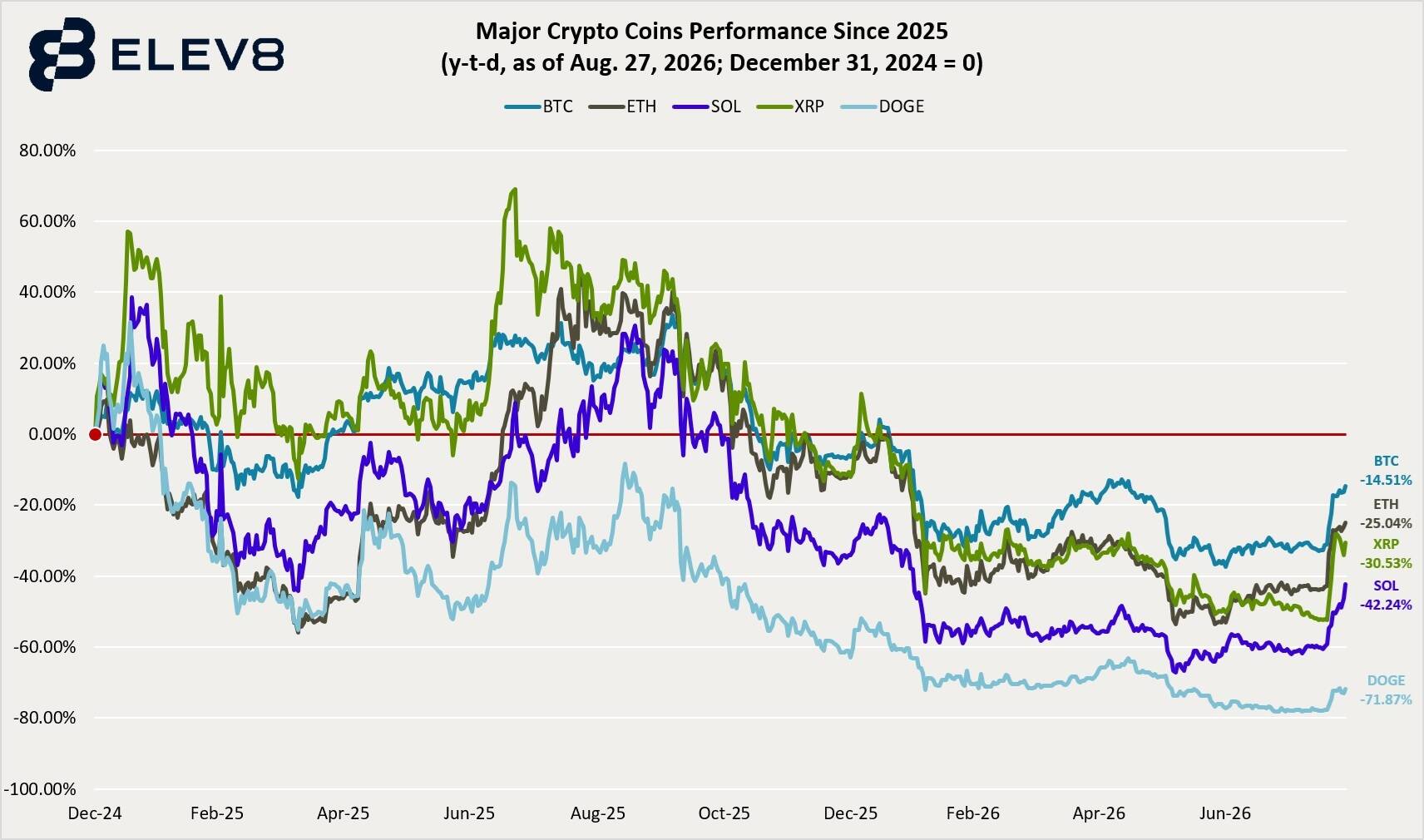
So, the rally was indeed broad-based. Therefore, if it stalls or reverses, many crypto names are likely to fall in tandem. Indeed, the general macro environment is still perilous for the crypto sphere. All major coins remain in a secular bearish market and are below their levels reached at the end of 2024 (see the chart below).

Bearish Factors
When everything looks rosy and promising , it is recommended to be especially cautious. Yes, Bitcoin is up and running thanks to supportive structural tailwinds—notably dollar weakness and pro-crypto legislation. However, headwinds are also there to watch out for. Below are five factors that could stall or reverse the Bitcoin rally.
First of all, anything that is bullish for the U.S. dollar would be bearish for Bitcoin. Thus, the main risk factors include U.S. inflation, Federal Reserve (Fed) monetary policy, and Fed Chair Kevin Warsh’s rhetoric.
- U.S. inflation
The latest Personal Consumption Expenditures (PCE) Price Index for July, the Fed’s preferred measure of inflation, came in at 3.7% year-on-year (vs 3.6% expected). Alarmingly, the unrounded core PCE monthly increase was nearly 0.3%, a very bad sign for anyone looking for rate cuts. Higher inflation is a structural bearish factor for Bitcoin because it increases the opportunity cost of holding non-yielding assets. In addition, higher inflation may prompt the Fed to raise short-term interest rates, which is detrimental to risk sentiment and will exert downward pressure on all crypto assets.
- Rising odds of a Fed rate hike
Rising inflation inevitably calls for tighter monetary policy. According to the latest interest rates swap market data, investors are currently pricing in a 35% chance of a September rate hike. Furthermore, market participants are almost 100% certain that by December this year, the Fed funds rate will be higher than it is today. Just like higher inflation, higher interest rates increase the opportunity cost of holding Bitcoin and make alternative assets relatively more attractive.
- Kevin Warsh
Fed Chair Warsh’s Jackson Hole speech on Friday could strengthen the dollar. This is not guaranteed, as market reactions depend on his broader framework, but it remains a possibility. Mr Warsh has historically been sceptical of quantitative easing (QE) and is generally considered a hawk on monetary policy, although as Fed Chair, he is expected to remain objective and data-dependent. Moreover, because Mr Warsh has abandoned explicit forward guidance and favours a ‘less is more’ communication style, the market reaction to his speech may carry a significant two-way volatility. And given that Bitcoin has already rallied 20% over the past two weeks, many traders may look to take profits, needing only a minor cue from Warsh to justify selling.
- Clarity Act
That same Clarity Act, which partly provoked the recent rally, may also reverse it. The bill is not guaranteed to pass the Congress. A failed vote is likely to end the bill for the whole of 2026, while a successful vote only starts the debate process, which requires further amendments and another House vote if the text changes. The Senate cloture vote is scheduled for 15 September. Traders should view it as an event risk rather than a guaranteed outcome.
- Technicals
Finally, technicals are beginning to look stretched. A 14-day Relative Strength Index (RSI) is overbought, while the failure to confidently close above the 80,000 level may signal rally exhaustion. If buying at these levels is not justified, selling becomes relatively more attractive, and the path of least resistance shifts to the downside.
Bitcoin Price Forecast
Every new Bitcoin analysis as it publishes, today's technical signal and key levels, live price — on one page.
See all Bitcoin forecastsDisclaimer: This article does not contain or constitute investment advice or recommendations and does not consider your investment objectives, financial situation, or needs. Any actions taken based on this content are at your sole discretion and risk—Elev8 does not accept any liability for any resulting losses or consequences.