Henry Hub’s natural gas fundamental backdrop today is shaped by a stronger official signal for warmth across a major sensitive region for heating demand. NOAA’s Climate Prediction Center discussion, issued October 13, assigns above-normal temperature probabilities extending to 80% across the north-central United States for the upcoming week. These forecasts suggest that demand may be somewhat light for heating.
The subsequent October 21–27 outlook also favors warmth across much of the United States, with probabilities above 70% in the north-central region. Parts of the western United States favor below-normal temperatures, which could help offset some of the lack of demand. But the outlook carries average confidence of about 60%.
The broader warmth pattern could delay stronger heating consumption in the United States, although regional cold and power demand can be a bit of a mix. An 80% probability of above-normal conditions does not mean temperatures are going to be extraordinarily hot; it simply suggests that demand for heating will more likely than not be lower than usual. Obviously, a subsequent shift toward colder conditions could change this assessment before appearing in storage statistics.
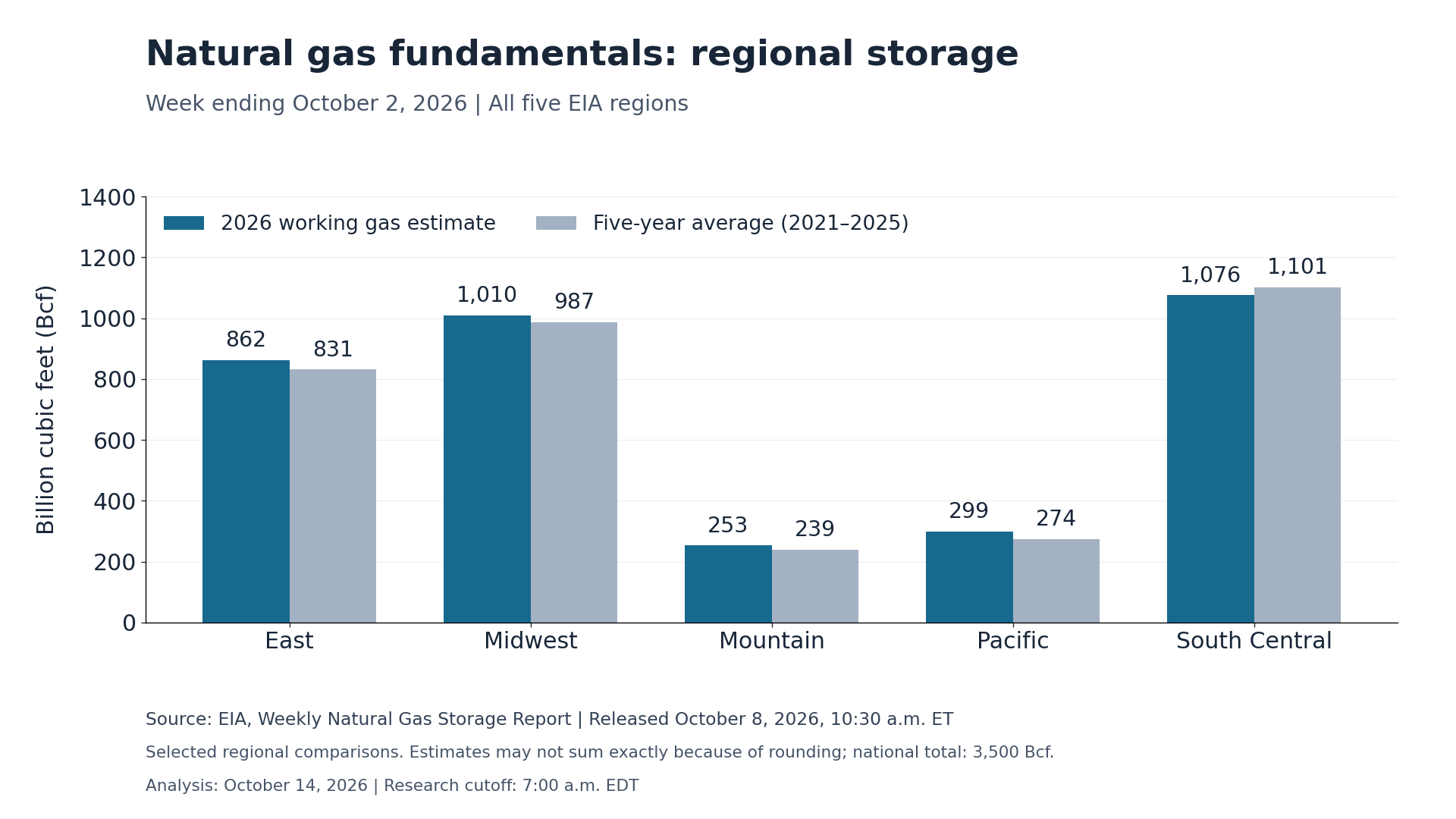
EIA’s latest weekly storage report, released October 8, estimates Lower 48 working gas at 3,500 Bcf for October 2, after an 85 Bcf injection. Stocks were 68 Bcf above the five-year average of 3,432 Bcf and 130 Bcf below the comparable year-earlier level of 3,630 Bcf. The next scheduled release is tomorrow, so the market will be watching.
The regional picture is less uniform than the national surplus suggests. For example, South Central inventories of 1,076 Bcf are 2.3% below their seasonal average, while East and Midwest stocks stood above theirs. The five regions are a bit of a mixed bag in comparison to their five-year benchmarks.

The LNG Channel Deserves the Same Distinction Between Capacity and Utilization
A separate power-market development does deserve some attention. The Department of Energy’s October 12 emergency order, effective October 13–16, authorizes PJM to dispatch specified units and use backup resources under defined reliability conditions. The Department of Energy cites elevated demand and planned generation and transmission outages across the electric grid.
This confirms reliability intervention, but it does not necessarily establish that authorized units ran or that natural gas consumption increased by a particular amount. For Henry Hub, the implication is that electric demand may not follow the heating outlook mechanically. Maintenance and dispatch decisions will alter the fuel mix.
Supply context remains comparatively strong but dated. EIA’s October 2 analysis reported record July gross withdrawals of 137 Bcf per day, primarily associated with Permian growth. Gross withdrawals differ from consumer-grade dry production, and the agency has also reported July records for dry and marketed output. These observations indicate an earlier production base capable of supporting supply.
EIA’s October 6 outlook forecast end-October inventories of 3,850 Bcf, around 2% above their five-year average. It also projects rising LNG exports alongside production growth. Model inputs were finalized October 1, so newer NOAA outlooks and subsequent operational developments are not necessarily included in this report.
The LNG channel deserves the same distinction between capacity and utilization. A terminal’s ability to export more does not prove that it is drawing that volume during that day. Actual operation, maintenance, and feed gas determine the realized demand.
The next meaningful updates are tomorrow’s storage release and NOAA’s big long-lead outlooks, also scheduled for tomorrow. Continued warmth and adequate injections would support a relatively comfortable winter-entry situation. Colder revisions, supply interruptions, or stronger export demand could erode that cushion.
Natural Gas Price Forecast
Every new Natural Gas analysis as it publishes, today's technical signal and key levels, live price — on one page.
See all Natural Gas forecastsTechnical Outlook
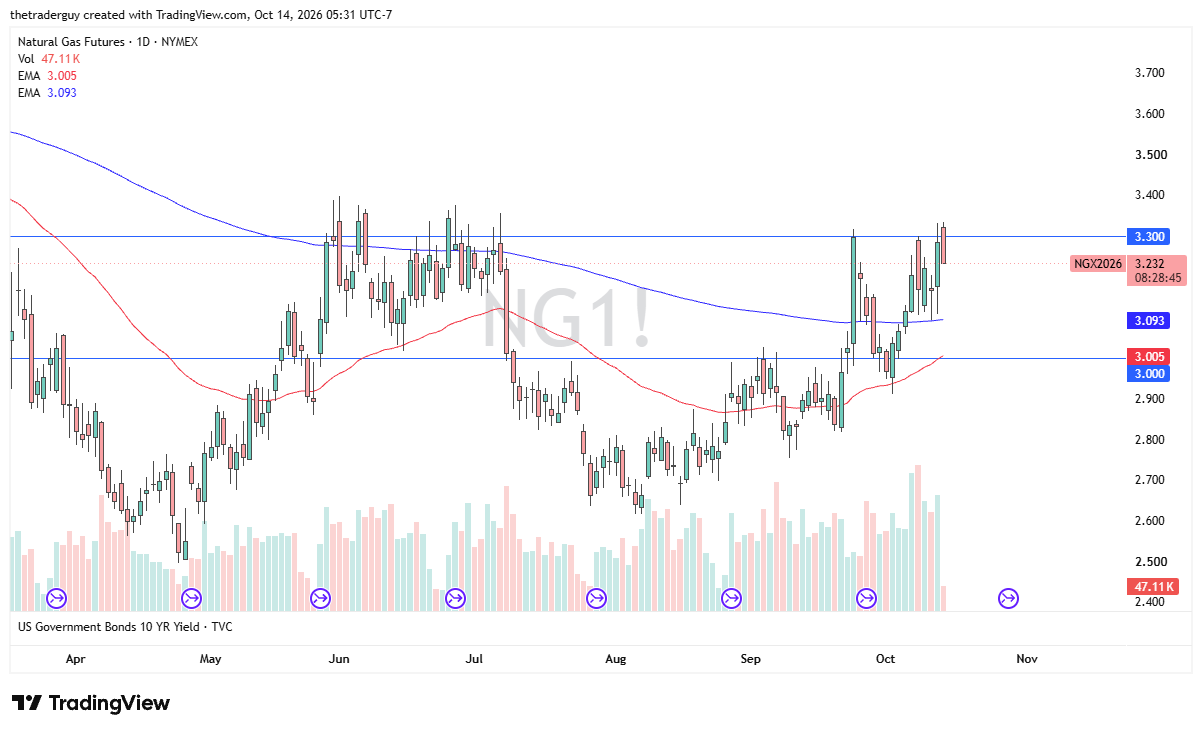
As things appear now, it does look like the November contract is struggling to break above the barrier that starts at $3.30 and extends to $3.40. At the end of the month, we will be rolling over into the December contract, a time that is typically more bullish. Ultimately, the 200-day EMA at $3.09 is a major support level I’m watching, and a break above $3.40 would have me getting very bullish in this market.