WTI
WTI crude oil’s fundamentals remain shaped by demand coming from refineries, exports, and the government’s response to the weather-related supply disruption from the hurricane in the Gulf of Mexico. The Department of Energy’s October 10 announcement authorized an emergency exchange of up to 4 million barrels from the Strategic Petroleum Reserve, split between ExxonMobil and BP America. This authorization was intended to maintain refinery operations, but there is no word that the full volume has already been delivered.
The authorization is a temporary stopgap measure, with participating companies required to return borrowed crude with premium barrels in 2027. The measure addresses the immediate logistical problem with the hurricane hitting Gulf of Mexico production.
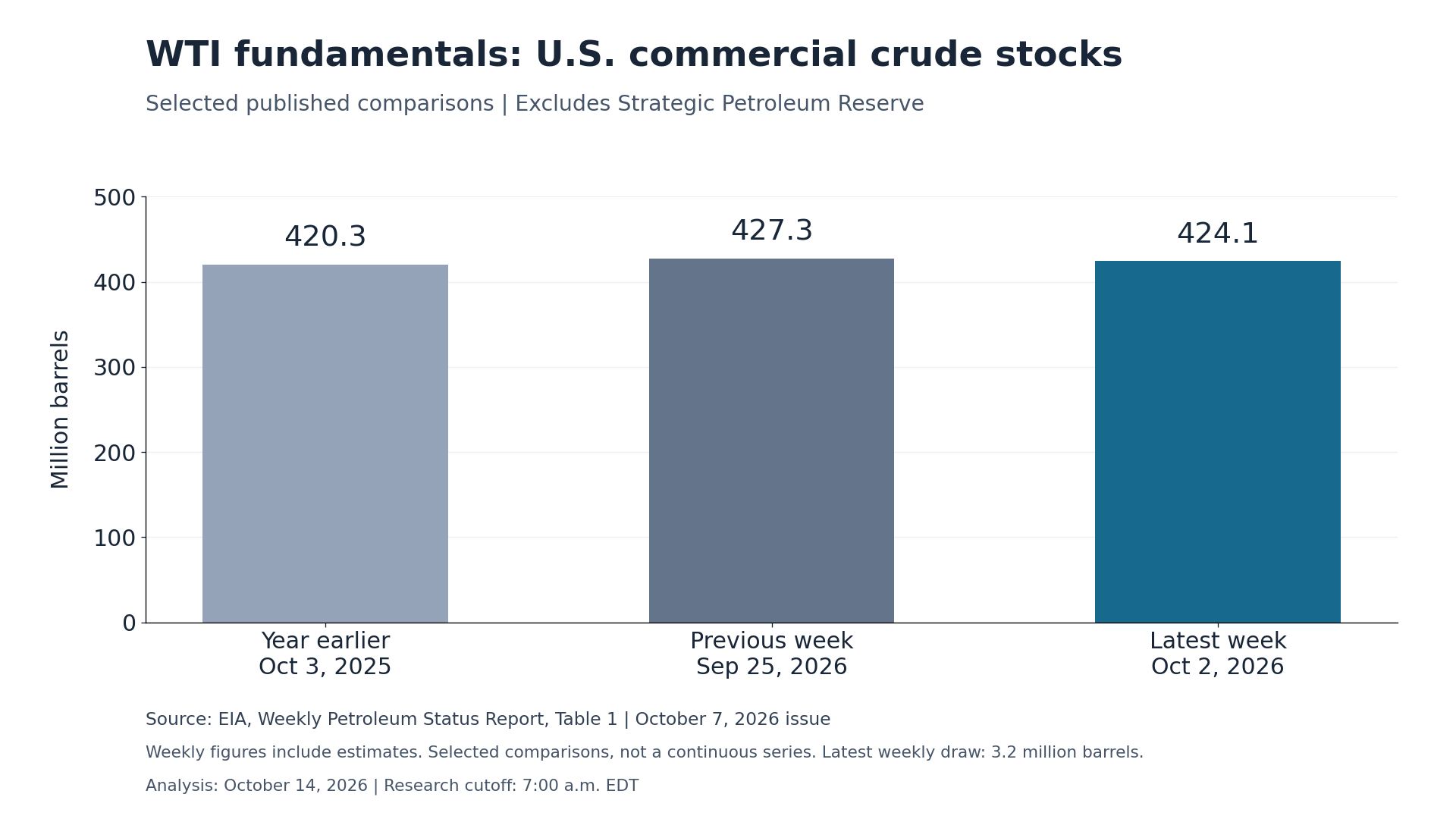
The latest EIA weekly balance sheet from October 2 states that commercial crude inventories, excluding the SPR, were at 424.1 million barrels, down 3.2 million from September 25 but above the comparable year-earlier level of 420.3 million. Refineries processed 16.48 million barrels per day during that week, 223 barrels per day more than a week earlier, operating at 92.7% utilization. Crude exports from America increased to 4.765 million barrels per day, while imports rose to 6.84 million. Higher imports did not prevent the stock draw, but the complete balance includes production, refinery inputs, and statistical adjustments as well.
Product inventories continue to show why refinery continuity matters. EIA reports show gasoline stocks at 204.7 million barrels and distillate stocks at 105.1 million, compared to 219 million and 121.6 million, respectively, last year. The comparison suggests less product cover than the previous year, although it does not establish a shortage at every location in the U.S.
The next petroleum report is scheduled for tomorrow at noon following Monday’s federal holiday. The biggest questions will be whether refinery demand holds up, export strength persists, and reserve exchanges reach the affected facilities. Sustained draws would support a tighter interpretation, though weaker throughput and rebuilding stocks would challenge it.

The WTI Crude Oil Market Is Currently Looking to Break Out of Recent Consolidation
At this point in time, buyers continue to jump in and try to take advantage of dips as they occur. A move about $98 would, more likely than not, bring in fresh buyers. I am looking to see this market get to the $100 fairly soon, with a lot of support below at $95.
Brent
The Brent market has been reacting to a multitude of factors. Today’s new international development is the IEA’s October Oil Market Report. It highlights estimated global oil supply in September at 102.3 million barrels per day, up 2.5 million from August. At the same time, the agency believes world oil demand is falling by roughly 2.6 million barrels per day on average this year. This points to recovering supply and impaired consumption.
Brent Oil Price Forecast
Every new Brent Oil analysis as it publishes, today's technical signal and key levels, live price — on one page.
See all Brent Oil forecastsThe IEA estimates that September global observed inventories fell by 10 million barrels. The 113 million-barrel decline in land-based stocks was largely offset by more oil from water-based facilities. Diesel exports remained 700,000 barrels per day below a year earlier. This suggests that the supply recovery that we have seen has not eliminated distribution and refined-fuel pressures.
For Brent, the implication is that available production and delivered supply remain different concepts. Barrels moving through longer transport chains can increase oil afloat without immediately improving accessible stocks for refiners. In this scenario, you can think of the Strait of Hormuz or alternate routes that are being taken to deliver to places like Asia and Europe.
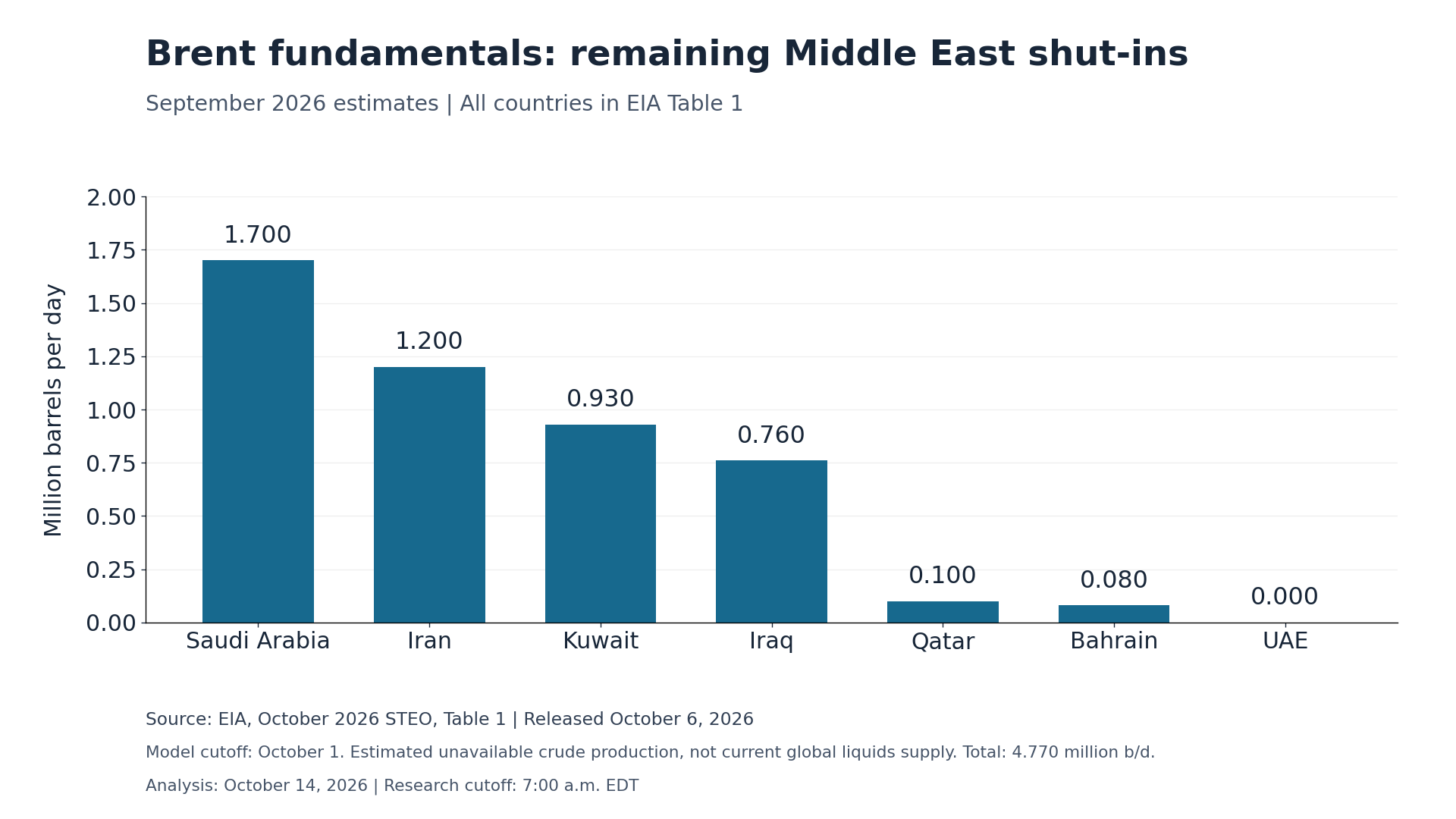
The EIA’s October 6 output supplies a separate and older assessment. It estimated September Middle Eastern crude production shut-ins at 4.77 million barrels per day, concentrated in Saudi Arabia, Iran, Kuwait, and Iraq. The forecast does suggest further recovery, but its models stopped at October 1. Its projected $105-per-barrel fourth-quarter Brent average is therefore neither a technical target nor anything to be thought of as a live quote.
Brent Looking to Break Higher
The Brent market is currently threatening the resistance barrier that extends up to the $110 level and has recently seen a lot of buying pressure. Short-term dips continue to be buying opportunities, with $100 being a significant support level. The 50-day EMA is sitting just below there as well. Continued choppiness may be the move forward, but if the market were to break above the $110 level, it opens up the possibility of trying to get to the $115 level.