



Gold Loses Ground as Fed Policy and Strong Dollar Weigh on Sentiment
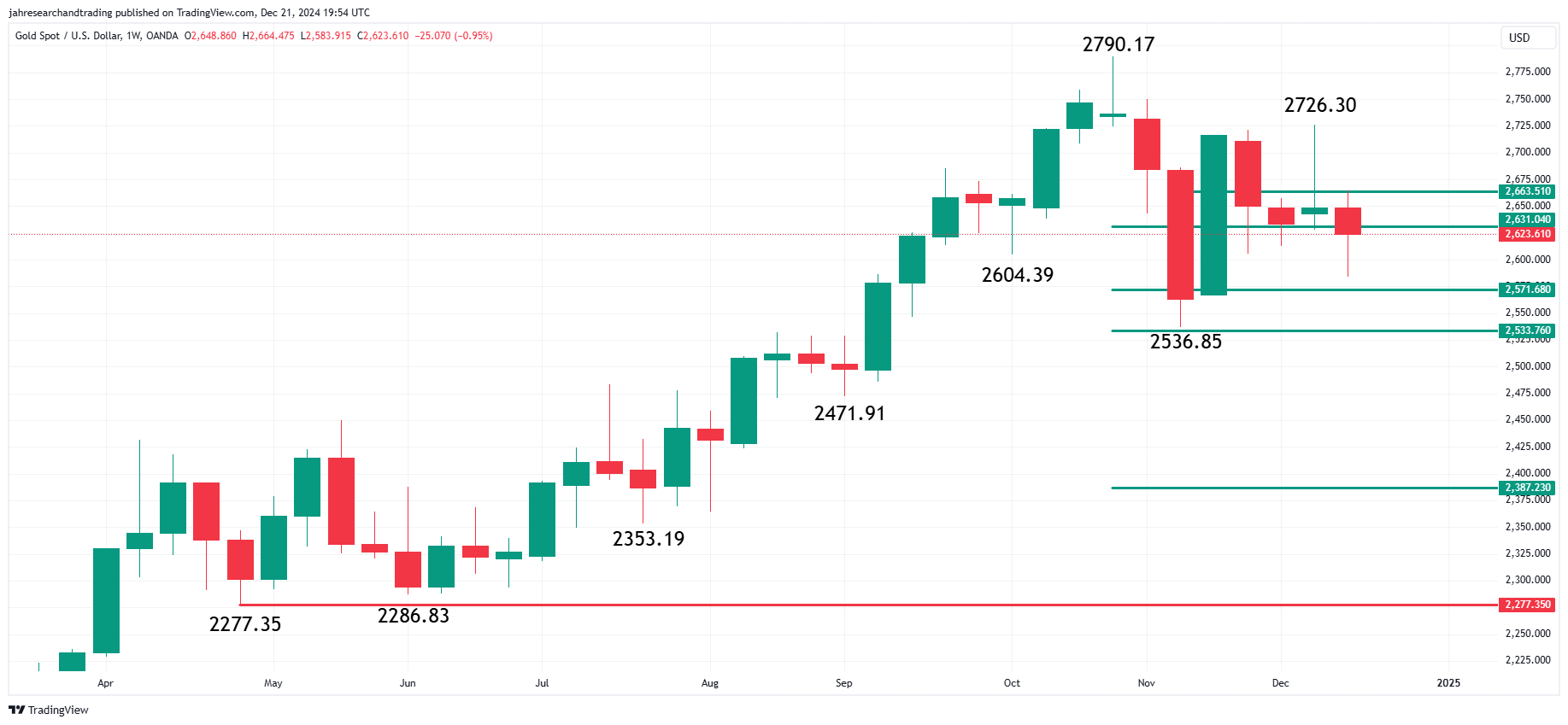
Gold prices closed last week at $2,623.61, posting a 0.95% weekly loss as the Federal Reserve’s hawkish stance continued to pressure the market. After peaking at $2,790.17 in early November, gold has struggled to regain upward momentum. Resistance held firm near $2,663.51 and $2,726.30, while key support lies at $2,571.68 and $2,533.76.

Fed’s Tight Grip on Rates Stifles Gold’s Potential
The Federal Reserve’s projection of just two rate cuts in 2025 poured cold water on bullish gold bets. This more conservative approach contrasts with market hopes for faster easing to counter slowing growth. Higher-for-longer interest rates increase the opportunity cost of holding gold, which does not generate yield.
Fed Chair Jerome Powell’s comments reinforced the view that policy will remain restrictive until inflation shows clearer signs of cooling. This stance supports higher Treasury yields – with the 10-year yield climbing to 4.40% – which in turn reduces gold’s attractiveness compared to yield-bearing assets.
Strengthening Dollar Amplifies Gold’s Struggles
The U.S. dollar remains a formidable obstacle for gold. The dollar index (DXY) reached 107.18 last week, buoyed by strong economic data and Powell’s hawkish tone. A strong dollar makes gold more expensive for foreign investors, further limiting demand.
For gold to mount a sustainable recovery, the dollar must weaken – likely requiring a more dovish pivot from the Fed or weaker economic performance in the U.S. So far, neither scenario has materialized.
Gold Price Forecast
Every new Gold analysis as it publishes, today's technical signal and key levels, live price — on one page.
See all Gold forecastsCooling Inflation Provides Brief Respite
Gold received temporary relief after November’s PCE inflation data showed a modest 0.1% increase, below expectations. This led to a 0.4% drop in the dollar, briefly boosting gold. However, the market viewed the dip as insufficient to alter the Fed’s path.
Phillip Streible, Chief Market Strategist at Blue Line Futures, commented:
“Gold needed more than just softer inflation. Traders are watching for consistent signs of economic slowdown before committing to long positions.”
What Needs to Change for Gold to Gain Momentum?
Gold’s path forward hinges on several key factors:
- Inflation: A sustained decline in inflation could force the Fed to accelerate rate cuts, lowering yields and weakening the dollar – both bullish for gold.
- Treasury Yields: A drop in yields, driven by economic softening or dovish Fed signals, could shift investor interest back to non-yielding assets like gold.
- Dollar Weakness: Any dovish shift in Fed language or a slowdown in U.S. economic growth could drive the dollar lower, boosting gold demand from overseas.
- Geopolitical Tensions: Escalating global risks could renew safe-haven demand, counteracting the negative impact of Fed policy and yield strength.
Until these factors align, gold’s upside remains limited, with near-term risks tilting bearish.
More Information in our Economic Calendar.


