
Gold News: ETF Inflows Surge as Markets Await Warsh and PCE
Gold and silver fundamentals for August 25 have been shaped by three factors: increased investment demand, uncertainty surrounding the Fed policy, and renewed geopolitical tensions concerns surrounding the Iran situation. Last week gold-backed ETFs experienced inflows of nearly 47 tonnes or around $6.4 billion, the largest weekly inflows in about 10 months. Demand from the institutional sector has picked up even with the elevated levels of long-term U.S. Treasury yields.
Market participants are waiting on Fed Chair Kevin Warsh’s Jackson Hole speech and the upcoming U.S. PCE inflation data. Currently the market expects around a 42% chance of a September rate hike, which has kept the expectations for Fed policy firmly in the middle. A lower than expected print for PCE inflation or a less hawkish Warsh speech would make non-yielding metals a less costly holding opportunity. Renewed expectations for tighter Fed policy would likely make non-yielding metals a more costly holding opportunity.
Geopolitical drivers are also supportive Gold and silver. The U.S. has expanded sanctions on Iran’s digital-asset, technology, gold, aviation and shipping sectors. The U.S. has also threatened to sanction any country or company continuing to do business with Iran. Iran has vowed to resist the sanctions. The risk for further disruption in the region is also elevated.
Silver also retains structural support. The Silver Institute expects the market will continue to be in a deficit for the sixth year in a row in 2026 due to increased demand from electronics and artificial-intelligence supported infrastructure and the power grid, while the demand for solar will be less due to further thrifting and the support of subsidies in other technologies.
In the context of the backdrop for August 25, precious metals looks constructive, but slightly sensitive. Metallic prices benefit from increasing ETF purchases, geopolitics, and the prospect of the Fed’s tepid policy becoming more aggressive. At Jackson Hole and PCE, we should know if loose money policy will gain steam or if it will become contractionary.

Gold Technical Analysis: XAU/USD Holds Above $4,619 as Rising Channel Remains Intact
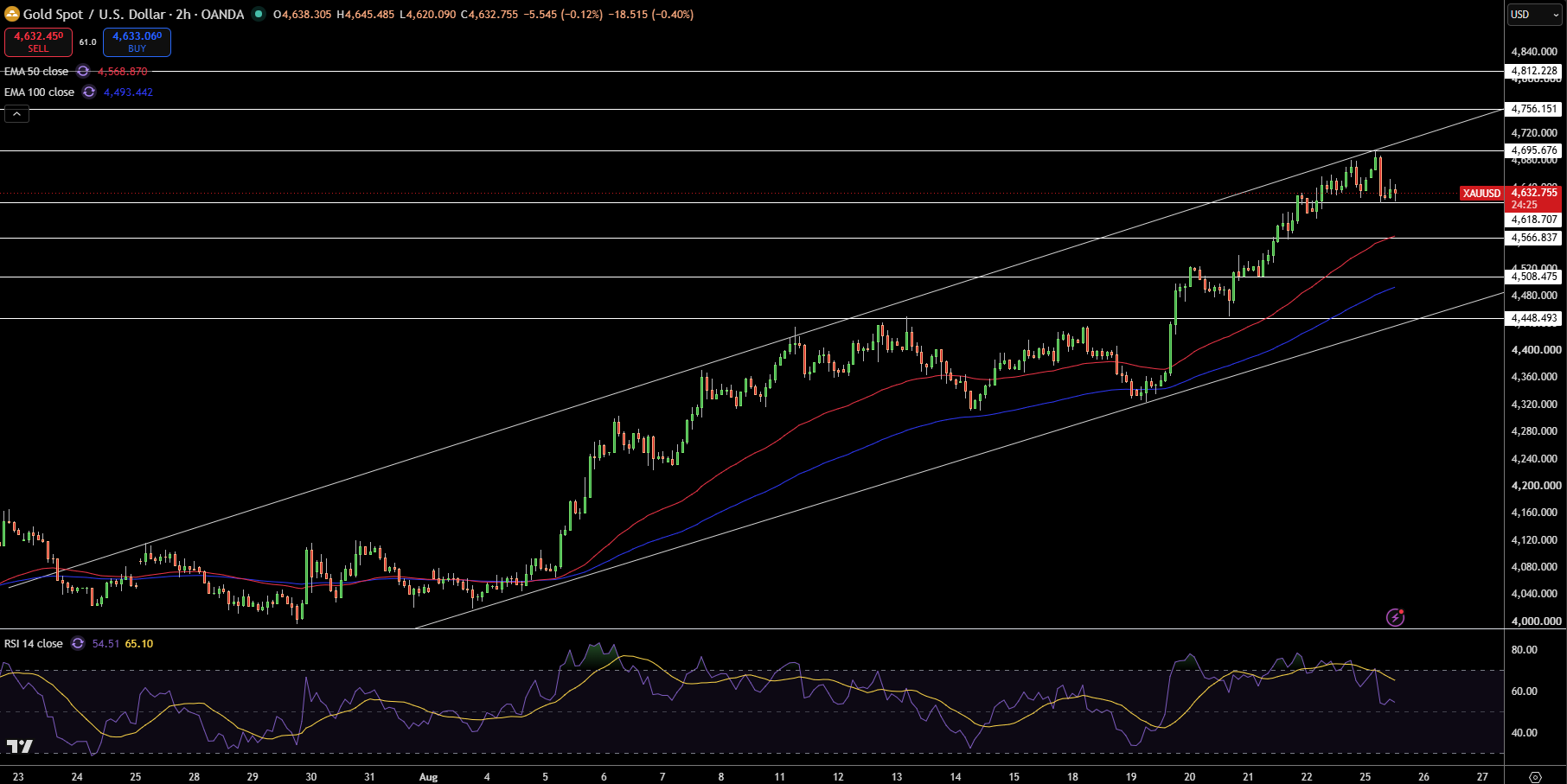
Despite pulling back to the upper boundary of a rising channel $4,633, gold is holding above the 50-EMA at $4,569 and the 100-EMA at $4,493 on the 2-hour chart. This shows that the correction does not threaten the overall bullish structure. Bears have been unable to push price below $4,619 and $4,567 thus far. This further supports the bullish structure. A rejection at the level of $4,696 signifies that the bears have returned, but this is likely to be a short-term setback as buyers defend the higher-low structure.
The RSI, currently sitting at 55, reflects that price momentum has shifted from being overbought and is now in a neutral range. Price may trade around support at $4,619 and below, at $4,567, $4,508 and $4,448. If previous support is broken price may continue to fall. Resistance levels may be found at $4,696 and above at $4,756, $4,812.
According to my analysis, there is a bullish trend as long as gold holds $4,619. A break above $4,696 may be followed by further buying up to the levels of $4,756 to $4,812. Conversely, if price breaks below $4,567, a deeper consolidation may happen around $4,508.
Gold Price Forecast
Every new Gold analysis as it publishes, today's technical signal and key levels, live price — on one page.
See all Gold forecastsSilver Technical Analysis: XAG/USD Tests Mid-Channel Support as Momentum Weakens
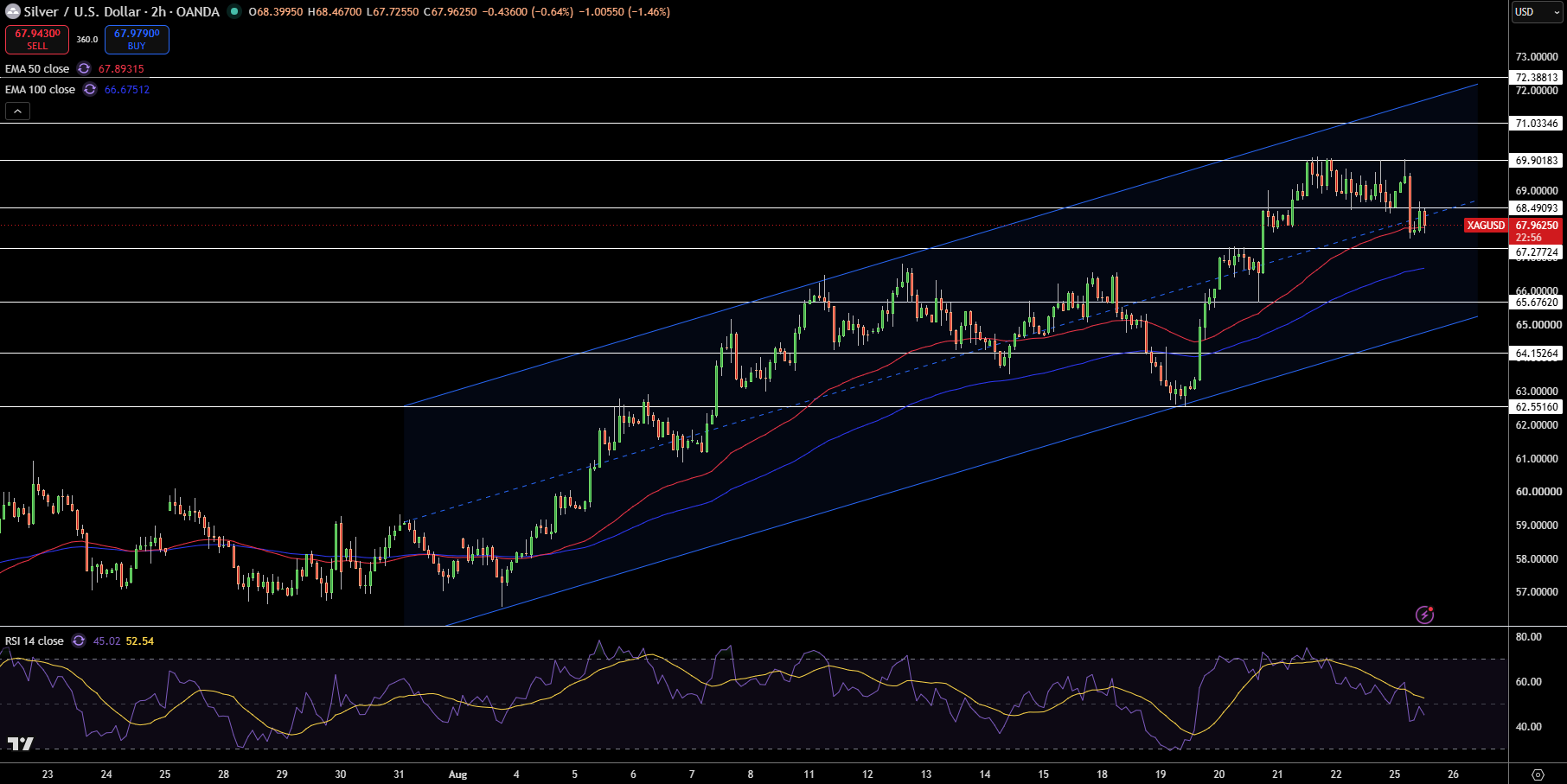
Silver is currently at $67.96, having pulled back from the $69.90 resistance zone. Silver remains in a broader uptrending channel, but the recent drop has brought XAG/USD down to the channel midline and the 50-EMA at $67.89. Price is still well within the channel and the 100-EMA at $66.68 is still below price, so the bullish structure remains intact.
Momentum has slowed and currently favors sellers slightly, as RSI is at 45. Below at $67.28, $65.68, $64.15 and $62.55 are the next support zones. Resistance will be met at $68.49, $69.90, $71.03 and $72.39.
Silver is still bullish in my view, but is corrective in the near term while trading above $67.28. Silver will be more bullish and will target $69.90 if $68.49 is taken out, but if $67.28 is broken, the pullback will continue and it will target $65.68.