
Gold News: Warsh’s Hawkish Shift Collides With Renewed Gulf Risk
Gold and silver are diverging because of the Fed and the situation in the Middle East. Fed Chair Kevin Warsh said more rate hikes may be coming if inflation doesn’t meet the 2% target. Markets think there is now a 57% chance that the Fed will increase rates next month, compared to what they thought before his speech. The two-year US Treasury yield is also above 4.3%, and that is keeping investments in gold and silver from looking productive.
Gold and silver are less expensive because of anticipation of increasing interest rates. There are also geopolitical concerns. US military action to destroy missile launchers on Larak Island was met with attacks on US facilities in Jordan by Iran. President Trump shared fake images of a struck oil facility on Kharg Island. Iranian officials said that the oil facility continued to operate normally. There is a lot of uncertainty between the US, Iran, and other countries. The tension is pushing oil prices up making other goods cost more. This also heightens the risk that inflation will stay high.
Even with the economic uncertainty, it is still a good time to buy gold. Data from the World Gold Council said that gold ETFs had $3 billion of new investment last month. This increased the physical gold by 23 tonnes and the value by $530 billion.
Like gold, the geopolitical risks make silver a good buy, and silver can also be used for industrial purposes, like photoelectric cells and holography. Because of the demand in the use of electronics, automobiles, artificial intelligence, and the electric grid, the supply of silver is already low enough that the markets are tighter than before.
An unusual conflict in some precious metals setups is observed on August 31. With Warsh’s hawkish turn and increasing bond yields, there is increased risk to gold and silver. However, the investment demand and the recent turmoil in the Gulf region add to the precious metals’ defensive nature.

Gold Technical Analysis: XAU/USD Breaks Below Key Fibonacci Supports as $4,396 Comes Into Focus
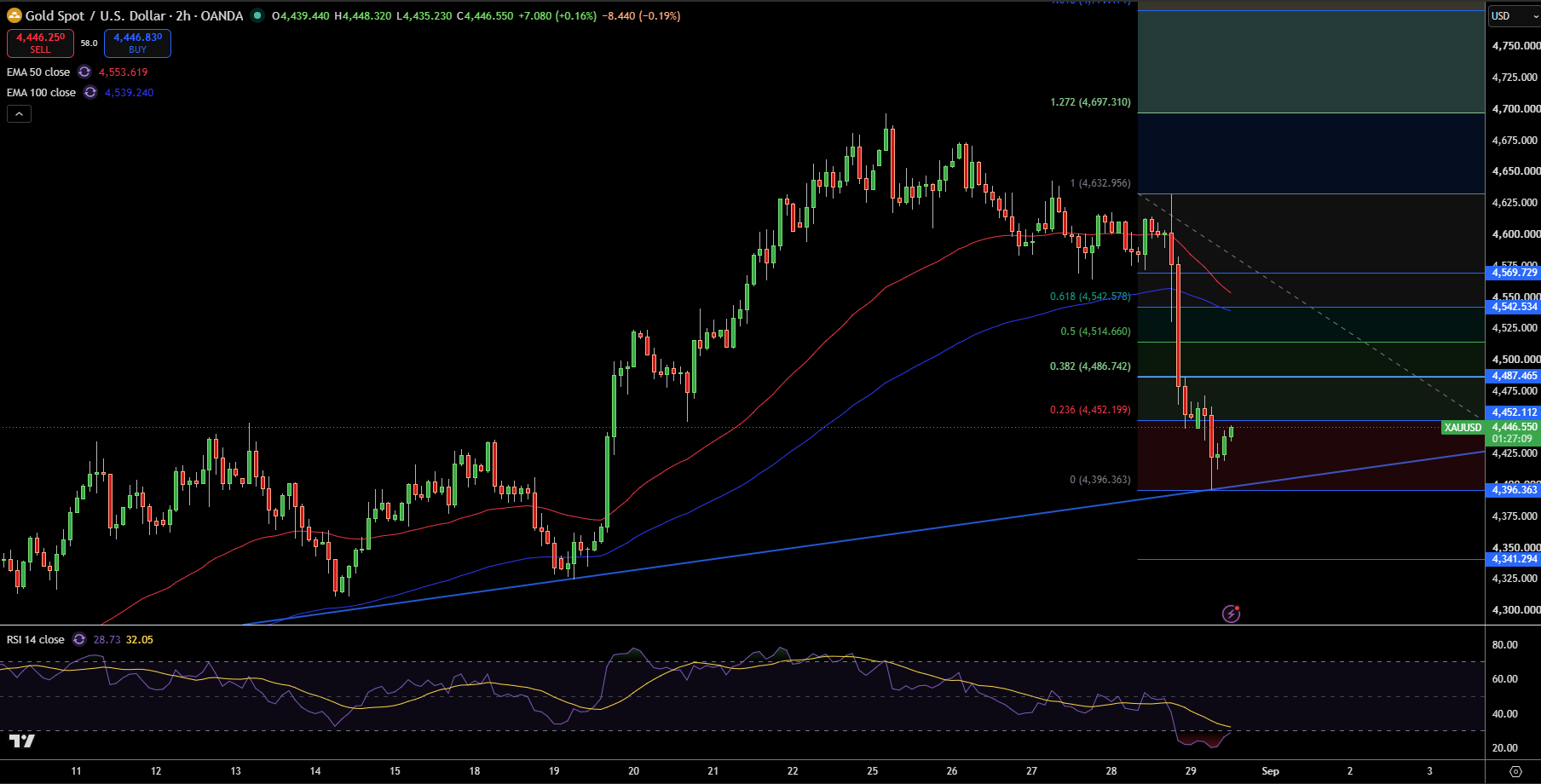
Gold is trading around $4,447 on the 2-hour chart after a notable bearish breakdown from around the $4,600-$4,630 range. Further price decline has broken the 61.8% Fib level at around $4,453, and is now trading below the 50-EMA at around $4,554 and below the 100-EMA at $4,539. This has a negative impact on the structure and creates a dominant negative momentum.
RSI is at around 29, which puts Gold in oversold territory, and makes a rebound in Price more likely. However, oversold territory trades do not confirm reversals. The immediate resistance is noted around $4,452-$4,487. Beyond this, the resistance is noted at $4,515, $4,543, and $4,570. Price is supported at $4,396 which is the rising trendline. The next major support is noted at $4,341.
Gold is currently trading in a bearish market below $4,452-$4,487. A break of $4,396 would expose $4,341. A break of $4,487 would indicate a loss of selling pressure.
Gold Price Forecast
Every new Gold analysis as it publishes, today's technical signal and key levels, live price — on one page.
See all Gold forecastsSilver Technical Analysis: XAG/USD Rebounds From $65.64 but Remains Below Key Moving Averages
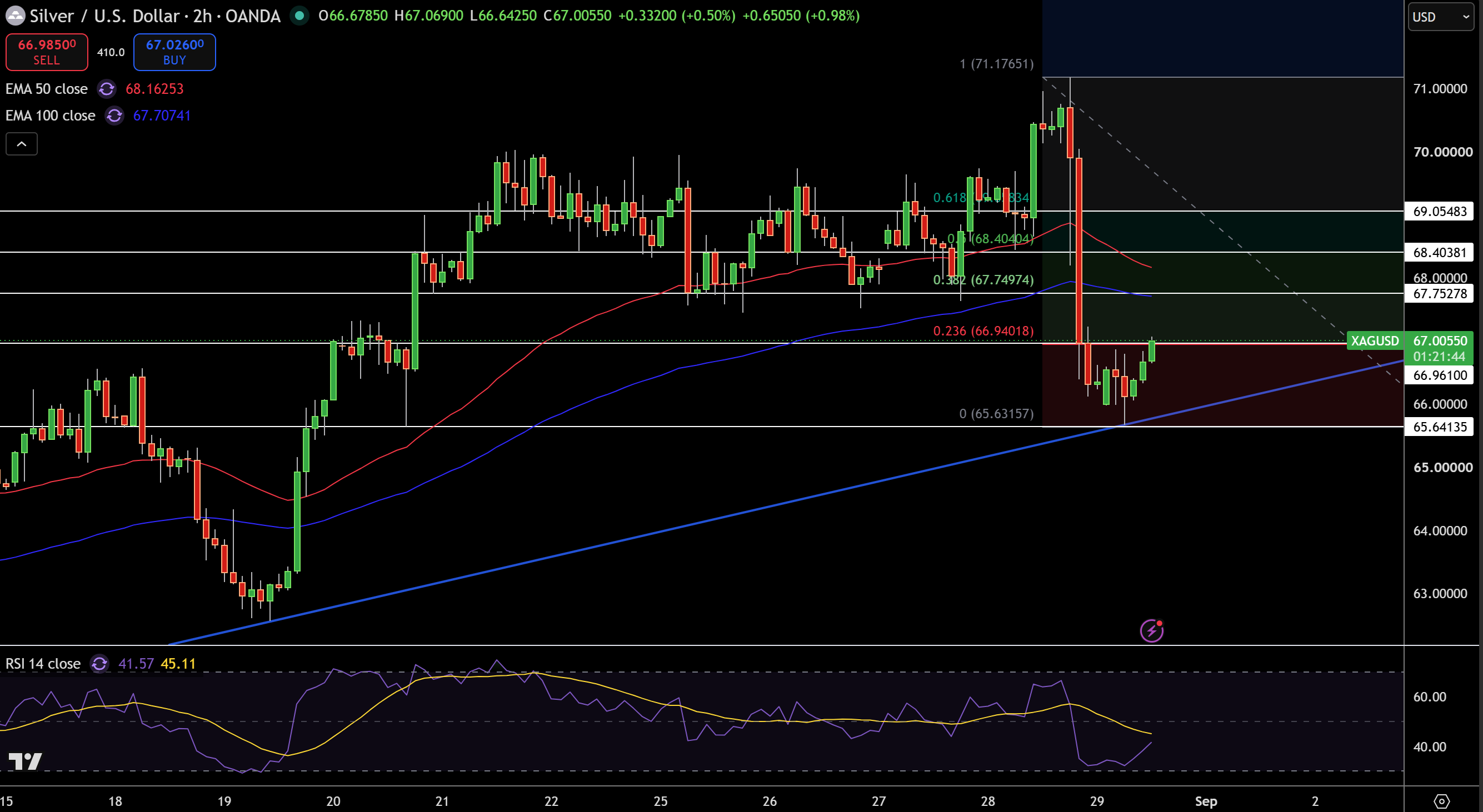
Silver is trading at $67.01 on the 2 hour chart, after bouncing back from $65.63-$65.64 support zone. This followed a sharp decline above $70, however, price is below the 50 EMA at $68.16 and the 100 EMA at $67.71, and therefore the structure is still not strong.
The structure of the market is still negative until a break above the 50 EMA at $68.16 and the 100 EMA at $67.71. Once these levels are broken, the structure of the market would then become neutral. Immediate resistance is noted at around $66.20 and $67.20. Beyond this, resistance is noted at $68.10. Support is noted above at $65.60.
The rebound is currently testing the 23.6% Fibonacci level at $66.94, and the next resistance area is at $67.75, $68.40, and $69.05. An upward break beyond $68.40 will strengthen the structure and place the focus on the next levels at $69.05 and possibly $71.18. On the other hand, support starts at $66.94 and then at $65.64 below.
RSI is at 42, showing that the momentum is still within oversold territory but is starting to improve. In my opinion, this is a corrective rebound, but the bulls will need to recover through $67.75-$68.40 to give a significant positive outlook. Below $66.94 would put $65.64 in the focus again.